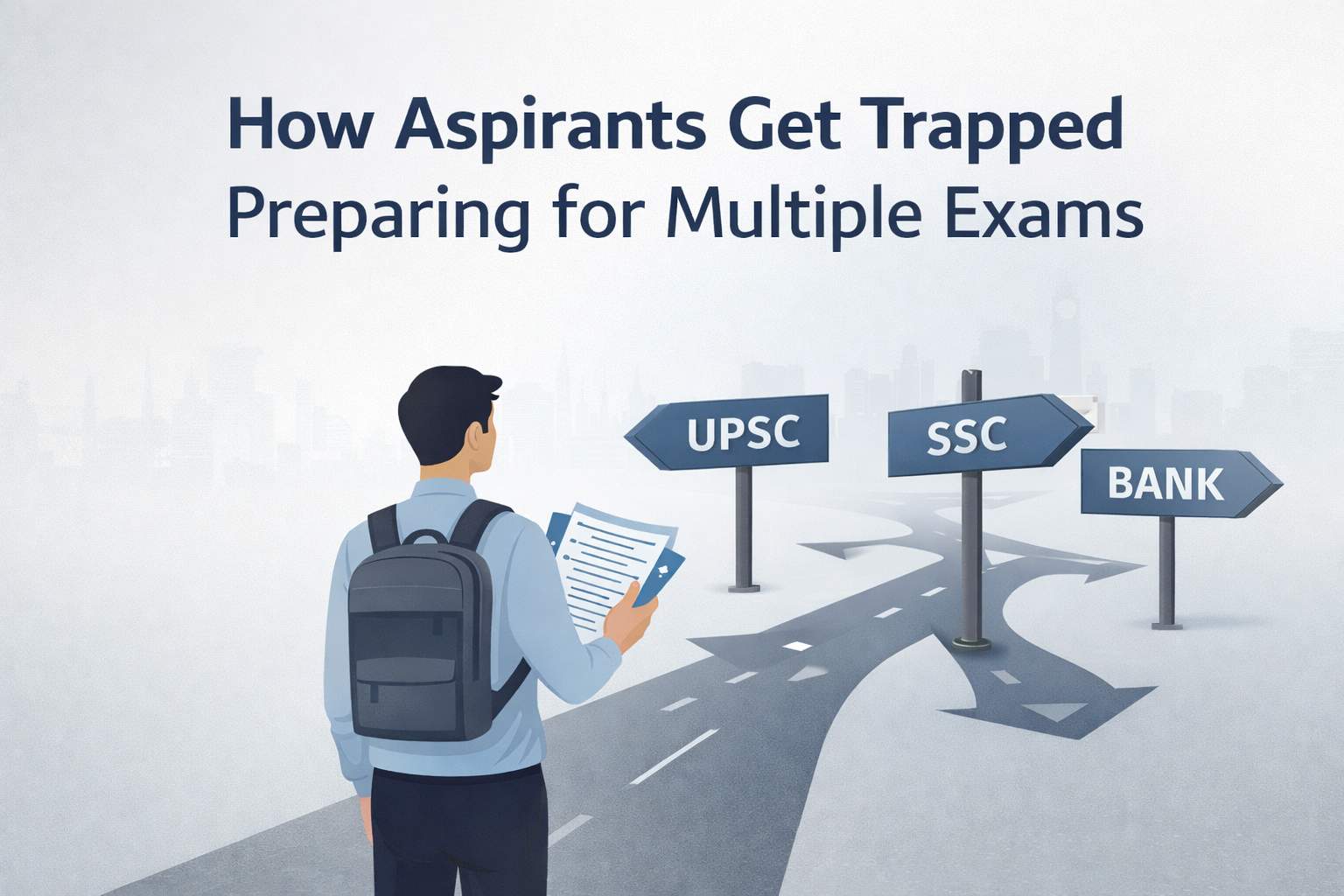
Category: Choosing Exams

  • How Aspirants Overestimate Their Flexibility

    How Aspirants Overestimate Their Flexibility

    It usually begins in a strangely casual way. A form appears online, someone shares it in a WhatsApp group, a coaching channel uploads a quick video, and within hours the conversation shifts. An aspirant who was preparing for one exam suddenly begins discussing another. Not because the first path ended. Just because the new option seems possible. Age limit fits. Graduation eligibility matches. The syllabus overlaps “a little.” And slowly a quiet assumption forms in the mind — that switching between exams is easier than it actually is.

    Across years of observing aspirants, this moment repeats with remarkable consistency. The decision rarely feels like a decision. It feels temporary, flexible, reversible. Someone fills a railway form while preparing for banking. Someone preparing for SSC begins considering state services after hearing about vacancies. Another person who planned for a specific exam suddenly adds two more simply because friends are applying. And the strange part is that no one believes they are changing direction. They believe they are keeping options open.

    The problem sits exactly there.

    Not in ambition. Not in curiosity.

    But in the assumption that exam preparation systems are interchangeable.

    The Quiet Illusion of Preparation Flexibility

    Aspirants often describe their situation using the same phrase: “Most of the syllabus is similar.” On the surface that sounds logical. Mathematics overlaps. Reasoning overlaps. General awareness appears everywhere. Even coaching advertisements reinforce this idea — one preparation covering multiple exams.

    But exam ecosystems are not built around subjects. They are built around patterns of evaluation.

    And those patterns shape how an aspirant spends years, not weeks.

    Take two aspirants who both start preparing after graduation. One commits to a banking exam structure. The other begins shifting between banking, SSC, and state-level recruitment cycles. For the first person, preparation gradually aligns with one pattern of difficulty, one speed expectation, one style of questions. For the second person, preparation keeps resetting. Slightly different expectations each time. Slightly different timelines. Slightly different pressure points.

    The difference is subtle in the beginning. Over three or four years it becomes enormous.

    Government exam selection means choosing the evaluation system that will shape your next several years.

    Most aspirants realize this too late.

    Forms Open, And Direction Quietly Changes

    There is a specific time of year when confusion increases. Notifications begin appearing in clusters. Railway recruitment. Staff selection. Banking. State boards. Public sector units. Suddenly the internet fills with videos explaining eligibility, vacancies, salary comparisons.

    Aspirants who had been studying quietly begin second‑guessing their path.

    Someone preparing for one exam sees thousands of applicants celebrating a different notification and starts wondering if they chose the wrong track. Another person notices discussions about central govt exam results and realizes friends from their coaching batch had attempted an entirely different recruitment cycle.

    The mind reacts quickly to visibility.

    Popularity starts influencing exam choice without anyone consciously noticing.

    And once that happens, preparation direction slowly begins drifting.

    Peer Conversations Shape More Decisions Than We Admit

    Most exam decisions are not made in solitude. They happen during conversations. Tea stalls outside libraries. Telegram groups. Hostel rooms late at night. Someone casually mentions that a particular exam has more vacancies this year. Another person claims a different exam has “better posting locations.” Someone else says interviews are unpredictable so written‑only exams feel safer.

    Small remarks. But they travel fast.

    Within weeks, entire preparation groups shift focus.

    Aspirants rarely question the information deeply in those moments. The decision feels collective, and collective decisions carry emotional comfort. If ten people from the same library begin preparing for a certain exam, it feels safer to join them.

    But exam preparation is ultimately solitary in its consequences.

    When years pass, the group rarely remains together.

    The Industry Cliché: “Keep Multiple Options Open”

    This advice appears everywhere. Coaching banners. Preparation videos. Social media threads.

    The logic sounds sensible: apply for everything possible so that chances increase.

    But the reality is more complicated.

    Applying broadly and preparing broadly are not the same thing.

    Filling forms across multiple exams is harmless. Preparation across fundamentally different evaluation systems slowly fractures attention. The mind never fully adapts to one pattern of thinking.

    So the cliché survives because it sounds practical, while the consequences appear slowly enough that no single moment reveals the mistake.

    Years later the pattern becomes visible — several attempts across several exams, but no deep alignment with any one of them.

    Age Limits Quietly Narrow the Window

    In the early years of preparation, age limits feel distant. A candidate at twenty‑two or twenty‑three rarely calculates the long‑term implications of exam eligibility windows.

    But government recruitment systems are structured around those windows.

    An exam that allows attempts until thirty creates a different psychological environment than one that effectively closes by twenty‑six. The preparation tempo changes. The tolerance for experimentation changes.

    Many aspirants realize this only when they begin comparing attempt counts. Suddenly someone says they have “only two attempts left.” Another realizes the next notification may be their final eligibility.

    And at that point switching exams becomes far more difficult than it seemed earlier.

    This is exactly why discussions around how to choose government exam should begin much earlier than most aspirants expect.

    Educational Background Creates Invisible Advantages

    There is another quiet pattern that rarely gets discussed openly.

    Certain exams naturally align with certain academic backgrounds. Not through eligibility criteria, but through thinking style. Engineering graduates often adapt faster to quantitative speed‑based exams. Humanities graduates sometimes navigate descriptive or policy‑heavy exams more comfortably.

    These tendencies are not rules.

    But they exist.

    Ignoring them forces aspirants to spend extra years adapting to an evaluation style that never quite becomes natural.

    And by the time that realization emerges, the candidate has already invested too deeply to change direction comfortably.

    The Industry Cliché: “Difficulty Should Decide Your Choice”

    Another common belief suggests aspirants should select the “easier” exam path. Coaching advertisements frequently reinforce this narrative — highlighting exams with lower cut‑offs or fewer stages.

    But difficulty fluctuates every cycle.

    What remains stable is the lifestyle attached to the eventual job role.

    An exam leading to administrative field postings creates a very different career rhythm than one leading to desk‑based financial roles or technical departments. Some jobs demand frequent transfers. Others keep employees in structured urban offices. Some roles involve public interaction every day; others remain largely internal.

    Aspirants rarely examine these realities while choosing exams.

    The focus stays on cracking the exam, not living the job.

    When Parallel Preparation Turns Into Directionless Effort

    There is a phase many aspirants quietly experience around the third or fourth year of preparation.

    Attempts have been made across several exams. Scores are decent but not exceptional. Friends from the original preparation group have either cleared one exam or left preparation entirely. And suddenly the aspirant looks back and notices something uncomfortable.

    There was never a clearly chosen path.

    Just a series of temporary adjustments.

    Preparation stretched across banking one year, SSC the next, then state recruitment notifications, then perhaps another central recruitment drive connected to public sector job opportunities.

    Each attempt felt logical at the time.

    Together they form a scattered trajectory.

    Exam Choice Is Quietly a Career Design Decision

    The exam itself lasts a few hours.

    But the preparation ecosystem surrounding it — the schedule, the study rhythm, the psychological pressure, the age‑limit timeline, the career outcome — shapes a large part of a person’s twenties.

    This is rarely explained when aspirants first enter the preparation world.

    Most guidance focuses on subjects, books, coaching institutes, or test series. Those things matter. But they come after a deeper question.

    What kind of professional life does the aspirant actually want to build?

    Because once preparation intensifies, changing direction becomes harder every year.

    And many aspirants discover this only after several exam cycles have quietly passed.

    The forms keep appearing. New notifications arrive. Friends discuss fresh opportunities. It still feels tempting to believe flexibility remains unlimited.

    But eventually the calendar begins answering that question more honestly than any preparation strategy ever could.


  • Choosing an Exam Based on Stability vs Lifestyle

    Choosing an Exam Based on Stability vs Lifestyle

    People rarely sit down and say, “I will now choose a government exam that matches my long-term life design.” What usually happens is simpler and more chaotic. A form opens. A friend forwards a notification. Coaching ads begin to circulate. Someone says the age limit is safe for now, so just fill it. And in that small window of urgency, a decision quietly gets made.

    I have watched this pattern repeat for years. The decision feels temporary. Almost casual. But it is not. An exam is not just a test; it is a direction. And once preparation begins seriously, the direction starts shaping sleep cycles, social circles, daily conversations, and even how a person imagines their thirties. The problem is not lack of effort. It is misalignment at the starting point.

    Most aspirants think exam choice is about syllabus comfort or perceived difficulty. That is surface thinking. The deeper layer sits elsewhere — in stability expectations and lifestyle tolerance. Few pause to examine that.

    Government exam selection is a long-term career alignment decision, not a short-term application act.

    That sentence may sound obvious. Yet in practice, exam forms are filled in clusters. If three major exams open in the same quarter, many apply to all three. Not because they have thought through each job role, but because “why miss a chance?” becomes the logic.

    This is where stability enters quietly. Some exams promise predictable postings, defined work hours, structured hierarchies. Others come with field movement, transfers, irregular schedules, public-facing pressure. Both are stable in salary terms. But stability of income and stability of life rhythm are not the same thing.

    I have seen aspirants preparing for enforcement-oriented roles who, in reality, dislike confrontation. I have seen candidates chasing administrative posts without enjoying responsibility-heavy decision-making. On paper, all of them were eligible. In life, not all were suited.

    There is also the age limit panic. When someone turns 27 or 28 and notices that a particular exam has fewer remaining attempts, urgency replaces clarity. Age becomes the primary filter. The question shifts from “Is this the right exam?” to “Can I still attempt this?” That subtle shift changes everything.

    Industry cliché says: choose the most reputed exam available to you. Expert counter-point — reputation does not absorb daily stress. It does not reduce transfer frequency. It does not decide whether you will enjoy your working hours ten years later.

    Stability is often imagined as a fixed posting in one city. But many central services involve transfers across states. Some state-level services keep you within a region but demand deep local administrative involvement. The difference matters if family responsibility is already present. It matters even more for working professionals attempting a career switch.

    I sometimes meet aspirants who say they are preparing for three exams simultaneously because syllabi overlap. On paper, that sounds efficient. In reality, overlapping syllabi do not mean overlapping job roles. A clerical desk-based career and a uniformed field-based career might share general awareness sections. They do not share lifestyle patterns.

    And then there is peer influence. Coaching centres unintentionally amplify popular exams. If a batch of 200 students is preparing for one exam, the social gravity becomes strong. No one wants to feel left out. The less popular exams — sometimes better aligned to an individual’s temperament — remain under-discussed.

    Another cliché floats around: take any government job first, then think later. The non-obvious reality is that internal transfers across departments are limited. Career tracks, once entered, tend to narrow. Promotions happen within the structure you initially join. Switching later is not like switching private jobs.

    The influence of forms opening cannot be underestimated. The moment notifications appear, social media fills with reminders. Telegram groups buzz. You will see messages about state wise govt job vacancies and suddenly feel behind, even if you had no prior intention of applying there. Fear of missing out becomes disguised as ambition.

    This is also where confusion around eligibility criteria plays tricks. Many exams after graduation eligibility appear similar at first glance. Graduation. Age bracket. Basic physical standards maybe. But graduation as a minimum requirement does not equal similar career outcomes. A graduate entering a regulatory body faces a different work culture than a graduate entering revenue administration.

    Some aspirants lean entirely on attempt limit calculations. “This exam has more attempts, so it is safer.” But attempt count is not a lifestyle variable. It only tells you how long you can stay in the cycle. It does not tell you whether you should.

    Working professionals face a sharper version of this dilemma. They often search for government exams suitable for working professionals, trying to balance preparation with current employment. The exam choice in such cases should factor in preparation intensity and probable transfer locations. Yet many end up choosing the most discussed exam, not the most compatible one.

    There is also silence around daily routine differences. A desk-based post might involve repetitive documentation, file movement, compliance checks. A field-intensive role might involve inspections, unpredictable visits, local political interaction. Both are government. Both are respected. But the temperament required is not identical.

    And lifestyle is not only about working hours. It includes where you might live. Urban postings versus rural blocks. Metro exposure versus district-level engagement. Some people thrive in grassroots environments. Others feel isolated there. These are rarely discussed during form filling.

    The phrase how to choose government exam is searched often. But the answers usually talk about syllabus familiarity or scoring trends. Real selection requires reverse thinking. Instead of asking which exam is easiest, ask what kind of daily life you are willing to live for decades.

    I have seen aspirants clear an exam and then struggle during training because the ground reality did not match the imagined version. They had prepared intensely. Cleared merit. Yet dissatisfaction began early. The cost of misalignment shows up later, quietly.

    Another expert counter-point is needed here. Many believe stability equals low stress. Not necessarily. Certain administrative roles bring high decision pressure but predictable salary growth. Some lower-tier roles offer limited decision pressure but slower financial progression. Stability is layered.

    The moment of realisation usually comes late. Often after two or three unsuccessful cycles in one exam, an aspirant starts questioning whether the exam itself was chosen wisely. That questioning is healthy, but by then two or three years have passed. Those years were not wasted in learning, but they were committed to one direction.

    There are also practical filters. Physical standards in some exams are non-negotiable. Transfer liabilities are non-negotiable. Interview processes in some exams introduce subjectivity. Written-only recruitment in others reduces that. Each of these structural differences shapes the lived experience beyond the exam hall.

    Some candidates consult a government job planning guide at the beginning. Most do not. Planning sounds slow. Filling forms feels active. So action replaces planning.

    Then there is the subtle administrative ecosystem around exams. Admit cards, centre allocations, document verification. Something as small as frequent govt hall ticket download reminders can keep you psychologically tied to multiple exams at once. You feel invested everywhere. Focus scatters.

    Lifestyle misfit does not appear on day one of service. It creeps in through small irritations. Long travel. Lack of personal time. Or, on the other side, monotony and lack of field engagement. The job is secure. The salary arrives. But internal friction builds.

    Some aspirants are deeply motivated by social authority. They want decision-making power. Others want predictable office hours and personal space for family. Neither is superior. But mixing the two without clarity leads to dissatisfaction.

    A useful internal exercise is simple though rarely done:

    • Imagine your posting city for the next five years.
    • Imagine your daily reporting time.
    • Imagine the nature of public interaction involved.
    • Imagine the transfer policy in practice, not in brochure language.

    If discomfort appears during imagination itself, that signal deserves attention.

    Another industry cliché says: crack the toughest exam; everything else becomes easier. Reality does not always cooperate. Preparation ecosystems differ. Some exams demand essay writing maturity. Some test procedural awareness. Some emphasise quantitative speed. Success patterns are not automatically transferable.

    And the social narrative of prestige complicates matters. Families often push toward certain well-known services without fully understanding role specifics. Aspirants comply out of respect. Years later, they find themselves in positions that satisfy family pride but not personal inclination.

    Exam choice also interacts with personal timeline. Marriage plans. Financial obligations. Care responsibilities. A highly transferable service might strain family stability. A region-locked service might limit exposure for someone seeking broader administrative reach.

    None of this means overthinking endlessly. It means pausing once, seriously, before deep preparation begins. Switching exams every year drains continuity. Parallel preparation across unrelated exams fractures depth.

    I have observed that aspirants who commit after clarity — even to less popular exams — display steadier preparation. They are less shaken by trends. They do not chase every new notification. Their direction may look quieter, but it is firmer.

    Choosing between stability and lifestyle is not binary. It is about understanding which form of stability you value — geographical, financial, hierarchical — and what kind of daily life you can inhabit without resistance.

    Years later, when someone says, “I wish I had thought about this earlier,” they are not talking about syllabus difficulty. They are talking about life rhythm. About where they live. About how often they move. About the nature of authority they hold.

    An exam form is small. The career it opens is not. And that difference, that gap between form and life, is wh

  • Why Late Exam Switching Often Backfires

    Why Late Exam Switching Often Backfires

    It usually starts quietly. One exam cycle ends. Results come. Some clear prelims, some miss by a few marks. Someone in the coaching group announces they are shifting to another exam because “scope is better.” Another friend says the age limit is safer there. And slowly, without a written decision, without a structured thought, the direction changes. I have watched this pattern for years. Not dramatic. Not emotional. Just subtle drift.

    The strange part is that most aspirants don’t feel they are making a career decision. They think they are simply filling another form. The form is available. Eligibility matches. Age still within limit. So why not. But the shift from one exam ecosystem to another is rarely small. It affects preparation style, competition type, interview exposure, service structure, even long‑term transfers. By the time someone realizes this, two or three cycles have already passed.

    Exam Choice Is a Career Architecture Decision

    Government exam selection is not about clearing a paper; it is about choosing the structure of your professional life.

    That sentence may feel heavy. But look at it closely. Every exam sits inside a larger administrative design. Some roles are field‑oriented. Some are desk‑bound. Some demand frequent transfers. Some stabilize early. Some offer faster promotion but slower lifestyle balance. When an aspirant shifts exams late, they are not changing subjects. They are changing the architecture of the life that follows.

    Yet this architectural thinking rarely happens at the beginning. Instead, exam decisions often begin with what is trending. If central government job vacancies increase in a particular sector, suddenly coaching centers reorient batches. Telegram groups become active. YouTube thumbnails become louder. And aspirants feel they must not miss the wave.

    But waves pass. Service structures remain.

    The Form‑Filling Moment That Changes Direction

    There is a very ordinary moment that causes late switching. An aspirant preparing for one major exam sees another notification open. Eligibility fits. Maybe graduation required, maybe 12th pass. Age still under limit. And someone says, “Keep options open.”

    It sounds practical.

    But parallel options often become parallel confusion. Different pattern. Different selection stages. Different mental preparation rhythm. One exam might have a heavy interview stage. Another may be fully objective. Some aspirants specifically search for government exams without interview process because they are uncomfortable with personality rounds. That is a valid preference. But switching to such exams after investing years in interview‑oriented preparation creates friction that no one talks about.

    And the friction is invisible at first. It shows up after months.

    Popularity Is Not Suitability

    One of the strongest influences I have observed is peer validation. If three friends are preparing for a particular exam, the fourth one often joins. If a senior clears a specific service, juniors follow the same route. Coaching institutes also amplify this behavior because batch formation depends on numbers.

    Industry cliché says: “Choose the exam with maximum seats.”

    Reality is less simple. Maximum seats do not automatically mean higher personal probability. The competition density changes. Preparation timelines vary. Background suitability matters more than seat count. A candidate with strong descriptive writing ability may struggle in highly speed‑oriented objective exams, even if those exams recruit more candidates.

    Late switching often happens after someone sees repeated failures in one exam and assumes another exam must be easier. That assumption is rarely examined properly.

    Another cliché says: “If one exam is not working, just shift.”

    But shift to what, and why?

    Switching without structural clarity is not strategy. It is fatigue reacting.

    Age Limit Pressure and Psychological Drift

    Age limit plays a silent but powerful role. As upper age approaches, anxiety increases. Aspirants begin scanning notifications differently. Instead of long‑term fit, they look at remaining attempts.

    The phrase “best exam according to age” is searched more often than people admit. But age‑based urgency can distort judgment. An exam chosen only because attempts are still available may not align with temperament or lifestyle expectations.

    I have seen candidates who prepared for years for a high‑intensity administrative service suddenly switch to a stable clerical or technical exam because age pressure rose. Nothing wrong with that shift if it is deliberate. But when the decision is reactive, dissatisfaction appears later.

    Age pressure compresses thinking. Compressed thinking creates hurried exam selection. And hurried exam selection creates long‑term regret.

    The Cost of Parallel Preparation

    Many aspirants believe they can prepare for multiple exams simultaneously because “syllabus overlaps.” On paper, this sounds logical. In practice, exam ecosystems differ in deeper ways.

    Objective speed‑driven exams demand continuous practice rhythm. Analytical mains‑oriented exams demand depth and articulation. Technical exams demand domain retention. When someone switches late, they carry habits from the previous exam into the new one. Often those habits do not fit.

    Parallel preparation dilutes identity. One day reading polity deeply for one exam, next day solving high‑speed reasoning for another. The brain does not build mastery in either direction. Instead, it remains in adjustment mode.

    Years pass in adjustment mode.

    Lifestyle Mismatch Is Underestimated

    This part is rarely discussed during preparation. Service lifestyle realities are often discovered only after selection or after interacting with serving officers.

    Some roles involve rural postings early on. Some involve rotational transfers across states. Some allow metropolitan stability. Some involve fixed office hours; others stretch unpredictably. When exam choice is based only on difficulty perception, lifestyle alignment is ignored.

    An aspirant preparing from a small town may later find that frequent national transfers create family strain. Another aspirant who prefers field engagement may feel constrained in desk‑heavy services. These mismatches do not show up in syllabus PDFs.

    They show up five years into service.

    And late exam switching increases the chance of such mismatch because decisions are not rooted in reflection but in urgency.

    The Quiet Damage of Repeated Resets

    There is another layer. Psychological reset cost.

    Every exam ecosystem has its own community, preparation culture, and evaluation logic. When someone switches after two or three years, they start again socially. New peers. New mentors. New comparison benchmarks. Confidence drops silently because earlier effort does not fully translate.

    Some aspirants then keep shifting—state level to central level, technical to administrative, interview‑heavy to interview‑free—never staying long enough to internalize one structure deeply.

    This is not flexibility. It becomes drift.

    I have seen candidates spend seven or eight years in preparation without ever committing deeply to one path. They were always almost starting.

    Expert Counter‑Point: “More Options Means More Safety”

    It sounds rational to keep multiple exam options open as insurance. But insurance works when the core risk is understood. If the aspirant has not identified which exam structure truly suits their cognitive style and life expectation, more options multiply uncertainty rather than reduce risk.

    A focused three‑year attempt in one carefully chosen exam often produces more clarity than six scattered attempts across different exams.

    And this clarity does not come from coaching advertisements. It comes from honest self‑audit.

    The Information Illusion

    Today, information is everywhere. Notifications, analysis videos, comparison posts, answer key discussions. Even small details like उत्तर कुंजी डाउनलोड लिंक become trending search phrases after every exam cycle.

    Access to information creates an illusion of control. Aspirants feel they are actively managing strategy by constantly reviewing options.

    But information consumption is not decision maturity.

    Decision maturity requires sitting with uncomfortable questions: What kind of authority do I actually want? What level of mobility am I willing to accept? Do I prefer predictable office routine or administrative unpredictability? Am I comfortable with public accountability roles?

    These questions rarely trend. So they are postponed.

    Educational Background and Identity Alignment

    Another pattern emerges among graduates. Engineers shift toward administrative exams after hearing success stories. Humanities graduates attempt technical or banking exams because peers say competition is lower. The idea that “background does not matter” is partly true for eligibility, but not entirely true for long‑term comfort.

    Eligibility criteria simply allow entry. They do not guarantee alignment.

    When exam choice ignores academic and cognitive strengths, preparation becomes heavier than necessary. And when late switching happens, the aspirant has to rebuild subject familiarity from scratch.

    Sometimes the reason for switching is as simple as exam difficulty comparison conversations in coaching corridors. Someone declares one exam tougher than another. Without verifying what “tougher” actually means—speed? depth? unpredictability?—decisions get influenced.

    Difficulty is contextual. Suitability is personal.

    A Thinking Framework Before Commitment

    This is not advice. It is a thinking structure I have seen work quietly for those who avoided late switching.

    First, examine service structure before syllabus. Promotion pace, transfer frequency, public interaction level, departmental hierarchy. This shapes decades.

    Second, evaluate selection architecture. Does it reward sustained analytical writing, or high‑speed objective precision? Does it include interview evaluation? This affects preparation psychology.

    Third, measure age runway realistically. Not just maximum attempts, but emotional stamina for repeated cycles.

    Fourth, check lifestyle tolerance. Urban vs rural, stable vs transferable, field vs office.

    Fifth, reflect on identity comfort. Does the role align with how you see yourself functioning in society?

    When these reflections happen early, switching reduces. When they are postponed, switching becomes reactive.

    Some aspirants ask quietly, “which government exam should I choose” as if there exists a univer

  • How Age Changes the Logic of Exam Selection

    How Age Changes the Logic of Exam Selection

    Somewhere around 22 or 23, most aspirants don’t really choose an exam. They choose a form. The form opens, friends fill it, coaching teachers mention it twice, Telegram groups start discussing expected vacancies — and suddenly that exam becomes “the plan.” I have seen this pattern for years. The decision rarely begins with a quiet evaluation of life direction. It begins with urgency. Or excitement. Or fear of missing out.

    And at that age, it doesn’t feel wrong. Time looks elastic. Five years seems like a wide field. Age limits feel distant. Attempt limits feel theoretical. So the logic behind exam selection is loose, almost casual. The thinking is simple: “Let’s try this first. If not this, something else.” But that loose logic begins to tighten as age moves forward. And slowly, without announcement, age changes everything about how an exam should be chosen.

    Exam Selection Is a Career Architecture Decision

    Exam selection is the structural decision that defines your working life for decades.

    This is not dramatic language. It is simply how the system works. Every government exam corresponds to a specific service structure, posting pattern, transfer policy, promotion timeline, and lifestyle rhythm. When someone fills an exam form, they are indirectly choosing all of that. Even if they don’t realize it.

    At 21, few think about service hierarchy or field exposure versus desk dominance. At 28, the same person begins asking different questions. Stability matters more. Location matters more. Salary progression matters more. Family expectations quietly enter the frame. The same exam that once looked glamorous now looks exhausting. Or impractical.

    Age does not just reduce eligibility windows. It changes risk tolerance.

    The 21–24 Window: Exploration Without Consequence (Or So It Feels)

    In early twenties, exam choice is often crowd-driven. Engineering graduates move toward one set of exams. Humanities graduates toward another. Commerce students cluster elsewhere. Nobody wants to feel left out of the dominant trend of their peer group.

    There is also an unspoken belief during this stage: harder exams are superior exams. So many young aspirants chase what is considered the “top” examination without asking whether the job role fits their temperament. Popularity becomes a proxy for prestige. Prestige becomes a proxy for purpose.

    Expert Counter-Point: The industry cliché says, “Aim for the highest exam first.” The quieter reality is that not every personality is built for every service structure. And discovering that after three failed cycles costs more than people admit.

    At this age, switching exams feels harmless. One year here. Another year there. But those switches create fragmented preparation histories. Concepts overlap, yes. But direction fractures.

    When Age 25–27 Introduces Pressure Without Warning

    Something subtle happens around 25. Not for everyone. But for many.

    Friends begin getting selected somewhere. Or they move into private jobs. Social comparisons sharpen. Family conversations shift tone. The same aspirant who once experimented freely now begins calculating remaining attempts.

    Search queries change too. I often see aspirants typing phrases like how to choose government exam late at night, not out of curiosity but anxiety.

    The logic of exam selection tightens here. Because now, opportunity cost becomes visible. If you commit two more years to one exam, what are you giving up? If you switch now, are you restarting from zero? If your age limit for a particular exam closes at 30, is this your final realistic window?

    Age does not create panic by itself. Unclear direction does.

    Age Limit Is Not Just a Number — It Is a Strategic Boundary

    Many aspirants treat age limit as a deadline, not as a design factor. That is a mistake.

    An exam with a higher upper age limit offers flexibility. An exam with fewer attempts compresses strategy. These structures affect planning differently at 22 and at 28.

    Expert Counter-Point: The common belief is, “As long as I am eligible, I should try.” But eligibility does not equal suitability. Just because you can attempt something does not mean it aligns with your remaining time, financial condition, or mental bandwidth.

    There is a distinct psychological difference between preparing with five attempts remaining and preparing with one. The pressure profile changes. Decision quality changes. Even self-belief changes.

    Parallel Preparation: The Illusion of Safety

    Many aspirants attempt to hedge their risk by preparing for multiple exams simultaneously. On paper, this seems intelligent. In practice, it often creates diluted focus.

    Different exams demand different answer styles, different depth levels, different physical or personality requirements. The brain keeps adjusting gears. The calendar keeps fragmenting.

    At 23, this experimentation might be manageable. At 29, parallel preparation becomes heavy. Every month spent in divided attention feels expensive.

    I have seen aspirants carry three exam identities at once. They introduce themselves differently in different groups. But internally, they know clarity is missing.

    Lifestyle Fit Changes With Age

    A field-intensive role that looks adventurous at 22 may look unstable at 30. Frequent transfers that once felt exciting begin to conflict with family stability. Night shifts that once felt manageable become draining.

    This is rarely discussed during exam selection. But it should be.

    Some government services demand physical mobility. Some demand desk patience. Some demand high public interaction. Some operate within rigid hierarchies where growth is slow but secure.

    Age shapes how we experience these realities.

    And yet, aspirants often choose exams based on difficulty perception rather than lifestyle projection.

    Financial Context Quietly Alters Decision Logic

    At 21, most aspirants are financially dependent. At 27, some are supporting households. The same preparation timeline carries different weight.

    An exam with a long selection cycle may be acceptable early on. Later, that waiting period becomes financially stressful.

    I have observed that working professionals re-entering preparation after a few years think differently. They evaluate posting location, promotion timeline, and transfer frequency more seriously. Because they have experienced the alternative — private sector rhythm, income structure, urban exposure.

    Government exams suitable for working professionals are not simply about difficulty. They are about compatibility with existing life commitments.

    Frequent Switching: The Hidden Cost

    Switching exams feels productive. It feels like taking action. But every switch resets psychological momentum.

    The mind adapts to one pattern of preparation. When that pattern changes repeatedly, fatigue accumulates. Aspirants rarely track this fatigue, but it shows up as reduced depth.

    There is also reputational fatigue within family circles. “Again a new exam?” It sounds small, but it weighs heavily over time.

    Expert Counter-Point: Many believe that flexibility is strength in preparation. Sometimes it is. But chronic switching often signals avoidance of strategic commitment.

    Age intensifies the cost of indecision.

    Exam Choice and Identity Formation

    Some aspirants tie their identity to a particular exam brand. They say, “I am preparing for X,” even when attempts are nearly exhausted. This identity attachment makes objective evaluation difficult.

    Younger aspirants can detach more easily. Older aspirants struggle because they have invested years into a single narrative.

    The danger is not failure. The danger is inertia.

    When age advances, the decision to continue or redirect becomes heavier. But that weight also forces maturity. It compels more honest assessment.

    A Thinking Framework Without Formulas

    Instead of asking, “Which exam is best?” the more relevant questions shift with age:

    • How many realistic years can I allocate to this path?
    • What lifestyle structure am I unconsciously choosing?
    • What happens if I clear this at 30 instead of 24?
    • Does this role match my temperament now, not five years ago?

    Notice the shift. The question is no longer about syllabus overlap or difficulty ranking. It is about life alignment.

    There is no universal best exam according to age. There is only alignment between stage of life and structural realities of the service.

    And that alignment changes. Quietly. Gradually. Sometimes painfully.

    The Silent Realization That Comes Late

    I have met aspirants at 29 who suddenly recognize that they never consciously chose an exam. They inherited it from their environment. And now, with limited attempts left, they are evaluating for the first time.

    This realization is uncomfortable. But it is honest.

    Age does not reduce opportunity automatically. It reduces experimentation margin.

    When you are 22, you can afford trial. When you are 30, every attempt carries accumulated years behind it. That difference alone changes the logic of exam selection more than any coaching advice ever will.

    The form you fill at 21 and the form you fill at 29 may look identical on a website. But they do not mean the same thing in your life.

    And that is where real exam selection begins — not at the notification stage, but at the stage where you understand what your current age quietly demands from your decisions.

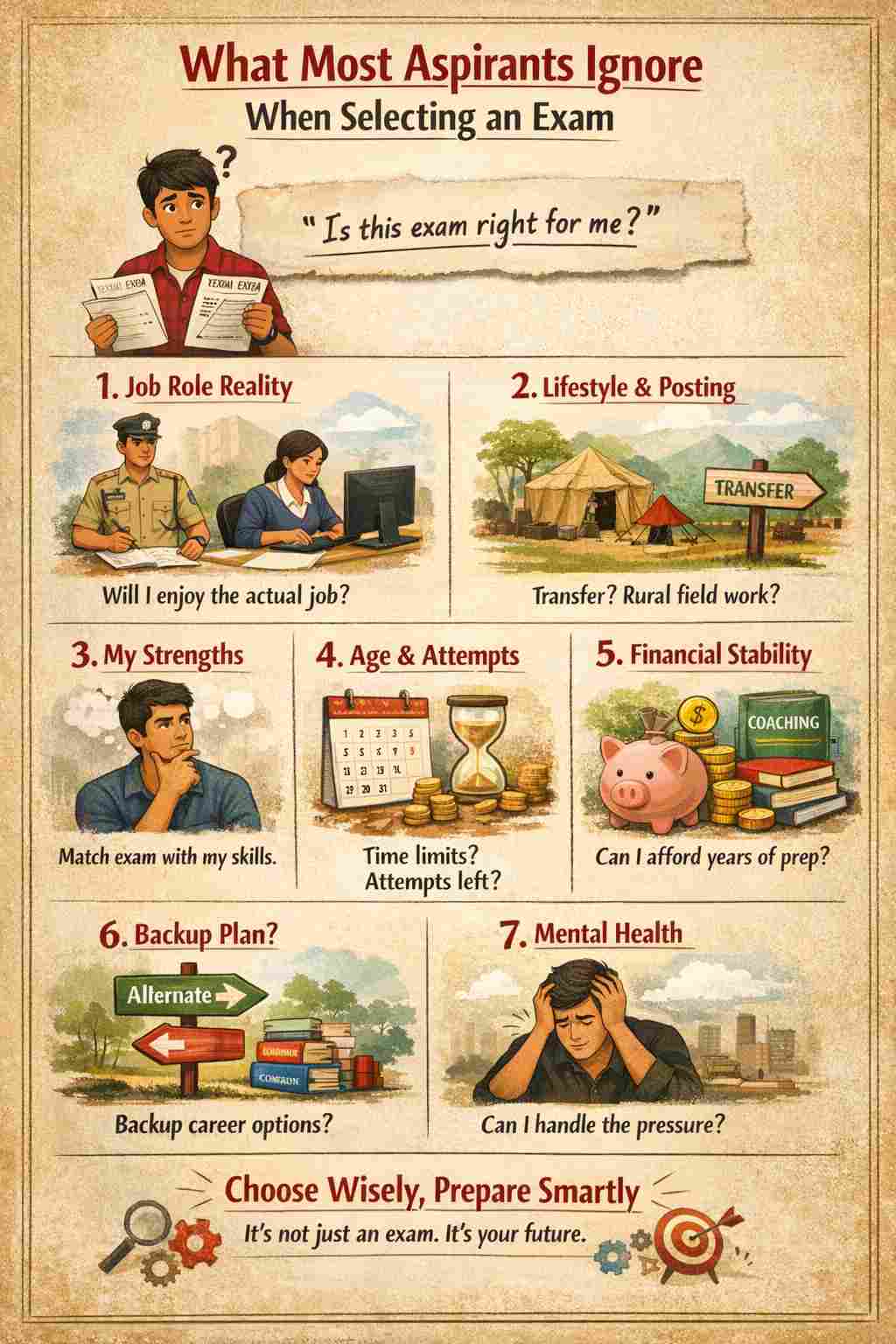
  • What Most Aspirants Ignore When Selecting an Exam

    What Most Aspirants Ignore When Selecting an Exam

    What Most Aspirants Ignore When Selecting an Exam

    They usually decide in the last week of the application window.

    I have seen this pattern too many times to treat it as coincidence. A notification comes. Forms open. Telegram groups light up. Coaching institutes start pushing batches. And suddenly, a student who had been “focused” on one exam for six months is filling out another form because friends are doing it, or because someone said the vacancy number looks good this year. The shift does not feel dramatic in that moment. It feels practical. Sensible, even. But this is where the first quiet mistake happens.

    The exam is treated like an opportunity. Not like a direction.

    Most aspirants do not sit down and ask what the job actually becomes after five, ten, twenty years. They rarely think about daily work structure, transfer patterns, administrative pressure, stagnation risk, or even the nature of authority the role carries. The thinking stops at eligibility. Graduation done? Apply. Age within limit? Apply. Attempts left? Apply. And so a career pathway is chosen with the same seriousness as filling a railway reservation form.

    Exam Selection Is a Career Architecture Decision

    This is the part that gets ignored. And it keeps getting ignored because no one feels immediate consequences.

    Exam selection is not about cracking a paper. It is about deciding the professional ecosystem you are willing to live inside. Every government exam feeds into a very specific administrative structure. Some structures are rigid and hierarchical. Some are field-heavy. Some are desk-bound and file-driven. Some offer slow but stable growth. Some plateau early. And the entrance gate you choose decides which structure absorbs you.

    But most aspirants never visualise the structure. They visualise the result day.

    There is a common industry cliché: “First get any government job, then think later.” It sounds practical. It is often repeated by relatives who mean well. But the reality is harder. Later rarely comes. Once someone enters a system, family pressure stabilises around income, transfers begin, responsibilities expand, and the appetite to restart preparation declines sharply. The ‘temporary’ choice quietly becomes permanent.

    The Popularity Trap

    Every few years, certain exams become fashionable. Vacancy numbers spike. YouTube discussions multiply. Coaching material floods the market. And aspirants feel left out if they are not preparing for that exam.

    The strange thing is that popularity is rarely connected to personal fit.

    Take a typical graduate in a tier-2 city. He begins with one central-level exam because seniors recommended it. After one attempt, he hears that another exam has “better growth” or “less interview risk.” He switches. Six months later, someone tells him state-level services are easier because of local language advantage. He switches again. By the third year, he has read three different syllabi partially and mastered none.

    The form-filling behaviour looks active. The career movement underneath is stagnant.

    Another cliché says, “Prepare for the toughest exam; others will automatically be covered.” That works only if exam structures genuinely overlap. In reality, differences in exam philosophy matter. Some exams test speed. Some test depth. Some test decision-making under ambiguity. Some test memory-heavy static content. The mental posture required is not identical. So preparing for everything becomes preparing properly for nothing.

    Eligibility Is Not Suitability

    This confusion is subtle but damaging.

    Just because you meet eligibility criteria does not mean the exam aligns with your temperament, background, or long-term stability expectations. Age limit and attempt limit create urgency, but urgency should not dictate direction.

    I have seen working professionals in their late twenties suddenly shift toward exams that demand two full years of uninterrupted study, ignoring their financial reality. I have also seen 22-year-olds rush into exams that offer early entry but slower promotion ladders, without considering that they have time on their side.

    Some exams are structurally better suited for people who can tolerate transfers every few years. Some suit those who prefer predictable office hours. Some are more comfortable for individuals with strong administrative confidence; others require silent, consistent documentation skills.

    There is a quiet question hidden here: which government exam should I choose? Most people search it online. Very few examine their own constraints first.

    Age Windows Create Panic Decisions

    Age limits distort judgment more than difficulty does.

    When an aspirant approaches the upper age bracket of a particular exam, the thinking narrows. The exam becomes “last chance.” Emotional weight increases. And in that pressure, people start ignoring fit entirely. They think in terms of possibility, not alignment.

    But age-based decisions often ignore a practical reality: the job secured at 30 will still be the job at 45. And lifestyle compatibility does not magically improve with time. It intensifies.

    Another expert counter-point to a popular belief: “You can adjust anywhere once you get selected.” Adjustment has limits. Administrative cultures differ widely. Field exposure differs. Public interaction load differs. Not everyone thrives in every system, even if they manage to survive.

    Parallel Preparation: The Illusion of Safety

    Preparing for multiple exams simultaneously feels intelligent. It feels like risk diversification.

    But the cost is mental fragmentation.

    When preparation cycles overlap with different patterns, aspirants unconsciously dilute effort. They tell themselves they are increasing chances. In reality, they are spreading limited cognitive energy across incompatible demands. After two or three years, the résumé of attempts looks wide. The depth of preparation looks shallow.

    This is not about capability. It is about design.

    The system of government recruitment is layered. Central services, state services, banking, railways, defence, regulatory bodies. Each has its own cadence. Its own culture. Its own reward structure. Choosing one path and committing deeply is not about limiting options; it is about respecting time.

    Peer Circles Quietly Shape Decisions

    In hostel rooms and rented flats near coaching hubs, exam choices often evolve through conversation rather than reflection.

    Someone says the interview stage is risky in one exam. Someone else says another exam has no interview. The room nods. Forms are filled. Rarely does anyone pause and ask whether the absence of interview means a different type of job responsibility later.

    There is also social validation attached to certain exams. Preparing for them signals ambition. Preparing for others signals practicality. Aspirants absorb these signals subconsciously.

    Over time, identity begins to attach itself to the exam name rather than the work profile.

    That is where clarity dissolves.

    Attempt Cycles and Psychological Drift

    Each failed attempt changes behaviour slightly.

    After one failure, the reaction is corrective. After two, it becomes defensive. After three, fatigue begins to influence exam selection itself. Aspirants start looking for “easier” options, not necessarily more suitable ones.

    The phrase easiest government exams to crack circulates every year in search bars. It reflects exhaustion, not strategy.

    Difficulty is relative. But mismatch is absolute. A moderately difficult exam aligned with one’s strengths is often more sustainable than a supposedly easier one that conflicts with temperament.

    Lifestyle Consequences Few Discuss Early

    Transfers. Workload spikes during audits. Rural postings. Departmental exams for promotion. Political interface in certain cadres. Public grievance pressure. Limited location stability in early years.

    These are not minor details. They shape marriages, children’s schooling, aging parents’ care, even health.

    Yet at the stage of selecting an exam, aspirants rarely imagine themselves inside those realities. They imagine salary credit messages.

    Government exam selection means deciding the administrative life you are willing to live, not just the exam you are willing to clear.

    That sentence is rarely spoken aloud in coaching classrooms.

    Educational Background Matters More Than Advertised

    Some exams structurally favour analytical backgrounds. Some reward language precision. Some reward policy awareness. Some reward numerical reflex.

    But instead of mapping their own educational comfort zone honestly, aspirants chase prestige tiers.

    There is nothing wrong with ambition. But ambition without structural awareness produces repeated resets.

    A science graduate uncomfortable with heavy descriptive writing may struggle persistently in exams that prioritise it. A humanities graduate uncomfortable with high-speed numerical sections may feel constant pressure in exams dominated by them. These are not insurmountable barriers. They are design mismatches.

    And design mismatches drain time quietly.

    The Silent Cost of Switching

    Every switch looks small in the moment. Six months here. Eight months there.

    But add the fragments.

    Three years pass. Then five.

    Switching exams frequently creates a hidden cost: loss of narrative coherence. The aspirant cannot clearly explain to themselves why they are preparing for what they are preparing for. Doubt increases. Family questions intensify. Internal conviction weakens.

    Stability of direction builds psychological endurance. Constant redirection erodes it.

    There is no universal best exam according to age or degree. There is only alignment between stage of life, financial runway, temperament, and long-term tolerance for the job environment.

    Most aspirants ignore that alignment phase. They assume selection will fix everything.

    It rarely does.

    Because the real decision was never the exam paper.

    It was the administrative life waiting behind it.

    And that decision, once made casually, tends to stay long after the admit cards stop printing.

  • Government Exams: One Clear Path or Many Half Paths

    Government Exams: One Clear Path or Many Half Paths

    Somewhere between filling one more form and telling a friend “let’s see what happens,” most exam decisions are actually made. Not in silence. Not after deep thinking. But in that small rush when notifications open, Telegram groups start buzzing, and somebody says this exam is safer. I have watched this pattern repeat for years. A graduate finishes college without a firm direction, opens three different recruitment websites, and applies for four exams simply because the eligibility criteria match. No one pauses to ask what the job looks like after selection. No one asks what kind of daily life that post creates. The form gets submitted. The idea of the job stays blurry.

    And then months pass inside preparation. Slowly, the exam becomes the goal instead of the job. Aspirants argue about cut-offs, not about career direction. They compare attempt limits, not lifestyle realities. They worry about age limit more than work environment. By the time confusion appears, one cycle is already lost. I have seen people spend two or three serious years preparing before they admit they never chose a path — they only followed momentum. That momentum feels productive. But it is often just movement without alignment.

    Exam Selection Is a Career Commitment

    Government exam selection is the long-term alignment between a person’s temperament and the nature of the post they are preparing for.

    That sentence sounds heavy, but it is simple. An exam is not only a paper with sections and negative marking. It is an entry gate into a structure. A department. A hierarchy. A transfer policy. A reporting style. A daily routine. When someone chooses an exam casually, they are choosing all of that casually too — without realizing it.

    Industry cliché says, “Just get any government job first. You can adjust later.” I have rarely seen that adjustment work smoothly. Adjustment becomes regret when the nature of work clashes with personality. A field-intensive role feels suffocating to someone who prefers desk analysis. A transferable job becomes exhausting for someone deeply rooted in family responsibilities. But by then, years have already been invested.

    This is not about ranking exams. It is about fit.

    How Most Aspirants Actually Choose Exams

    Let’s look at ordinary moments.

    A notification opens for a central exam. Friends say it has a stable posting. Someone else says the promotion is slow. A YouTube video claims the difficulty level is moderate this year. An aspirant who was preparing for a state-level exam quietly shifts focus. No structured decision. Just a shift.

    Another common scene: age limit pressure. Someone realizes they have three attempts left in one exam but maybe six years left for another. So the logic becomes numerical. More attempts means safer. But more attempts does not mean more interest. It only means more time to repeat the same uncertainty.

    And then eligibility criteria plays its silent role. Graduates search phrases like exams after graduation eligibility late at night, scanning lists rather than examining compatibility. Eligibility becomes the filter, not suitability.

    These are not foolish decisions. They are hurried ones.

    Popularity Versus Personal Fit

    Every few years, one exam becomes the “trend.” Coaching institutes expand batches. Social media fills with toppers’ interviews. Aspirants assume popularity equals value.

    Here is an expert counter-point that rarely gets discussed openly: popularity often increases competition density without improving role satisfaction. When thousands chase one post because it sounds prestigious, very few stop to evaluate whether the work structure matches their expectations.

    Prestige is external. Work experience is daily.

    I have seen aspirants who cleared highly popular exams but felt drained within two years because the job rhythm was not what they imagined. On the other hand, some chose less talked-about services aligned with their skills and built steady careers without noise.

    The exam that sounds impressive in conversation may not be the exam that fits your temperament quietly.

    Age Limit and Attempt Limit Psychology

    Age limit creates urgency. Attempt limit creates anxiety. Both influence decision-making more than people admit.

    Aspirants nearing upper age limit often shift to exams with extended eligibility, even if those exams were never part of their original interest. The reasoning feels rational: more time equals more chances. But internally, it creates divided preparation.

    Another industry cliché says, “Use every attempt available.” That sounds practical. But using every attempt without clarity spreads focus thin. Attempt count should not dictate identity.

    There is also the illusion that an exam with no interview process feels safer. Many search government exams without interview process assuming it reduces unpredictability. It might reduce one variable. It does not remove the larger question of job suitability.

    Time flexibility is not the same as career clarity.

    Parallel Preparation: The Hidden Cost

    Preparing for two or three exams simultaneously looks efficient on paper. Syllabus overlaps create false comfort. Aspirants convince themselves that quantitative aptitude or reasoning sections are common, so why not attempt multiple pathways.

    But what quietly happens is fragmentation. One week focused on a banking-style pattern. Next week on a state-level descriptive exam. Then back to a central recruitment structure. Each exam carries different expectations of depth, speed, and orientation. The brain keeps resetting.

    Over years, this creates a pattern of half-preparation. Enough to stay in the race. Not enough to finish it.

    And there is an emotional cost too. When results come, it becomes unclear which exam failure actually hurts. The mind never committed fully to one. So disappointment becomes dull, repetitive, almost routine.

    Many half paths feel safer than one clear path. They are not.

    Lifestyle Consequences Few Think About

    When choosing between exams, most aspirants discuss salary first. Rarely do they discuss posting patterns, transfer frequency, field exposure, reporting pressure, or long-term mobility.

    Consider this ordinary conversation: someone preparing in a metro city dreams of a central role without deeply examining transfer liability. Later, frequent relocations strain family life. Or a candidate selects a uniformed service attracted by authority, then struggles with the physical and disciplinary environment year after year.

    These are not rare stories. They are common, just not loudly shared.

    Career is lived daily. Not annually.

    Educational Background and Skill Alignment

    Graduation subject often becomes irrelevant during exam selection. Engineers prepare for clerical roles. Commerce graduates prepare for investigative posts without considering analytical inclination. Arts graduates attempt highly technical services because peers are doing it.

    This is not about restricting choice. It is about recognizing natural strengths.

    When exam choice ignores educational background entirely, preparation becomes mechanical. When it aligns loosely, preparation becomes slightly more intuitive. Over long cycles, that difference matters.

    It is easy to believe that hard work alone compensates for misalignment. Hard work does a lot. But sustained hard work requires internal acceptance of the destination.

    The Silent Drift of Years

    I have seen aspirants enter preparation at twenty-two with open timelines. At twenty-five, they are still “trying options.” At twenty-eight, decisions feel heavier because social comparison increases. Suddenly marriage, financial stability, family expectation start shaping exam preference.

    What began as exploration turns into pressure.

    The real issue is not failure. It is delayed clarity.

    When exam choice keeps shifting, identity becomes unstable. One year aspiring officer, next year banking hopeful, next year state service candidate. The mind adapts outwardly. Inside, it remains unsettled.

    A Thinking Framework, Not Advice

    Instead of asking which government exam should I choose in a general sense, a better internal question sounds different. It sounds specific. What kind of daily responsibility do I want? Do I prefer structured hierarchy or relative autonomy? Am I comfortable with transfers? Does public interaction energize or exhaust me?

    These questions are rarely asked before serious preparation begins. They appear only after friction.

    Exam selection can be looked at through three quiet filters:

    1. Nature of Work – desk, field, administrative, enforcement, analytical.
    2. Mobility – local stability versus transferable structure.
    3. Long-Term Rhythm – slow promotions with stability or competitive internal progression.

    None of these filters require coaching notes. They require honest reflection.

    Choosing one clear path does not guarantee selection. It only guarantees coherence. And coherence, over years, compounds.

    Many aspirants fear commitment because it feels risky. So they keep options open. But options kept open too long quietly consume time. And time, in the government exam ecosystem, is not abstract. It is measured in age limits, in attempt counts, in peer progression.

    There is nothing wrong with exploration in the early phase. The problem begins when exploration becomes avoidance.

    Exam forms will keep opening every year. Notifications will keep appearing. Popular exams will keep trending. But at some point, a decision has to move from “I am eligible” to “I am aligned.”

    And that shift does not happen in a coaching classroom or a Telegram poll. It happens privately. Usually late. Sometimes after a result that stings more than expected.

    One clear path feels restrictive in the beginning. Many half paths feel flexible. Over a decade, the math reverses quietly.

  • How Social Trends Influence Exam Selection Decisions

    How Social Trends Influence Exam Selection Decisions

    How Social Trends Influence Exam Selection Decisions

    Some of the most serious career decisions in the government exam space are made in the most casual moments. A form notification appears. A friend shares a screenshot in a Telegram group. Coaching centers suddenly change their banners. And within days, thousands of aspirants shift their focus without fully realizing that they have shifted their future. I have watched this pattern repeat quietly over years. The decision rarely feels dramatic. It feels temporary. “Let’s fill this form also.” “Everyone is preparing for this.” “This exam has scope.” These sentences sound harmless. They are not.

    The confusion does not begin because aspirants lack intelligence. It begins because exam selection is rarely treated as a career architecture decision. It is treated like a short-term opportunity. Something to attempt. Something to try. And in that trying, years accumulate. Social currents pull harder than personal clarity. When a particular exam becomes fashionable, the pull is visible everywhere — YouTube discussions, coaching enrollments, neighborhood conversations, even family gatherings. It becomes difficult to sit still and ask a quiet question: Is this exam aligned with the kind of job I actually want to live with for 30 years?

    The Moment Forms Open and Direction Changes

    There is a very specific week every year when this happens. Forms open. Eligibility seems broad. Age limit allows one more attempt. Suddenly, someone preparing for one exam begins considering another. Not because of deep thought, but because of availability. Availability creates illusion. If a form is open, it feels wasteful not to fill it. So the aspirant fills it. Then buys material. Then joins a test series. Within a month, attention is divided.

    This is where drift begins.

    And drift is rarely visible in the beginning. It feels productive. Multiple exams mean multiple chances. That is the logic repeated in almost every peer circle. But what is not discussed openly is the cognitive cost of divided preparation. Each exam has its own rhythm, its own expectation, its own type of temperament it rewards. Preparing half-heartedly for three exams often means not fully preparing for even one.

    Exam Popularity Is Not Job Compatibility

    One industry cliché says: “Prepare for the most popular exam. It has maximum opportunities.”

    The reality is quieter. Popularity reflects application numbers, not personal fit. An exam can be widely attempted and still be deeply unsuitable for someone’s long-term temperament. Clerical roles, field-intensive roles, desk-based analytical roles, enforcement-heavy roles — they demand different personalities. But during trend cycles, these differences disappear in conversation.

    Government exam selection is not about passing a test; it is about choosing the nature of your working life.

    That sentence is not dramatic. It is literal. Once selected, transfers, work culture, stress patterns, public dealing intensity, promotion pace — all of it follows from that initial exam choice. And very few aspirants visualize the job itself while selecting the exam. They visualize the result day. The posting letter. The stability. Rarely the daily routine five years later.

    Coaching Influence and the Illusion of Collective Wisdom

    Another pattern I have observed is how coaching ecosystems amplify trends. When one exam cycle produces visible selections, banners multiply. Testimonials spread. Faculty discussions intensify around that exam. Naturally, new aspirants assume this exam must be “better.”

    But coaching momentum does not equal career suitability.

    Coaching centers respond to demand. They do not design your long-term life. When thousands enroll in one batch, it creates psychological comfort. Collective preparation feels safe. If everyone is doing it, it cannot be wrong. Yet many aspirants who enter such waves quietly feel misaligned within months. The subjects may not interest them. The job profile may not excite them. But exiting feels like defeat because the group continues forward.

    And so they continue too.

    Peer Pressure Works Subtly, Not Loudly

    Peer pressure in government exam circles is rarely aggressive. It is conversational. “Why are you not preparing for this?” “This exam has faster results.” “That exam is unpredictable.” Small statements. Repeated often.

    Over time, they alter perception.

    An aspirant who originally wanted a certain department begins doubting it. Not because of new data, but because of repeated opinion exposure. Social repetition creates perceived truth. I have seen aspirants abandon one exam after two unsuccessful attempts simply because their friends moved to another. No independent evaluation. Just social movement.

    Switching is not always wrong. But unconscious switching usually is.

    The Age Limit Trap

    There is another subtle influence — the age window. When aspirants realize that a particular exam allows attempts only up to a certain age, panic enters decision-making. Suddenly the exam becomes urgent. Even if there was no earlier interest.

    This creates what I call “deadline-driven attachment.” The exam feels important because it may close soon. Not because it aligns deeply.

    And sometimes aspirants stretch themselves across incompatible exams just to avoid future regret. Ironically, this spreads preparation thin and reduces the probability of clearing any of them.

    Expert Counter-Point: More Exams Do Not Mean More Security

    A common belief is that preparing for multiple exams increases safety. It sounds logical. More forms, more chances. But long-term observation suggests something else. Aspirants who commit deeply to one aligned exam tend to develop stronger conceptual depth, better emotional resilience, and clearer identity as candidates. Those constantly switching often restart psychologically every year.

    Security does not come from quantity of attempts. It comes from clarity of direction.

    Lifestyle Mismatch Is Rarely Discussed Early

    Different government jobs lead to different lives. Field postings with unpredictable hours. Desk jobs with routine structure. Jobs involving public grievance handling. Jobs involving technical file work. Some roles require constant relocation. Some offer geographic stability.

    But during exam selection, these realities are background noise.

    The focus remains on salary scale and prestige perception. Social media amplifies salary. It rarely discusses daily fatigue. I have met aspirants who cleared exams only to realize they disliked the very nature of the job. That realization is expensive. By then, identity and years are invested.

    The Silent Cost of Frequent Switching

    Every exam cycle consumes roughly one year. Sometimes more. When an aspirant switches exams every one or two cycles, the loss is not only time. It is depth.

    Preparation is not just content accumulation. It is familiarity with a pattern. Comfort with a certain style of questioning. Emotional steadiness built through repetition. Switching disrupts that accumulation. The aspirant feels busy but rarely feels anchored.

    And after four or five years, a quiet question surfaces: If I had stayed with one path, where would I be now?

    That question carries weight.

    Social Media Trends and Perceived Prestige

    In recent years, online platforms have intensified trend cycles. One topper interview can shift thousands of minds. One viral video comparing services can create new hierarchies overnight. Prestige becomes dynamic.

    But prestige in conversation and satisfaction in daily work are not identical experiences.

    When aspirants choose exams primarily based on perceived status among peers, they outsource their internal decision to external applause. And applause fades quickly after selection. Routine remains.

    Expert Counter-Point: Stability Is Not Uniform Across All Exams

    Another widespread assumption is that “all government jobs are stable, so choice does not matter much.” That statement hides complexity. Stability may be structural, but work pressure, transfer frequency, departmental culture, and promotion pace differ widely. Some roles demand high public interaction and carry social scrutiny. Others operate in quieter administrative frameworks.

    Choosing blindly under the label of “government job” ignores these distinctions.

    A Thinking Framework Before Committing

    Instead of asking which exam is trending, a more useful internal inquiry is different. What kind of daily problems am I willing to solve for decades? Do I prefer structured desk-based analytical work or dynamic field interaction? Am I comfortable with frequent relocation? Do I value predictable schedules over influence and authority? These are not romantic questions. They are practical.

    It is also useful to examine one’s preparation behavior. If attention naturally sustains for certain subjects and repeatedly drops for others, that pattern reveals alignment. Forcing enthusiasm because an exam is popular rarely works long-term.

    And one more uncomfortable thought. Sometimes aspirants avoid choosing decisively because multiple exams allow psychological escape. If one fails, another remains. But decisive choice brings accountability. There is nowhere to hide. That discomfort often explains constant diversification more than strategy does.

    When Trends Fade, You Remain

    Every few years, exam popularity shifts. Notifications change. Vacancy numbers fluctuate. Coaching narratives evolve. What was once the “best exam” becomes secondary in public discussion. Those who chose purely on trend must adapt again.

    But those who chose with clarity experience less disturbance. They continue on their path, unaffected by noise cycles.

    Choosing an exam looks like filling a form. It is not. It is selecting the environment in which your adult life will unfold — the kind of pressure you will handle, the routine you will wake up to, the conversations you will have daily. Social trends will continue to rise and fall. Forms will continue to open. Peers will continue to shift directions.

    But at some point, the aspirant must sit alone, without banners or group discussions, and decide which professional life feels sustainable beyond the excitement of selection day.

  • Why Preparing for Too Many Exams Dilutes Progress

    Why Preparing for Too Many Exams Dilutes Progress

    Why Preparing for Too Many Exams Dilutes Progress

    It usually starts casually.

    A form opens. Someone in the library mentions it. A Telegram group lights up. And before the week ends, the aspirant who was “seriously preparing” for one exam is now filling two more forms — just in case.

    I have watched this pattern repeat for years. Not dramatically. Quietly. No one announces that they are diluting their effort. It feels practical at the time. Sensible even.

    But somewhere between the third notification and the fifth admit card, something shifts. Focus fragments. Energy scatters. And preparation, which demands depth, becomes surface-level activity.

    This is not about hard work. Most of these aspirants work very hard. The issue is direction.

    Preparing for multiple unrelated government exams at once is not diversification; it is fragmentation.

    And fragmentation has a cost that is rarely visible in the first year.

    How Exam Choices Usually Happen in Real Life

    Very few aspirants sit down and consciously decide, “This is the career I want, therefore this is the exam I will commit to.”

    Instead, decisions form around availability.

    The banking form is open, so it is filled.

    SSC is popular, so it is added.

    State PSC feels prestigious, so it stays in the background as a long-term plan.

    Railways? Why not. The syllabus overlaps “somewhat.”

    The reasoning sounds harmless. Overlap becomes justification. Eligibility becomes strategy. Popularity becomes validation.

    In group discussions, someone inevitably says, “Keep all options open.” It sounds mature. But open options without clear direction become open loops. They never close.

    Over time, the aspirant is not preparing for a role. They are preparing for exams as events.

    And events keep coming.

    The Overlap Myth

    One of the most repeated industry clichés is this: “Most government exams have the same syllabus. You can prepare for all together.”

    On paper, yes. Quantitative aptitude appears everywhere. Reasoning appears everywhere. General awareness appears everywhere.

    But depth does not overlap as cleanly as topics do.

    Banking exams demand speed under extreme pressure. SSC demands precision in static sections. State-level exams often demand descriptive depth. Higher administrative exams demand sustained analytical writing.

    The surface is shared. The skill expression is not.

    So the aspirant moves from one pattern to another. Speed practice today. Static revision tomorrow. Essay writing on Sunday. Then back to mocks for something else.

    There is constant activity. But no cumulative sharpening.

    After a year, they feel busy. But not better.

    When Forms Open, Clarity Closes

    There is a particular week every few months when multiple notifications overlap. That week is revealing.

    The aspirant who was following a schedule suddenly shifts attention to application deadlines. Fees are paid. Documents uploaded. Admit card dates tracked.

    Preparation rhythm breaks.

    And psychologically, something else happens. Commitment weakens.

    Because when five exams are on the calendar, failure in one feels acceptable. There are others.

    But that mindset prevents the urgency required to master even one.

    I have seen candidates appear in eight to ten exams in a year, travelling city to city, returning exhausted, barely analyzing performance before the next paper arrives.

    Activity replaces reflection.

    Age, Attempts, and the Illusion of Time

    Another common assumption is that early years are for experimentation.

    “Let me try everything now. I will decide later.”

    Experimentation sounds safe when age limits are far away. But each year spent in scattered preparation reduces the years available for focused attempts.

    The first two cycles often pass in adjustment. Understanding patterns. Learning basics. Making mistakes.

    If those cycles are divided across four exams, the learning curve resets repeatedly.

    By the time seriousness sets in, age pressure quietly appears.

    And now switching becomes harder.

    This is not fear-based thinking. It is arithmetic.

    Parallel Preparation and Mental Fatigue

    There is a specific kind of fatigue that does not look like exhaustion.

    It looks like restlessness.

    Aspirants preparing for too many exams often cannot sit with one subject for long. Their mind keeps calculating what else needs coverage for another exam. If they revise banking awareness, they feel they are neglecting state-specific content. If they prepare for descriptive papers, they worry about losing speed for objective exams.

    So sessions shorten. Attention jumps.

    Over months, this constant mental switching creates shallow retention.

    Information enters. It does not settle.

    Candidates then blame memory. Or luck.

    But the issue is structural.

    Career Outcomes Are Not Identical

    Another cliché often heard: “Government job is government job. Stability is what matters.”

    Stability is important. But roles are not interchangeable.

    Clerical banking roles, investigative roles, administrative services, technical posts, regulatory bodies — they lead to very different daily lives.

    Work hours differ. Transfer patterns differ. Growth trajectories differ. Field exposure differs.

    An aspirant who prepares blindly for all may clear one unexpectedly. Then accept it because years have been invested in “government exams” generally.

    Later, dissatisfaction appears. Not because the job is bad. But because there was no conscious alignment in the first place.

    Exam choice is not merely about clearing a paper. It is about selecting a work-life structure for decades.

    The Social Influence Layer

    Exam switching rarely happens in isolation.

    A friend clears prelims of one exam. Suddenly that exam gains importance in the group.

    A coaching institute launches a new batch for another exam. Marketing creates urgency.

    YouTube analysis videos compare cut-offs. Telegram channels amplify trends.

    The aspirant’s internal clarity becomes reactive.

    I have spoken to candidates who changed their primary target three times in two years — not because their interests changed, but because peer momentum shifted.

    And each shift required reorientation.

    Momentum is powerful. But borrowed momentum rarely sustains long preparation cycles.

    Expert Counter-Point: “More Attempts Increase Probability”

    Statistically, more attempts at the same exam increase familiarity and improve performance.

    But more attempts across different exams do not automatically increase probability of selection.

    Probability improves with depth of pattern mastery, not with the number of admit cards downloaded.

    The difference is subtle. Yet crucial.

    The Hidden Cost of Partial Mastery

    There is something psychologically dangerous about scoring “almost enough” in multiple exams.

    Missing cut-offs by small margins in three different exams feels like near success. It sustains hope. But it also hides the absence of deep competence in any one format.

    The aspirant remains close to selection in many spaces, yet inside none firmly.

    This near-success loop can continue for years.

    And years matter.

    Why Switching Feels Productive

    Switching exams gives a temporary sense of renewal.

    A new syllabus feels fresh. A new strategy feels intelligent. A new coaching batch feels structured.

    But the brain often interprets novelty as progress.

    In reality, progress in competitive exams comes from repetition under constraints. From doing similar patterns until reactions become automatic.

    Switching resets that accumulation.

    The candidate feels busy, not stagnant. Yet their rank position across cycles barely moves.

    Expert Counter-Point: “Keep Backup Exams”

    Having a backup sounds rational.

    But backup should mean a closely aligned alternative, not five unrelated tracks.

    If the primary exam demands analytical depth and the backup demands high-speed objective solving, preparation styles clash.

    Backup becomes parallel track. Parallel track becomes divided identity.

    And divided identity reduces commitment.

    A Thinking Framework Before Committing

    I am not suggesting that one exam suits everyone. Nor that exploration is wrong.

    But exploration should be time-bound and deliberate.

    Before committing deeply, an aspirant needs to quietly answer a few uncomfortable questions:

    • Which work environment am I actually comfortable with — desk-based structured routine or field-intensive unpredictability?
    • Do I prefer speed-based objective testing or descriptive articulation and policy understanding?
    • Am I willing to relocate frequently? For how many years?
    • Does the long-term growth path of this role align with my tolerance for transfers and administrative hierarchy?

    These questions rarely get discussed in coaching corridors.

    But they shape satisfaction more than cut-offs do.

    Once clarity emerges, preparation narrows naturally.

    And narrowing is not loss. It is consolidation.

    The Compounding Effect of Focus

    There is a visible difference between candidates who prepare for one primary exam over three consistent years and those who rotate across three exams over the same period.

    The focused candidate develops exam-specific instincts. They sense trap patterns. They manage time instinctively. They predict question distribution shifts.

    The rotating candidate remains adaptable, but rarely instinctive.

    Instinct wins in competitive environments.

    And instinct only develops through repeated immersion in one pattern.

    Quiet Realizations After Multiple Cycles

    Often, clarity comes late.

    After three or four cycles of scattered attempts, some aspirants finally pause. They notice that despite constant study, there is no stronghold.

    That pause is uncomfortable. It feels like admitting wasted time.

    But that pause is also the beginning of alignment.

    When an aspirant finally says, “I will not fill every form this year,” something stabilizes.

    Study sessions lengthen. Distraction reduces. Confidence builds slowly — not from motivation, but from continuity.

    Continuity compounds.

    And compounding requires staying in one lane long enough.

    Preparing for too many exams does not fail loudly. It fails gradually.

    In small diluted hours. In divided attention. In years that look active on paper but thin in depth.

    At some point, every serious aspirant confronts a simple truth — that exam selection is not about maximizing options; it is about choosing a direction and accepting its trade-offs.

    And that choice, made early or made late, quietly decides how many years of life are scattered… and how many are built.

  • The Difference Between Exam Eligibility and Exam Suitability

    The Difference Between Exam Eligibility and Exam Suitability

    It usually starts when the notification calendar begins to fill up.

    Someone shares a form link in a Telegram group. Another friend says, “You’re eligible for this one too.” And suddenly, the decision feels automatic. If eligible, then apply. If applied, then prepare. No one pauses long enough to ask what the exam actually leads to.

    I have watched this pattern repeat for years. The form becomes the decision. Not the job. Not the life that follows. Just the form.

    Eligibility Feels Like Permission

    In the government exam ecosystem, eligibility is clear and technical. Age limit. Degree requirement. Category relaxation. Physical standards where applicable. It is measurable. It is binary. Either you qualify or you don’t.

    And because it is clear, it feels decisive.

    An aspirant checks the criteria, matches the boxes, and feels an odd sense of relief. “I can sit for this exam.” That sentence carries more emotional weight than it should. It sounds like opportunity. It sounds like progress.

    But eligibility only tells you that the door is open. It says nothing about whether you should walk through it.

    There is a subtle psychological shift here. When a form is open and you are eligible, not applying begins to feel like missing out. Almost irresponsible. So applications multiply. Preparation splits. Focus thins.

    No one calls this a mistake in the beginning.

    Suitability Is Quieter, Harder, and Often Ignored

    Suitability rarely appears in notification PDFs. It doesn’t sit in a bullet list. It isn’t discussed in coaching advertisements.

    And yet it is the part that shapes everything after selection.

    Exam suitability means the alignment between a person’s temperament, long-term lifestyle expectations, and the real-world demands of the job that exam leads to.

    That alignment is rarely examined early.

    I have seen engineering graduates preparing for enforcement roles without any genuine interest in field operations. I have seen candidates uncomfortable with frequent transfers still preparing for all-India cadre posts. I have seen introverted aspirants choosing highly public-facing administrative tracks because they are “top exams.”

    None of them were ineligible.

    But suitability was never discussed.

    And so the preparation years stretched, sometimes five, sometimes eight. The exam became an identity. The job, if achieved, often felt different from what was imagined.

    The Industry Cliché: “Prepare for the Best, You Can Adjust Later”

    This line floats around coaching corridors and YouTube discussions. Aim high. Crack the toughest. Adjust to the job once you are inside.

    It sounds ambitious.

    But it ignores a practical reality: government jobs are not short-term assignments. They are long institutional careers. Transfers, departmental culture, work rhythm, exposure, public dealing, administrative pressure — these are not adjustable inconveniences. They are structural.

    Adjustment has limits.

    Over time, I have noticed something quiet but consistent. Aspirants who chose exams based purely on prestige often struggled more with job satisfaction later than those who chose based on fit. Not because one exam is superior to another. But because expectations and reality did not match.

    Prestige does not compensate for daily mismatch.

    How Popularity Distorts Exam Choice

    There are phases when certain exams dominate discussion. One year it is civil services. Another year, regulatory bodies. Another year, banking. Social media cycles amplify trends.

    An aspirant sitting in a small town library hears repeated names. Naturally, those names begin to feel like default options.

    I remember conversations where someone said, “Everyone is preparing for this, so I also started.” No deeper reason. Just momentum.

    Popularity creates perceived safety. If many are choosing it, it must be right.

    But mass participation does not mean personal suitability.

    The reality is blunt: exam ecosystems are competitive by design. Following a crowd does not dilute competition; it intensifies it. And when preparation stretches beyond three or four cycles, the initial trend that influenced the decision no longer matters. Only the personal cost remains.

    The Quiet Cost of Frequent Switching

    Switching exams rarely feels dramatic. It happens gradually.

    After one unsuccessful cycle, an aspirant thinks, maybe this other exam has fewer candidates. Or maybe this syllabus overlaps. Or maybe age is running out for this one, better try quickly.

    So preparation fragments.

    Mornings for one pattern. Evenings for another. Optional subjects half-read. Job roles vaguely understood. Years pass in parallel preparation.

    The assumption behind switching is usually strategic flexibility.

    The reality is cognitive dilution.

    Different exams test different orientations — analytical writing versus objective speed, administrative reasoning versus operational precision, financial regulation versus public grievance handling. When aspirants oscillate between ecosystems, depth rarely develops.

    And the bigger loss is psychological. Without a defined destination, preparation becomes survival mode. Clearing “any exam” becomes the aim. But “any job” is not a neutral outcome. It is a 30-year trajectory.

    The Age Limit Trap

    Age limit is one of the strongest forces shaping exam choice in India.

    As upper age approaches, urgency increases. Aspirants start adding exams simply because they are about to lose eligibility. The logic sounds practical: use every remaining chance.

    But this is where confusion deepens.

    Applying to preserve eligibility is different from committing to suitability.

    I have seen aspirants stretch themselves thin in their final attempts, juggling multiple exam formats out of fear of missing the last window. The emotional weight of “last chance” clouds clarity. Decisions are reactive.

    Later, even when selection happens in a peripheral exam chosen in haste, a strange dissatisfaction lingers. Not because the job is bad. But because it was never consciously chosen.

    The Second Industry Cliché: “Government Job Is Government Job”

    This phrase reduces all roles into a single category. Stable. Secure. Respectable.

    But within the system, roles differ widely.

    Some demand constant field movement. Some are desk-intensive. Some involve heavy public interface. Some remain largely internal. Some offer faster promotional pathways. Others plateau structurally.

    The umbrella label hides complexity.

    I have observed candidates who cleared a technically secure post but struggled with routine desk cycles because they preferred dynamic environments. And others who entered highly field-oriented roles only to find the unpredictability exhausting.

    Security is common. Experience is not.

    Peer Influence Is More Powerful Than Most Admit

    Very few aspirants independently design their exam path.

    Preparation hubs create invisible pressure. If a roommate is preparing for one exam, it becomes easier to align with the same timetable. Shared notes. Shared classes. Shared discussion.

    This convenience feels efficient.

    But shared preparation does not guarantee shared suitability.

    There is a moment I have seen often. A candidate privately expresses doubt about an exam choice but continues anyway because the peer group is moving together. The cost of divergence feels socially uncomfortable.

    Years later, those early doubts resurface.

    Peer alignment should never substitute self-alignment.

    What Actually Defines Long-Term Fit

    Suitability requires uncomfortable thinking. Not about syllabus. Not about cut-off trends.

    But about life.

    Where do you realistically see yourself functioning daily? Do you prefer structured hierarchy or operational independence? Are you comfortable relocating frequently? Do you want policy exposure or execution responsibility? Do you prefer predictable office cycles or fluctuating public interaction?

    These are not glamorous questions.

    And they do not produce viral content.

    But they matter.

    The difference between satisfaction and quiet frustration often lies here, in choices made before the first serious year of preparation even begins.

    The Time Horizon Most Aspirants Ignore

    Preparation years feel long. But job years are longer.

    Three to five years of preparation is significant. Twenty-five to thirty years of service is defining.

    When exam choice is treated casually at the beginning, those later decades are shaped by an early, under-examined decision.

    I have spoken to mid-career officers who admitted they never deeply considered what the role entailed. They chased an exam name. And they adapted. Many adapt well. Some don’t.

    Adaptation is possible. But alignment would have been easier.

    A Thinking Framework, Not Advice

    Clarity rarely arrives in a dramatic realization. It emerges from slowing down.

    Instead of asking, “Which exam can I clear?” a more grounded question is, “Which job structure can I live with long-term?”

    Notice the shift. One is about capability under exam conditions. The other is about temperament under institutional conditions.

    List the roles you are eligible for. Then step away from cut-off statistics and preparation trends. Examine posting patterns, work environment, promotion design, transfer frequency, and the kind of authority exercised. Not superficially. Actually imagine daily functioning.

    And if that imagination feels forced, that hesitation itself carries information.

    Suitability is not about passion. It is about tolerance and orientation. About what drains you slowly versus what feels manageable across decades.

    When aspirants ignore this, preparation becomes a race without a defined finish line. When they consider it early, preparation acquires direction. Even setbacks feel contextual rather than chaotic.

    I have never seen clarity harm an aspirant. I have often seen impulsive eligibility-based decisions stretch years unnecessarily.

    Eligibility opens doors.

    Suitability decides which door leads somewhere you can remain without constant internal resistance.

    And that distinction, though rarely discussed in the rush of application dates, quietly decides far more than most realize.

  • How Aspirants Misjudge Their Fit for Certain Government Jobs

    How Aspirants Misjudge Their Fit for Certain Government Jobs

    People rarely sit down and say, “Let me choose the government job that fits my personality, my tolerance, my long-term temperament.” It almost never happens like that.

    What usually happens is quieter. A form opens. A friend sends a link. A coaching institute announces a new batch. And suddenly the exam becomes the plan.

    I have seen this pattern repeat for years.

    An aspirant begins not with the job in mind, but with the exam that is currently visible.

    Exam Choice Is Not a Form—It Is a Career Filter

    Government exam selection is often treated like a small administrative step. Fill the form. Prepare. See what happens. If not this, then something else.

    But the exam you choose slowly filters the kind of life you are entering.

    A government exam is not just a test; it is a long-term lifestyle gatekeeper.

    That sounds heavier than most people expect. But look at what different exams eventually lead to—desk roles, field roles, uniformed services, clerical repetition, inspection authority, rural postings, urban postings, transferable careers, static offices, public dealing, back-end processing.

    These are not small variations. They define daily rhythm. They define stress. They define identity in subtle ways.

    Yet aspirants rarely think in those terms when they begin.

    How Exam Choices Actually Get Made

    Most decisions are influenced by three things: popularity, perceived difficulty, and social proof.

    If everyone in a coaching center is talking about a particular exam, that exam feels important. If YouTube is flooded with “strategy” videos for one exam, that exam feels achievable. If seniors from the neighborhood cleared a specific exam, it feels safe.

    But popularity is not compatibility.

    I have observed aspirants preparing for civil services simply because “it is the highest.” Not because they understand the administrative lifestyle. Not because they want policy responsibility. But because the exam has prestige.

    At the same time, some dismiss certain exams as “small” without understanding that the work profile might actually suit them better.

    This is where misjudgment begins.

    The Silent Cost of Choosing by Prestige

    There is a widely accepted belief that higher-prestige exams automatically mean better life outcomes. That is the industry cliché.

    But the non-obvious reality is this: prestige cannot compensate for personality mismatch.

    An introverted person who dislikes constant public interaction may struggle deeply in roles that require continuous field presence and negotiation. A person who needs structured, predictable work may feel restless in highly dynamic administrative roles.

    These tensions rarely show up in preparation phase. They show up after selection.

    By then, switching is no longer simple.

    Eligibility Is Not the Same as Suitability

    Another pattern repeats every year. Someone checks age limit and educational eligibility. They qualify. So they apply.

    But eligibility only means you are allowed to sit for the exam. It does not mean the eventual job fits your disposition.

    I have met candidates who cleared competitive exams and later realized they were uncomfortable with authority-driven roles. Others found clerical repetition mentally draining after the initial relief of selection faded.

    This is not failure. It is mismatch.

    And mismatch often begins with the thought: “I am eligible, so why not try?”

    Trying is easy. Committing years is not.

    Forms Create Illusion of Direction

    There is something psychological about filling a form. It feels like progress. It feels like a step taken.

    When multiple forms open within weeks—banking, SSC, railways, state services—aspirants sometimes fill all of them. The logic sounds practical: more attempts, more chances.

    But preparing seriously for all is rarely possible.

    What actually happens is divided focus. Half-preparation for multiple exams. Constant switching between syllabi styles. Confusion about priorities.

    And after two or three cycles, fatigue sets in.

    Then comes the quiet realization: “I have been busy, but not directional.”

    Parallel Preparation: Efficiency or Escape?

    Parallel preparation is often marketed as smart strategy. And yes, there is overlap between some exams. But overlap in syllabus does not mean overlap in job nature.

    Aspirants sometimes move between banking and administrative services because subjects intersect. But the eventual work environments differ significantly.

    So the question is not whether subjects overlap.

    The question is whether the life outcomes align.

    Without answering that, parallel preparation becomes an avoidance mechanism—avoiding the discomfort of choosing one path deeply.

    And deep commitment is uncomfortable.

    Peer Pressure Is Subtle, Not Loud

    No one directly forces an aspirant to choose a specific exam. The pressure is indirect.

    A group of friends joins coaching for a particular exam. So one joins too. Someone says, “This exam has more vacancies.” Someone else says, “That exam has fewer attempts left.”

    Gradually, decisions start reacting to external urgency rather than internal clarity.

    Years later, when attempts are exhausted, the question appears too late: “Did I ever actually choose this path?”

    Age Limits Create Panic Decisions

    Upper age limits distort judgment more than people admit.

    When an aspirant realizes only two or three attempts remain for a certain exam, the emotional reaction is strong. Suddenly that exam feels urgent, even if there was no prior alignment.

    This panic-driven decision can consume the final productive years of eligibility.

    And if it does not work out, regret becomes sharper because the decision was rushed.

    Time pressure should sharpen thinking. Instead, it often clouds it.

    Expert Counter-Point: “Secure Job Means Secure Life”

    This is another industry cliché. A government job is equated with security, therefore any government job is acceptable.

    But security is multi-layered.

    Financial stability matters. But so does psychological stability. So does daily job satisfaction. So does geographic mobility or immobility depending on one’s priorities.

    A role that demands frequent transfers might be secure in salary but unstable in family life. A field-intensive job might offer authority but reduce personal time drastically.

    Security is not one-dimensional.

    Switching Exams Quietly Extends Uncertainty

    I have watched aspirants switch from one major exam to another after two or three unsuccessful attempts. The logic seems reasonable: “Maybe this exam suits me better.”

    Sometimes that is true.

    But often the switch happens without deeper reassessment. It is not based on job fit. It is based on recent disappointment.

    And so the cycle restarts. New syllabus. New strategy. New hope.

    Years pass.

    The individual is working hard. But the direction keeps shifting slightly, just enough to prevent consolidation.

    The Lifestyle Blind Spot

    Very few aspirants think concretely about daily work life.

    What does a normal Tuesday look like in that job? How much public interaction? How much paperwork? How much physical presence? How often transfers? How hierarchical is the structure?

    These questions feel secondary during preparation. But they are central after selection.

    Exam choice without lifestyle visualization is like signing a long-term contract without reading clauses.

    And government jobs are long-term contracts.

    Expert Counter-Point: “Clear First, Think Later”

    Some advise aspirants to focus only on clearing the exam first and worry about job realities later.

    That approach works only if the individual is flexible about any outcome. Many are not. They carry unspoken preferences—about city life, authority levels, structured schedules, public dealing.

    If those preferences are ignored for years, friction emerges later.

    Clearing first is not wrong. But ignoring long-term fit entirely is risky.

    Family Expectations Complicate Clarity

    In many households, specific exams carry symbolic weight. Civil services may be valued more. Police services may carry status. Banking may be seen as stable for marriage prospects.

    These expectations are rarely imposed harshly. They float in conversation. They influence choice subtly.

    An aspirant may not consciously acknowledge this influence. But it shapes decisions.

    And when selection aligns with family expectation but misaligns with personal temperament, adjustment becomes harder.

    What Long-Term Consequences Actually Look Like

    Wrong exam selection does not always produce dramatic regret. It often produces quiet dissatisfaction.

    A person may perform well, receive promotions, and still feel out of place. Not unhappy exactly. Just slightly disconnected from their own work rhythm.

    That feeling accumulates over decades.

    And it often traces back to the initial choice made without deep consideration.

    A Thinking Framework, Not Advice

    Instead of asking, “Which exam has more vacancies?” a different set of questions may be more revealing:

    • What type of work environment drains me quickly?
    • Do I prefer authority-driven roles or process-driven roles?
    • How important is geographic stability?
    • Am I comfortable with high public visibility?
    • Do I tolerate unpredictability well?

    These are not preparation questions. They are self-assessment questions.

    They require uncomfortable honesty.

    And honesty is slower than filling forms.

    Exam Choice Defines Years, Not Months

    Preparation years are intense. But service years are longer.

    Five years of preparation may feel heavy. But thirty years in a mismatched role is heavier in a different way.

    This is why exam choice deserves more reflection than it usually receives.

    Not overthinking. Just grounded thinking.

    Because once serious preparation begins—once years are invested, identity attaches to a specific exam, and social circles narrow around that goal—the ability to step back reduces.

    So the moment before deep commitment matters.

    That moment is often quiet. No one announces it. It arrives when the next form opens, when friends discuss plans, when age limits start to shrink.

    And in that moment, the decision is less about clearing a test and more about choosing the kind of life you are willing to inhabit for decades.

  • Why Exam Choice Matters More Than Study Strategy

    Why Exam Choice Matters More Than Study Strategy

    Why Choosing the Right Government Exam Shapes Your Career More Than Preparation

    It usually starts at a very ordinary moment. A form notification. Someone in a WhatsApp group says, “This exam is also coming, you should fill it.” Another friend mentions age is still safe. Coaching posters begin to appear everywhere. And suddenly, without anyone saying it clearly, the question shifts from what kind of job do I want to which form should I not miss.

    That shift is where most exam journeys quietly go wrong.

    Not loudly. Not dramatically. Just slowly.

    People rarely sit down and decide an exam path the way they decide a career. They drift into it. One exam becomes two. Two become three. Preparation begins before clarity. And once books are opened, changing direction feels like loss, even when the direction itself was never chosen consciously.

    The Hidden Moment When an Exam Becomes a Life Path

    No one marks the day when an exam stops being “one attempt” and starts becoming a life structure. But it happens.

    It happens when daily routines adjust around an exam calendar. When family conversations revolve around “next cycle.” When jobs are rejected because “preparation is going on.” When relationships are postponed because “after selection things will settle.”

    This is where a quiet truth operates in the background, often unnoticed:

    A government exam is not just a test; it is a long-term lifestyle contract that reshapes years, habits, income patterns, and social identity.

    Most aspirants do not enter this contract knowingly. They enter it through momentum.

    And momentum is powerful. It can carry someone very far in the wrong direction before fatigue forces reflection.

    How Exams Are Usually Chosen (And Why That Pattern Fails)

    In observation, exam choice rarely follows personal alignment. It follows availability.

    Forms open. Someone is eligible. Age is within limit. Fees are manageable. Coaching material is easily available. A friend is preparing. The exam is popular this year.

    So it feels safe.

    Popularity creates psychological safety. If many people are preparing, it feels like a “valid” choice. If coaching markets it aggressively, it feels established. If results are discussed on YouTube, it feels achievable.

    But popularity hides one uncomfortable fact: most popular exams are popular because outcomes are uncertain and cycles repeat endlessly.

    People confuse visibility with suitability.

    An exam being discussed everywhere does not mean it fits everyone who discusses it.

    Eligibility Is Not Alignment

    One of the most misleading filters aspirants use is eligibility. “I am eligible, so why not try?”

    Eligibility only answers whether you can appear. It says nothing about whether you should invest years of your life into that exam ecosystem.

    Age limits, degrees, categories—these are administrative gates, not guidance systems.

    Many aspirants remain stuck because they treat eligibility as permission, not as a basic filter. So they attempt exams that clash with their temperament, patience capacity, or long-term expectations from work life.

    And slowly, resentment builds. Not always toward the exam. Sometimes toward oneself.

    The Coaching Echo Chamber Effect

    Spend time around preparation hubs long enough, and a pattern becomes clear. Aspirants start thinking in the language of coaching institutes.

    Exams are described as “safe,” “risky,” “backup,” or “hot.” Years are described as “wasted” or “saved.” Jobs are reduced to pay level and posting myths.

    This ecosystem rarely encourages aspirants to ask how a job feels after ten years. Or what daily authority looks like versus imagined power. Or how transferable the experience is if one wants to exit later.

    Because those questions don’t sell forms.

    So many aspirants unknowingly borrow someone else’s dream, someone else’s risk tolerance, someone else’s patience threshold. And then wonder why motivation keeps collapsing despite sincere effort.

    Expert Counter-Point: More Attempts Do Not Always Mean More Opportunity

    A common belief is that exams with many attempts are safer because “you can try again.”

    In reality, unlimited or high-attempt exams often stretch uncertainty the longest. Aspirants keep returning not because prospects improve, but because exit becomes emotionally expensive.

    Time invested creates attachment. Even weak probability begins to feel like hope.

    And so years pass without closure.

    Parallel Preparation: The Illusion of Safety

    Another pattern that feels practical but quietly damages clarity is parallel preparation.

    Preparing for multiple exams with different job realities under the assumption that “something will work out.”

    On paper, it sounds flexible. In practice, it fractures focus and delays commitment to any single path.

    Parallel preparation is often not strategy. It is avoidance of decision-making.

    It allows aspirants to postpone the harder question: Which life am I actually choosing if this exam works out?

    So preparation becomes mechanical. Syllabi overlap becomes justification. But mental alignment never fully forms.

    What Frequent Switching Really Costs

    Switching exams is rarely treated as loss. It is framed as exploration. And early on, it is.

    But repeated switching after multiple cycles carries a cost that does not show in result sheets.

    Confidence thins out. Memory becomes cluttered. Identity weakens. Aspirants stop introducing themselves with certainty. Everything becomes “trying for now.”

    The damage is subtle. It shows up as chronic fatigue, irritability, and inability to commit deeply even when opportunity finally appears.

    Switching does not reset time. It redistributes regret.

    Expert Counter-Point: Hard Exams Are Not the Problem—Misfit Exams Are

    Another popular idea is that failure happens because exams are “too tough.”

    But observation shows something else. People tolerate difficulty well when the outcome aligns with their self-image and long-term expectations.

    Misfit exams feel heavier even when syllabus is manageable. Fit exams feel demanding but meaningful.

    Difficulty alone does not exhaust people. Misalignment does.

    How Exam Choice Quietly Defines Lifestyle

    Few aspirants think about posting patterns, transfer frequency, authority limits, or daily monotony before choosing an exam.

    These realities surface only after selection. By then, changing course is costly.

    Some jobs reward patience. Some reward assertiveness. Some require constant movement. Others enforce routine.

    An exam is an entry point into a system, not just a position.

    Choosing blindly means accepting system consequences blindly.

    A Thinking Framework, Not a Checklist

    Clear exam choice does not come from comparing syllabi or cut-offs. It comes from asking slower, heavier questions.

    What kind of uncertainty can I tolerate for years?

    What kind of authority do I actually want, not admire?

    What happens if this takes longer than expected?

    How will I feel doing this job at forty?

    These questions rarely produce immediate answers. But sitting with them prevents long detours.

    Expert Counter-Point: Stability Is Not the Same as Satisfaction

    Government jobs promise stability. But stability only removes certain anxieties. It does not guarantee fulfillment.

    Many aspirants chase stability as an emotional rescue, not realizing that dissatisfaction can survive inside secure systems too.

    Choosing an exam purely for stability often leads to quiet disengagement later.

    And that disengagement has a cost of its own.

    The Quiet Realization That Comes Late

    It often arrives after a few failed cycles. Or after seeing a junior succeed in a different path. Or during a break forced by exhaustion.

    The realization is simple but heavy: I never consciously chose this exam. I just kept continuing.

    That moment is painful. But it is also clarifying.

    Some listen to it. Some suppress it and continue. Both choices shape the next decade.

    Exam choice is not about being right or wrong. It is about being awake while choosing.

    Because once years pass inside preparation, the exam stops being a test.

    It becomes a direction.

  • Choosing a Government Exam Without Understanding Its Reality

    Choosing a Government Exam Without Understanding Its Reality

    Understanding the Reality Behind Government Exam Choices Before You Begin

    It usually starts in the middle of a form-filling week.

    Someone has already filled two applications. A third is open in another tab. Phone notifications keep buzzing with messages about age limits, syllabus overlap, and last dates. The question is not which exam to choose. The question feels simpler than that. It feels like: which form should not be missed.

    Over the years, watching aspirants move through these moments, one pattern keeps returning. Exam choice is rarely a decision. It is often a reaction. To timing. To peers. To availability. To fear of missing out.

    And that is where trouble quietly begins.

    How exam choices actually happen, not how people think they do

    Ask most aspirants why they chose a particular government exam, and the answer comes quickly. “Scope hai.” “Posts zyada hain.” “Syllabus match karta hai.” “Everyone is preparing for this.”

    These reasons sound reasonable. They are not irrational. But they are incomplete. They describe surface logic, not lived consequences.

    What gets missed is that exam choice is rarely revisited after the first year. It hardens into identity. Someone becomes “SSC wala,” or “banking aspirant,” or “state services candidate.” The exam stops being an option and becomes a path, even when doubts appear quietly in the background.

    This shift happens without ceremony. No one announces it. But once it happens, changing direction becomes emotionally expensive.

    Forms create urgency; careers require distance

    One ordinary but powerful moment shapes exam choice more than people admit: the opening of application forms.

    Forms create deadlines. Deadlines create pressure. Pressure compresses thinking.

    When three major exams open within weeks of each other, aspirants feel forced to choose quickly or choose all. Very few pause to ask whether they want the job reality attached to that exam.

    This is where a widely accepted belief often misleads people. The cliché says: you can decide later, first clear the exam. The quieter reality is that preparation itself reshapes daily life, habits, and expectations long before selection.

    So the idea of postponing clarity has a cost. It consumes time in a direction that may not suit the person.

    A government exam is not just a test; it is a doorway into a specific working life

    This point is obvious on paper and strangely absent in real decisions.

    Different exams lead to different kinds of authority, pace, transfers, exposure, pressure, and stagnation. These are not abstract outcomes. They affect where someone lives, how often they move, how much discretion they have, and how their days feel ten years later.

    Yet aspirants often treat exams as interchangeable ladders to “a secure job.”

    That abstraction hides the most important truth.

    A government exam is a long-term occupational filter, not a short-term opportunity.

    Once this is understood, many popular assumptions start to wobble.

    Popularity creates safety illusions

    One expert counter-point worth stating plainly: popularity does not reduce risk; it redistributes it.

    Exams with massive participation feel safer because millions cannot be wrong. Coaching ecosystems reinforce this belief. Peer groups amplify it. Online discussions normalise it.

    But popularity also means crowded competition cycles, longer waiting periods, and repeated attempts that stretch across years. Many aspirants discover this only after two or three cycles, when age limits begin to matter and energy starts thinning.

    At that stage, switching exams feels like starting over, even if logically it is not.

    Eligibility is not suitability

    Another common misunderstanding grows quietly from eligibility criteria.

    If someone is eligible by age and education, they assume suitability by default. The exam form allows it, so the path must be viable.

    This is a technical truth, not a human one.

    Eligibility does not measure temperament. It does not account for tolerance to routine, appetite for authority, comfort with public dealing, or willingness to relocate repeatedly. These aspects only show themselves later, often after selection.

    Many aspirants only realise the mismatch when they see seniors already in service, tired in ways they did not anticipate.

    Parallel preparation sounds efficient, often becomes diffused

    There is a phase almost everyone enters. Preparing for two exams “side by side.” It feels practical. Syllabi overlap. Effort seems optimised.

    But something subtle happens over time. Focus fragments. Revision cycles misalign. Emotional investment splits.

    More importantly, decision accountability disappears. When results do not come, the mind attributes failure to juggling, not to a deeper misalignment with the exam path itself.

    This delays honest reassessment.

    Age limits turn silent earlier than expected

    Another moment observed repeatedly comes after a gap of years. Someone checks the notification and realises they are on the edge of eligibility.

    The panic is not loud. It is internal. Suddenly, every past choice feels heavier. Switching exams now carries mathematical risk. Continuing carries emotional fatigue.

    This is not failure. It is the delayed outcome of a decision that was never fully examined.

    Coaching advice fills the vacuum left by self-clarity

    In the absence of personal clarity, external voices grow louder.

    Coaching institutes, mentors, seniors, and even casual acquaintances step in to recommend exams. Often with good intentions. Sometimes with business incentives. Usually with partial perspectives shaped by their own paths.

    Listening is not the problem. Delegating the decision is.

    When advice replaces reflection, aspirants inherit someone else’s trade-offs without knowing it.

    Switching exams repeatedly has an invisible cost

    Frequent exam switching is often described as flexibility. In reality, it often reflects unresolved confusion.

    Each switch resets momentum. Notes change. Peer groups change. Confidence takes a quiet hit.

    More importantly, identity destabilises. Not belonging fully to any exam community creates isolation, even when effort remains high.

    This does not mean switching is wrong. It means switching without understanding why the previous choice failed repeats the pattern.

    What long-term observation shows, not motivational slogans

    After years of watching outcomes, one thing becomes clear.

    Those who endure longest are not always the most intelligent or disciplined. They are often the ones whose exam choice matched their tolerance for uncertainty, routine, and delayed reward.

    This is rarely discussed openly. Because it is not glamorous. It does not sell courses.

    But it explains why some people survive long cycles without bitterness, while others burn out early despite effort.

    A thinking framework, not advice

    Before committing deeply, a few quiet questions tend to matter more than strategy.

    • Can I live with the job reality this exam leads to, not just the idea of selection?
    • If selection takes longer than expected, what does my daily life look like in the meantime?
    • Am I choosing this exam because it fits me, or because it is familiar and socially validated?

    These questions do not demand immediate answers. They demand honesty over time.

    The cost of not choosing consciously

    The most painful stories are not of failure. They are of delayed clarity.

    People who realise, five years in, that they never wanted the role they were chasing. People who clear exams and feel strangely disconnected from the job they worked so hard to get.

    These outcomes are not rare. They are just not discussed loudly.

    Exam choice shapes years. Quietly. Patiently. Without asking permission.

    And by the time its reality becomes fully visible, much has already been invested.

  • The Hidden Risk of Preparing for “Popular” Government Exams

    The Hidden Risk of Preparing for “Popular” Government Exams

    It usually starts in a very ordinary way. A form notification circulates in a WhatsApp group. Someone says, “Everyone is filling this one.” Another says, “This is the safest exam.” No one says it out loud, but the assumption settles quickly: if so many people are choosing this exam, it must be the right choice.

    I have watched this moment repeat for years. Not once or twice, but every season, across different age groups, different towns, different backgrounds. The exam changes. The logic does not.

    Most aspirants do not actively choose an exam. They drift into one.

    They drift because the exam is popular. Because the form opened early. Because coaching centres are advertising it heavily. Because seniors prepared for it. Because peers are filling it. The decision feels harmless, almost administrative. Fill the form first, think later.

    The problem is not popularity itself. The problem is what popularity quietly hides.

    How popularity becomes a shortcut for decision-making

    When an exam becomes widely discussed, it starts functioning like a default option. Aspirants rarely say, “I chose this exam because it fits my temperament or long-term work life.” Instead, they say, “This is what everyone prepares for.”

    Popularity removes the discomfort of thinking alone. It replaces personal evaluation with social validation. If thousands are running in the same direction, it feels safer to run with them, even without knowing where the road actually leads.

    In many cases, the exam is not chosen because it suits the person. It is chosen because it is visible.

    Visibility is deceptive. It creates an illusion of certainty where none exists.

    The form-filling phase where confusion quietly begins

    There is a specific period every year when multiple forms open around the same time. This is where confusion intensifies. Aspirants sit with laptops or phones open, toggling between notifications, eligibility clauses, age limits.

    Conversations sound practical on the surface. “This exam has more vacancies.” “This one has age relaxation.” “This one is conducted regularly.”

    What is missing in these conversations is any serious reflection on the nature of the job itself.

    The form gets filled first. The thinking is postponed. Sometimes indefinitely.

    Later, when preparation becomes heavy and irreversible, aspirants realise they never really asked themselves what they were signing up for.

    Popularity hides the lifestyle cost of an exam

    Every government exam leads to a specific kind of life after selection. Not just a job title, but a daily rhythm, a work environment, a hierarchy, a posting structure.

    Popular exams are often discussed only in terms of prestige and stability. Rarely are they discussed in terms of daily realities.

    I have seen aspirants prepare intensely for exams whose eventual work culture they quietly dislike. Long hours. Constant transfers. Limited autonomy. Or the opposite: routine-heavy roles with little variation.

    By the time this mismatch becomes visible, years have already been invested.

    Popularity glosses over these realities because it sells the outcome, not the process or the aftermath.

    The silent role of coaching ecosystems

    Coaching institutes do not create popularity, but they amplify it. Once an exam becomes commercially viable, it gets packaged as a primary path.

    Study material, test series, advertisements, success stories — all start revolving around a narrow set of exams. Aspirants entering this ecosystem often assume these exams are the most rational choices simply because infrastructure exists for them.

    What is rarely discussed is that coaching viability has little to do with individual suitability.

    An exam being well-supported does not mean it aligns with your strengths, patience, or long-term tolerance for the job it leads to.

    Peer pressure that does not feel like pressure

    Most aspirants will tell you no one forced them to choose their exam. Technically, that is true.

    The pressure is subtle. When all close peers prepare for the same exam, choosing something else feels like unnecessary risk. You lose shared discussions. You lose collective reassurance. You feel slightly out of sync.

    So aspirants stay aligned, even if doubts exist.

    Years later, many realise they stayed not because the exam fit them, but because breaking away felt harder than staying confused.

    Parallel preparation: the illusion of keeping options open

    One common response to exam confusion is parallel preparation. Aspirants convince themselves they are being flexible.

    In reality, this often leads to fragmented focus and prolonged uncertainty.

    Preparing for multiple popular exams at once usually means preparing shallowly for all. More importantly, it delays commitment to any specific life direction.

    I have seen aspirants stuck in this loop for years, switching emphasis based on which notification came last, never fully aligning with any path.

    The cost is not just academic. It is psychological. Life remains on hold.

    When years pass without a clear reason why

    One of the most difficult conversations happens after two or three failed cycles. Aspirants struggle to explain why they chose this exam in the first place.

    The answer is rarely clear.

    “It just happened.”

    That sentence carries a lot of weight. It means years were invested without a conscious decision.

    At this stage, changing direction feels like admitting loss. So many continue, not because belief has strengthened, but because exit feels expensive.

    Exam choice as a time commitment, not a formality

    An exam is not something you prepare for in isolation. It reshapes your years.

    Your daily schedule. Your financial dependence. Your social circle. Your sense of progress. Even how you measure age and milestones.

    Popular exams demand repeated attempts because competition is high and selection ratios are thin. This is not a flaw. It is a structural reality.

    What matters is whether an aspirant consciously accepts this trade-off or stumbles into it.

    Patterns seen among those who chose deliberately

    A small group of aspirants approach exam choice differently. They are not louder or more confident. Often, they are quieter.

    They take longer to fill forms. They ask uncomfortable questions about postings, transfers, and daily work. They sometimes ignore trends.

    Interestingly, even when they fail, they rarely feel lost. Their preparation has direction, even if outcomes vary.

    The difference is not intelligence or effort. It is clarity.

    Thinking before preparing, not after

    Exam choice works best when it is treated as a life alignment decision rather than an opportunity grab.

    This does not require complex frameworks. It requires slowing down before the first form is filled.

    Once preparation begins in earnest, thinking becomes emotionally biased. Before that, it can still be honest.

    Many aspirants reverse this order. They prepare first, justify later.

    That reversal is where the hidden risk lies.

  • How Aspirants Get Trapped Preparing for Multiple Exams

    How Aspirants Get Trapped Preparing for Multiple Exams

    It often starts without any clear intention.

    A form opens. Someone forwards a link. A friend says they are filling it too. The exam date seems far away enough to keep options open. So the aspirant fills the form, telling themselves there is no harm in keeping a backup. Over the years, I have seen this moment repeat in slightly different rooms, on different phones, with different exams—but the same quiet confusion underneath.

    This is usually where the trap begins, not because the aspirant is careless, but because exam choice is treated as an administrative step rather than a career decision. The seriousness comes later, when preparation deepens, when years are invested, and when leaving becomes emotionally expensive.

    I have observed aspirants who never consciously chose an exam. The exam slowly chose them.

    When Choice Is Driven by Availability, Not Fit

    Most aspirants do not sit down one day and decide, “This is the job I want to live with.” Instead, choices are driven by what is currently open. If an SSC form is active, SSC becomes the plan. If a banking notification follows, banking gets added. When a state-level exam appears, it feels foolish to ignore it. The logic feels practical at the moment.

    What is rarely examined is whether these exams actually lead to similar work lives, daily routines, or long-term realities. They do not. Yet they are grouped together under the vague idea of a “government job,” as if the end result is interchangeable.

    This availability-driven decision-making creates a moving target. Preparation never settles. The aspirant is always adjusting, always re-aligning, always feeling slightly behind.

    The Illusion of Safety in Multiple Options

    Preparing for multiple exams feels safe on the surface. It gives psychological comfort. If one exam fails, another might work. Parents feel reassured. Peers nod in approval. The aspirant feels less exposed.

    But over time, this safety becomes fragile.

    Different exams demand different mental conditioning. Not syllabus differences alone, but rhythm, temperament, patience level, and tolerance for uncertainty. Switching between them fragments focus. Months are spent becoming “almost ready” for many exams, but fully ready for none.

    I have seen aspirants reach their fourth or fifth year still saying, “I’m keeping options open.” At that stage, it is no longer openness. It is indecision that has hardened into habit.

    Popularity as a Proxy for Correctness

    Another pattern appears whenever a particular exam gains popularity. Coaching advertisements multiply. Telegram groups swell overnight. YouTube thumbnails start using the exam name repeatedly. Suddenly, it feels like this exam must be important, must be worth chasing.

    Popularity quietly replaces reasoning.

    Very few aspirants ask why an exam is popular at a particular time. Often, popularity rises not because the job is better, but because the number of vacancies briefly increased, or because earlier batches had visible success stories. Those conditions may not exist by the time a new aspirant reaches the final stages.

    Yet the aspirant commits years based on momentum created by others.

    Eligibility and Age: The Silent Pressure

    Age limits play a subtle but powerful role in trapping aspirants into multiple exam preparation. When eligibility overlaps, it feels logical to attempt everything “while age permits.” This creates urgency without clarity.

    The aspirant begins preparing defensively. Not to build a career, but to avoid future regret. The thought is not, “Is this right for me?” but “What if I miss this chance?”

    Over time, this defensive mindset leads to exhaustion. The aspirant is constantly racing against invisible deadlines, rarely stopping to ask whether the race itself makes sense.

    Parallel Preparation and the Cost of Constant Switching

    Preparing for multiple exams in parallel introduces a particular kind of fatigue. It is not always visible. On some days, productivity seems high. Notes are made. Tests are attempted. But beneath that activity is a lack of depth.

    Mental context keeps shifting. One day demands speed and accuracy. Another demands long concentration. A third demands rote familiarity. The brain never fully adapts to one mode.

    I have seen aspirants blame themselves for inconsistency, when the real issue was incompatible preparation demands layered on top of each other.

    The Quiet Years That Slip Away

    The most serious consequence of multiple exam preparation is not failure. It is time.

    Years pass without a clear professional identity forming. Work experience is postponed. Skill-building outside exams is delayed. Social milestones quietly move ahead without the aspirant.

    This is rarely acknowledged openly. The aspirant tells themselves that success will justify the delay. But when success does not arrive quickly—and it often does not—the weight of those years becomes heavier.

    By then, changing direction feels risky. So the aspirant continues, not out of belief, but out of sunk cost.

    How Peer Conversations Shape Decisions

    Exam choices are often made in conversation, not in solitude. A friend switching exams triggers doubt. Someone else’s mock score creates anxiety. A senior’s advice, given casually, carries disproportionate influence.

    These conversations rarely include discussion about the nature of the job itself. They focus on chances, cut-offs, attempts left. The aspirant absorbs these fragments and builds a plan that looks strategic but lacks coherence.

    Over time, the original reasons for choosing any exam become blurred.

    When Preparation Becomes an Identity Loop

    Another pattern I have noticed is how preparation itself becomes an identity. The aspirant is no longer someone choosing an exam; they are someone “preparing.” Switching exams then feels easier than stopping preparation altogether.

    Multiple exams sustain this identity. There is always something to prepare for. Always a reason to continue. The difficult question—what life this leads to—gets postponed.

    Exam Choice as a Lifestyle Decision

    Every government exam leads to a specific kind of life. Location stability, hierarchy, public interaction, transfer patterns, daily pace—all differ significantly. Yet aspirants often discover these differences only after selection.

    Preparing for multiple exams delays this discovery, but does not remove it. When selection finally happens, the mismatch can feel sudden and irreversible.

    I have spoken to selected candidates who quietly admit they never imagined this work life. The exam fit, on paper, did not translate into life fit.

    Thinking Without Deciding Immediately

    What distinguishes aspirants who avoid this trap is not superior intelligence or discipline. It is the willingness to pause early and think slowly.

    They treat exam choice as something to be lived with, not cleared and forgotten. They accept that saying no early may feel uncomfortable, but saying no late is far more costly.

    They do not rush to fill every form. They allow uncertainty to exist for a while instead of masking it with activity.

    This does not guarantee success. Nothing does. But it reduces regret.

    The exam you choose will quietly decide where you live, how your days unfold, how much control you have over your time, and how your working years feel. It is not just an entry test. It is a direction.