Category: Govt Jobs

  • SBI CBO Result 2026

    SBI CBO Result 2026

    The State Bank of India (SBI) declared the result of its Circle Based Officer (CBO) recruitment on 30 June 2026. The list of candidates shortlisted for the interview round was published as a PDF on the official SBI careers portal, sbi.bank.in. Candidates who appeared in the CBO online examination held on 14 March 2026 can search their roll number or registration number in this PDF to see whether they have moved to the next stage.

    Important: Verify Your Result on the Official Website

    Always confirm your result, interview call and any later notice on the official SBI careers portal. YuvaJobs.com is not the official result authority, and this article is an information guide based on the available notification. If any detail here differs from the official SBI website, treat the official website as final.

    SBI CBO Result 2026: Result Status at a Glance

    • Recruiting Organization: State Bank of India (SBI)
    • Post Name: Circle Based Officer (CBO)
    • Advertisement No.: CRPD/CBO/2025-26/18
    • Exam Date: 14 March 2026
    • Result Status: Declared
    • Result Date: 30 June 2026
    • Result Mode: Online (PDF)
    • Type of List Released: List of candidates qualified for interview
    • Details Needed to Check: Roll number or registration number
    • Cutoff Marks: Not specified in the available notification.
    • Final Merit List: Not released at this stage; the PDF is an interview shortlist
    • Next Stage: Interview

    Where to Find the SBI CBO Result PDF

    The interview-qualified list is uploaded on the SBI careers page. The exact PDF address is not specified in the available notification, so the safest route is to open the careers section of the official website and use the “Current Openings” link given below. The PDF shows the advertisement number, the post name and the roll numbers or registration numbers of shortlisted candidates.

    How to Check the SBI CBO Result 2026

    1. Visit the official SBI careers portal at sbi.bank.in.
    2. Open the “Current Openings” section on the homepage.
    3. Find the notice titled “Recruitment of Circle Based Officer (List of Candidates Qualified for Interview Announced)”.
    4. Click on “List of Candidates Qualified for Interview”.
    5. Open the PDF, then download and save it.
    6. Press Ctrl + F and enter your roll number or registration number to find your entry quickly.

    If your number appears in the list, you have been shortlisted for the interview round. If it does not appear, you have not been shortlisted at this stage.

    What the Result PDF Contains

    • Name of the recruiting authority and the advertisement number
    • Post name (Circle Based Officer)
    • Roll numbers or registration numbers of candidates shortlisted for interview
    • Instructions about the next stage of recruitment

    This is a qualifying list for the interview, not a final selection list. No separate merit list has been released at this stage.

    Scorecard, Marks and Cutoff

    A separate scorecard with section-wise and overall marks is typically made available after the result through candidate login on the careers portal. The exact release date and the login fields required are not specified in the available notification. The cutoff marks are not specified in the available notification, so candidates should not rely on unofficial cutoff figures.

    SBI CBO Marking Scheme

    The written exam follows negative marking. Final Marks = (Correct Answers × 1) − (Wrong Answers × 0.25)

    • Correct Answer: +1 mark
    • Wrong Answer: −0.25 mark
    • Unattempted Question: No penalty

    What Happens After the Result: Selection Process

    Shortlisted candidates move through the remaining stages of the recruitment process:

    1. Interview
    2. Language Proficiency Test
    3. Document Verification
    4. Medical Examination
    5. Final Selection

    The final merit list is prepared from combined performance in the online exam and the interview. The reported weightage is 75:25 (online test : interview), and the interview carries 50 marks. Since this weightage is a reported figure, candidates should confirm it in the official notification.

    SBI CBO Interview Date 2026

    Reports point to a mid-July 2026 interview window, with different sources citing 13 July and 14 July 2026. This is not confirmed in the available notification. Candidates should rely only on the official interview call letter on the SBI careers portal for their exact date, time and venue.

    SBI CBO 2026 Total Vacancies

    The official state-wise breakup adds up to 2,050 posts. Some report portals have listed the total as 2,273. Candidates should cross-check the final figure in the official CBO notification PDF on sbi.co.in.

    State-Wise Vacancy and Language Requirement

    CBO is a circle-specific post, so vacancies and required local languages vary by region.

    • Uttar Pradesh: 200 posts (Hindi / Urdu)
    • Delhi / Uttarakhand / Haryana / UP: 76 posts (Hindi)
    • Madhya Pradesh / Chhattisgarh: 97 posts (Hindi)
    • Rajasthan: 103 posts (Hindi)
    • Odisha: 80 posts (Odia)
    • Telangana: 80 posts (Telugu)
    • West Bengal / Sikkim / A & N Islands: 200 posts (Bengali / Nepali)
    • Maharashtra: 194 posts (Marathi)
    • Maharashtra / Goa: 143 posts (Marathi / Konkani)
    • Assam / Arunachal Pradesh / Manipur / Meghalaya / Mizoram / Nagaland / Tripura: 68 posts (Assamese / Bengali / Bodo / Manipuri / Garo / Khasi / Mizo / Kokborok)
    • Gujarat / Dadra & Nagar Haveli / Daman & Diu: 194 posts (Gujarati)
    • Andhra Pradesh: 97 posts (Telugu / Urdu)
    • Karnataka: 200 posts (Kannada)
    • J&K, Ladakh / Himachal Pradesh / Haryana / Punjab: 103 posts (Hindi / Punjabi / Urdu)
    • Tamil Nadu / Puducherry: 165 posts (Tamil)
    • Kerala / Lakshadweep: 50 posts (Malayalam)

    SBI CBO 2026 Important Dates

    • Online Application Start: 29 January 2026
    • Online Application Last Date: 25 February 2026 (extended)
    • Admit Card Release: 6 March 2026
    • Online Exam Date: 14 March 2026
    • Result Declaration: 30 June 2026
    • Interview Round: Reported as mid-July 2026; date to be confirmed via official call letter

    SBI CBO Result 2026: Important Links

    • Interview-Qualified List (Result PDF): Official SBI careers page, under “Current Openings” (direct PDF address not specified in the available notification)
    • SBI Careers Portal: sbi.bank.in
    • SBI Official Website: sbi.co.in

      FAQs

      Q1. Has the SBI CBO Result 2026 been released?
      Yes. SBI declared the result on 30 June 2026 as a list of candidates qualified for the interview.

      Q2. Where can I check the SBI CBO Result 2026?
      On the official SBI careers portal, sbi.bank.in, under the “Current Openings” section.

      Q3. How can I check my SBI CBO result?
      Open the interview-qualified list PDF from the careers page, download it, and search for your roll number or registration number using Ctrl + F.

      Q4. What details are required to check the result?
      Your roll number or registration number is needed to find your entry in the PDF.

      Q5. What is the SBI CBO cutoff for 2026?
      Not specified in the available notification.

      Q6. Is the SBI CBO result a final merit list?
      No. It is a list of candidates shortlisted for the interview. The final merit list is prepared later from the online exam and interview performance.

      Q7. What is the next step after the SBI CBO result?
      Shortlisted candidates go through the interview, language proficiency test, document verification and medical examination before final selection.

      Q8. When is the SBI CBO interview?
      Reports suggest mid-July 2026 (13 or 14 July), but this is unconfirmed. Candidates should follow the official call letter
  • MP High Court Assistant Grade III Online Form 2026 – Date Extend

    MP High Court Assistant Grade III Online Form 2026 – Date Extend

    The High Court of Madhya Pradesh, Jabalpur has extended the application deadline for Assistant Grade-III Recruitment 2026. The recruitment is being conducted for 1,174 Assistant Grade-III posts in the establishments of the District and Sessions Courts of Madhya Pradesh. The online application process started on 17 August 2026, and the revised last date to submit the application is now 30 September 2026 up to 5:00 PM.

    Candidates who have not completed their application can use the extended application window, subject to fulfilling the prescribed eligibility conditions. The recruitment is being conducted under Advertisement No. 614/परीक्षा/2026. Candidates should check the official notification carefully for qualification, typing, computer, age, fee and other requirements before applying.

    MP High Court Assistant Grade III Recruitment 2026 – Overview

    Particular Details
    Recruiting Authority High Court of Madhya Pradesh, Jabalpur
    Recruitment Assistant Grade-III Recruitment 2026
    Advertisement No. 614/परीक्षा/2026
    Department/Establishment District & Sessions Courts of Madhya Pradesh
    Total Vacancies 1,174
    Application Mode Online
    Application Start Date 17 August 2026
    Original Last Date 15 September 2026
    Revised Last Date 30 September 2026
    Last Time 5:00 PM
    Age Limit 18–45 Years
    Pay Scale ₹19,500–₹62,000
    Preliminary Exam To be notified
    Official Website mphc.gov.in

    MP High Court Assistant Grade III Vacancy 2026

    A total of 1,174 Assistant Grade-III vacancies have been notified for the establishments of the District and Sessions Courts of Madhya Pradesh.

    Candidates should refer to the official recruitment notification for the detailed category-wise vacancy distribution, reservation provisions and other applicable conditions.

    MP High Court Assistant Grade III Important Dates 2026

    Event Date
    Notification Date 14 August 2026
    Online Application Start 17 August 2026
    Original Last Date 15 September 2026
    Extended Last Date 30 September 2026, 5:00 PM
    Error Correction Window 6 October to 8 October 2026
    Preliminary Examination To be notified

    The extension gives eligible candidates additional time to complete the application process. Candidates should not wait until the final hours because payment or technical issues can affect timely submission.

    MP High Court Assistant Grade III Eligibility 2026

    Candidates must satisfy the educational, computer, typing and other eligibility requirements prescribed in the recruitment notification.

    The post requires candidates to have the prescribed graduation qualification from a recognised university or institution along with the required Hindi and English typing/computer-related qualifications or conditions specified in the recruitment rules and notification.

    Candidates should carefully verify the exact qualification and typing requirements before submitting the application.

    MP High Court Assistant Grade III Age Limit 2026

    The prescribed age range for the recruitment is 18 to 45 years.

    The applicable age is reckoned according to the date and conditions mentioned in the recruitment notification. Candidates belonging to eligible reserved categories may receive age relaxation according to applicable Madhya Pradesh government rules.

    Candidates should verify their category-specific age relaxation from the official notification before applying.

    MP High Court Assistant Grade III Application Fee 2026

    The application fee depends on the candidate category and applicable portal charges.

    As reported for the recruitment, the fee is:

    • ₹943.40 – applicable general category applicants
    • ₹743.40 – applicable reserved category applicants

    Candidates should check the application portal for the exact fee displayed for their category before making payment.

    MP High Court Assistant Grade III Salary 2026

    The notified pay scale for Assistant Grade-III is ₹19,500 to ₹62,000.

    The actual salary received by a selected employee can include applicable allowances and deductions according to the service rules of the concerned establishment.

    MP High Court Assistant Grade III Selection Process 2026

    The recruitment process includes the following major stages:

    Preliminary Examination → Skill Test → Final Selection

    Candidates should prepare according to the syllabus and instructions provided in the official recruitment notification.

    The preliminary examination date will be announced separately by the High Court of Madhya Pradesh.

    MP High Court Assistant Grade III Exam 2026

    The preliminary examination is expected to assess candidates on the subjects and areas prescribed by the High Court for the Assistant Grade-III recruitment.

    Candidates should use the official syllabus and examination instructions as the primary source for preparation.

    The examination date should be checked through the official MP High Court website because it may be announced separately after the application process.

    How to Apply for MP High Court Assistant Grade III Recruitment 2026?

    Eligible candidates can submit their applications online through the official High Court of Madhya Pradesh website.

    Step 1: Visit the Official Website

    Go to the official MP High Court website and locate the Assistant Grade-III Recruitment 2026 section.

    Step 2: Open the Online Application

    Select the online application link related to Assistant Grade-III Recruitment under Advertisement No. 614/परीक्षा/2026.

    Step 3: Complete Registration

    Enter the required personal and contact information and complete the registration process.

    Step 4: Fill the Application Form

    Provide educational, category and other required details carefully.

    Step 5: Upload Documents

    Upload the photograph, signature and other required documents according to the prescribed specifications.

    Step 6: Pay the Application Fee

    Pay the applicable fee through the available online payment method.

    Step 7: Submit and Save

    Check all details before final submission. After successfully submitting the form, save or download the application confirmation and fee receipt for future reference.

    Documents Required

    Candidates should keep the following documents and information ready:

    • Educational qualification certificates
    • Marksheets
    • Date of birth proof
    • Valid photo identity document
    • Category certificate, where applicable
    • Domicile or other required certificates, where applicable
    • Photograph
    • Signature
    • Computer/typing qualification documents, where applicable
    • Payment details
    • Other documents mentioned in the official notification

    What Does the Date Extension Mean?

    The original application deadline was 15 September 2026. The High Court of Madhya Pradesh has now extended the application deadline to 30 September 2026 at 5:00 PM.

    Therefore, candidates who meet the eligibility requirements and have not yet submitted their forms can apply during the extended application period.

    Candidates who have already submitted their applications should also check whether the applicable correction facility is available and whether any permitted changes are required.

    MP High Court Assistant Grade III Recruitment 2026 – FAQs

    How many vacancies are available in MP High Court Assistant Grade III Recruitment 2026?

    There are 1,174 Assistant Grade-III vacancies.

    What is the revised last date for MP High Court Assistant Grade III Online Form 2026?

    The revised last date is 30 September 2026 up to 5:00 PM.

    When did the application process start?

    The online application process started on 17 August 2026.

    What is the age limit?

    The notified age range is 18 to 45 years, subject to the applicable conditions and relaxations.

    What is the salary of MP High Court Assistant Grade III?

    The notified pay scale is ₹19,500–₹62,000.

    What is the selection process?

    The recruitment process includes a Preliminary Examination and Skill Test, followed by the applicable final selection procedure.

    When will the MP High Court Assistant Grade III exam be conducted?

    The preliminary examination date is to be notified separately by the High Court of Madhya Pradesh.

    Where can candidates apply?

    Candidates should submit the application through the official High Court of Madhya Pradesh recruitment/application portal.

    Can candidates apply after the original 15 September deadline?

    Yes. The application deadline has been extended to 30 September 2026 at 5:00 PM, subject to the prescribed eligibility and application conditions.

    Important Links

    Purpose Link
    Official MP High Court Website MP High Court
    Recruitment Notification Assistant Grade-III CEN/Advertisement
    Apply Online Official Application Portal
    Latest Recruitment Notice MP High Court Recruitment Section

    YuvaJobs Disclaimer

    YuvaJobs.com provides recruitment information for educational and informational purposes. YuvaJobs.com is not the recruiting authority and does not conduct the MP High Court recruitment process.

    Candidates should read the official recruitment notification carefully and verify the latest information on the official High Court of Madhya Pradesh website before submitting the application or paying any fee.

    Recruitment dates, vacancies, eligibility conditions, examination schedules and other details may be changed by the concerned authority through an official notice or corrigendum. Candidates should rely on the latest official information for final confirmation.

    Conclusion

    The MP High Court Assistant Grade III Recruitment 2026 provides an opportunity for eligible candidates to apply for 1,174 Assistant Grade-III posts in the District and Sessions Courts of Madhya Pradesh. The application deadline has been extended from 15 September to 30 September 2026 at 5:00 PM.

    Candidates who have not yet applied should verify their eligibility, prepare the required documents and complete the online application within the revised deadline.

  • RRB Paramedical Staff Online Form 2026 – Start

    RRB Paramedical Staff Online Form 2026 – Start

    The Railway Recruitment Boards (RRBs) have released CEN 05/2026 for various Paramedical Categories, inviting online applications for 590 posts across participating Railway Recruitment Boards. The online application process started on 15 September 2026, and eligible candidates can submit their applications up to 14 October 2026 at 11:59 PM. The recruitment includes posts such as Nursing Superintendent, Pharmacist, Health & Malaria Inspector Grade II, Radiographer X-Ray Technician, Lab Assistant Grade II, ECG Technician, Dialysis Technician, Optometrist, and Audiologist & Speech Therapist.

    Candidates should check the post-specific educational qualification, age limit, medical standard and other eligibility conditions before applying. The selection process is based on a Computer Based Test (CBT), Document Verification and Medical Examination.

    RRB Paramedical Staff Recruitment 2026 – Overview

    Particular Details
    Recruiting Organisation Railway Recruitment Boards (RRBs)
    Ministry Ministry of Railways, Government of India
    Recruitment RRB Paramedical Staff Recruitment 2026
    CEN Number CEN 05/2026
    Total Vacancies 590
    Application Mode Online
    Application Start Date 15 September 2026
    Last Date to Apply 14 October 2026
    Last Date for Fee Payment 16 October 2026
    Modification Window 17 October to 26 October 2026
    Selection Process CBT, Document Verification, Medical Examination
    Pay Level Level 3 to Level 7
    Official Application Portal RRB Apply Portal
    Official Website Railway Recruitment Boards

    RRB Paramedical Vacancy 2026

    The CEN 05/2026 recruitment covers 590 Paramedical vacancies across nine categories.

    Post Name Vacancies Pay Level Initial Pay
    Nursing Superintendent 365 Level 7 ₹44,900
    Pharmacist (Entry Grade) 118 Level 5 ₹29,200
    Health & Malaria Inspector Grade II 43 Level 6 ₹35,400
    Lab Assistant Grade II 31 Level 3 ₹21,700
    Radiographer X-Ray Technician 25 Level 5 ₹29,200
    ECG Technician 4 Level 4 ₹25,500
    Optometrist 2 Level 4 ₹25,500
    Dialysis Technician 1 Level 6 ₹35,400
    Audiologist & Speech Therapist 1 Level 6 ₹35,400
    Total 590 — —

    Vacancies are distributed across participating RRBs and railway establishments. Candidates should check the detailed notification for the vacancy available under their preferred RRB and post.

    RRB Paramedical Recruitment 2026 Important Dates

    Event Date
    Indicative Notice 12 September 2026
    Online Application Begins 15 September 2026
    Last Date to Apply Online 14 October 2026, 11:59 PM
    Last Date for Fee Payment 16 October 2026
    Application Modification Window 17 October to 26 October 2026
    Scribe Details Submission Window 27 October to 31 October 2026
    CBT Exam Date To be announced

    Candidates should complete the application before the deadline rather than waiting for the final day.

    Who Can Apply for RRB Paramedical Staff Recruitment 2026?

    Eligibility depends on the post. Candidates must possess the required qualification, registration or professional certification wherever applicable.

    Nursing Superintendent

    Candidates generally need a recognised nursing qualification such as GNM or B.Sc Nursing, along with the required nursing registration and other conditions prescribed in the notification.

    Pharmacist (Entry Grade)

    The prescribed qualification includes B.Pharm or Pharm.D in the relevant discipline along with registration as a Pharmacist under the Pharmacy Act, 1948.

    Health & Malaria Inspector Grade II

    Candidates need the prescribed Science graduation qualification with Chemistry and the required Health/Sanitary Inspector qualification as mentioned in CEN 05/2026.

    Radiographer X-Ray Technician

    The eligibility includes 10+2 with Physics and Chemistry along with the prescribed Diploma in Radiography, X-Ray Technician or Radiodiagnosis Technology.

    Lab Assistant Grade II

    Candidates generally require 10+2 in Science along with Diploma in Medical Laboratory Technology (DMLT) or the prescribed equivalent qualification.

    ECG Technician

    Candidates require the qualification prescribed for ECG Laboratory Technology, Cardiology or the relevant technician course as specified for the post.

    Optometrist

    The prescribed qualification includes B.Sc in Optometry or the specified Diploma in Ophthalmic Technician, along with applicable registration requirements.

    Dialysis Technician

    Candidates must possess the qualification and practical/training requirements prescribed for the Dialysis Technician post.

    Audiologist & Speech Therapist

    The post requires the prescribed Bachelor’s qualification in Audiology and Speech-Language Pathology along with applicable professional registration requirements.

    Important: Eligibility is post-specific. Candidates should not assume that one paramedical qualification makes them eligible for every post.

    RRB Paramedical Age Limit 2026

    The age limit varies according to the post. The age is calculated as on 1 January 2027.

    Post Age Limit
    Nursing Superintendent 20–40 years
    Pharmacist (Entry Grade) 20–35 years
    Dialysis Technician 20–33 years
    Health & Malaria Inspector Grade II 18–33 years
    Audiologist & Speech Therapist 21–30 years
    Radiographer X-Ray Technician 19–33 years
    ECG Technician 18–33 years
    Optometrist 18–33 years
    Lab Assistant Grade II 18–33 years

    Age relaxation is available to eligible reserved and other categories according to the applicable Railway rules and CEN 05/2026.

    RRB Paramedical Application Fee 2026

    The application fee is category-dependent.

    • General/OBC/EWS: ₹500
    • SC/ST/Ex-Servicemen/PwBD/Female/Transgender/Minorities/EBC: ₹250

    The prescribed refund rules apply after appearing in the CBT, subject to the conditions mentioned in the notification. Applicable bank charges may also be deducted.

    RRB Paramedical Salary 2026

    The initial basic pay depends on the post and its Pay Level under the 7th Central Pay Commission.

    • Nursing Superintendent – ₹44,900, Level 7
    • Dialysis Technician – ₹35,400, Level 6
    • Health & Malaria Inspector Grade II – ₹35,400, Level 6
    • Audiologist & Speech Therapist – ₹35,400, Level 6
    • Pharmacist – ₹29,200, Level 5
    • Radiographer X-Ray Technician – ₹29,200, Level 5
    • ECG Technician – ₹25,500, Level 4
    • Optometrist – ₹25,500, Level 4
    • Lab Assistant Grade II – ₹21,700, Level 3

    Other admissible allowances and benefits are provided according to applicable Railway rules.

    RRB Paramedical Selection Process 2026

    The recruitment process consists of the following major stages:

    Computer Based Test (CBT) → Document Verification → Medical Examination → Final Selection

    Candidates shortlisted on the basis of the recruitment process must satisfy the document and medical requirements applicable to their post.

    The CBT pattern and professional subject requirements can vary according to the notified recruitment structure. Candidates should use the detailed CEN 05/2026 syllabus and exam instructions for preparation rather than relying only on previous-year patterns.

    RRB Paramedical Exam Pattern 2026

    The CBT is objective in nature. The recruitment examination includes professional ability along with general sections as prescribed in the notification.

    Candidates should prepare for areas such as:

    • Professional Ability
    • General Awareness
    • General Arithmetic
    • General Intelligence and Reasoning
    • General Science

    There is negative marking for incorrect answers as prescribed in the recruitment notification.

    How to Apply for RRB Paramedical Staff Online Form 2026?

    Eligible candidates can submit the application online through the Railway Recruitment Boards’ designated application system.

    Step 1: Visit the Official RRB Application Portal

    Open the official RRB recruitment/application portal and select CEN 05/2026 – Paramedical Categories.

    Step 2: Complete Registration

    Create or use the required candidate account and provide the requested basic information.

    Step 3: Select the Applicable Post

    Choose the paramedical post for which you meet the prescribed educational and other eligibility requirements.

    Step 4: Enter Personal and Educational Details

    Fill in the candidate’s personal, educational, category and other required information carefully.

    Step 5: Upload Documents

    Upload the photograph, signature and other documents in the prescribed format and size.

    Step 6: Pay the Application Fee

    Pay the applicable examination/application fee through the available online payment methods.

    Step 7: Submit and Save

    Review all details carefully before final submission. After submitting the application, download or save the confirmation/application copy for future reference.

    Documents Required for RRB Paramedical Application

    Candidates should keep the relevant documents ready before starting the online application, including:

    • Educational qualification certificates and marksheets
    • Professional registration certificate, wherever applicable
    • Date of birth proof
    • Valid photo identity document
    • Category certificate, if applicable
    • PwBD certificate, if applicable
    • EWS certificate, where applicable
    • Recent photograph
    • Signature
    • Other documents specified for the selected post

    Candidates should ensure that the name and date of birth entered in the application match their supporting documents.

    Important Things to Check Before Applying

    Before submitting the RRB Paramedical application, candidates should carefully verify:

    1. Whether their qualification matches the selected post.
    2. Whether the required professional registration is available.
    3. Whether they fall within the applicable age range.
    4. Whether the selected RRB and post are correct.
    5. Whether category and other certificates are valid.
    6. Whether uploaded documents meet the prescribed specifications.
    7. Whether all application details are correct before final submission.

    RRB Paramedical Staff Recruitment 2026 – FAQs

    What is the total vacancy in RRB Paramedical Recruitment 2026?

    There are 590 vacancies under CEN 05/2026 across various Paramedical categories.

    When did the RRB Paramedical online application start?

    The online application process started on 15 September 2026.

    What is the last date to apply for RRB Paramedical Recruitment 2026?

    The last date to submit the online application is 14 October 2026 up to 11:59 PM.

    What is the age limit for RRB Paramedical posts?

    The age limit varies by post. The notified age ranges include 18–33, 19–33, 20–33, 20–35, 20–40 and 21–30 years, depending on the post.

    What is the selection process for RRB Paramedical Staff?

    The selection process includes Computer Based Test, Document Verification and Medical Examination.

    How many Nursing Superintendent vacancies are available?

    There are 365 Nursing Superintendent vacancies under CEN 05/2026.

    How many Pharmacist vacancies are available?

    There are 118 Pharmacist (Entry Grade) vacancies.

    Can a candidate apply for any paramedical post with any medical qualification?

    No. Eligibility is post-specific. Candidates must satisfy the exact educational, registration, age and other requirements prescribed for the selected post.

    Is there negative marking in the RRB Paramedical CBT?

    Yes. Negative marking applies for incorrect answers as prescribed in the CEN 05/2026 examination rules.

    Where can candidates apply for RRB Paramedical Recruitment 2026?

    Candidates should apply through the official Railway Recruitment Board application system and verify the active application link from the official RRB website before submitting the form.

    Important Links

    Purpose Link
    RRB Official Website Railway Recruitment Boards
    RRB Apply Online Official RRB Application Portal
    CEN 05/2026 Notification Official Recruitment Notification
    Online Application Apply through the official RRB portal

    YuvaJobs Disclaimer

    YuvaJobs.com provides recruitment information for educational and informational purposes. YuvaJobs.com is not the recruiting authority and does not conduct the RRB recruitment process. Candidates should carefully read the official CEN 05/2026 notification and verify the latest information on the official Railway Recruitment Board website before submitting an application or paying any fee.

    Recruitment dates, vacancies, eligibility requirements and other conditions may be changed by the concerned authority through an official notice or corrigendum. Candidates should rely on the latest official information for final confirmation.

    Conclusion

    RRB Paramedical Staff Recruitment 2026 under CEN 05/2026 offers 590 vacancies across multiple healthcare and paramedical categories, including Nursing Superintendent, Pharmacist, Health & Malaria Inspector, Radiographer, Lab Assistant and other posts. The application window is open from 15 September to 14 October 2026.

    Candidates who meet the post-specific eligibility requirements should review the official notification carefully, prepare the required documents and submit the online application within the prescribed deadline.

  • Bank Of Baroda LBO Online Form 2026 (2482 Posts)

    Bank Of Baroda LBO Online Form 2026 (2482 Posts)

    Bank of Baroda LBO Recruitment 2026 is open for 2,482 Local Bank Officer (LBO) posts on a regular basis in Junior Management Grade/Scale-I (JMG/S-I). Eligible candidates can submit their applications online through the Bank of Baroda recruitment portal. The application deadline has been extended to 17 September 2026 up to 11:59 PM.

    Candidates applying for the Local Bank Officer position should carefully check the prescribed educational qualification, banking experience, age limit and local-language requirements before submitting the application.

    Bank of Baroda LBO Recruitment 2026 – Quick Overview

    Particular Details
    Organization Bank of Baroda
    Recruitment Local Bank Officer (LBO)
    Grade Junior Management Grade/Scale-I
    Total Posts 2,482
    Application Mode Online
    Application Start Date 18 August 2026
    Extended Last Date 17 September 2026
    Exam Online Test
    Exam Date Tentatively First Week of October 2026
    Qualification Graduation
    Experience As prescribed in the official advertisement
    Age Limit 21–30 Years
    Job Location Across participating States
    Official Website Bank of Baroda

    The Bank of Baroda’s official career page lists the recruitment as a pan-India opportunity with 2,482 vacancies and confirms the revised application deadline of 17 September 2026. The same page also provides the official application link, advertisement and latest addendum.

    Bank of Baroda LBO Vacancy 2026

    Bank of Baroda has announced 2,482 Local Bank Officer vacancies under Advertisement No. BOB/HRM/REC/ADVT/2026/16.

    The vacancies are distributed across different States and categories. Candidates should check the official advertisement for the detailed state-wise and category-wise vacancy distribution before selecting their preferred State.

    An important point for applicants is that the recruitment is for Local Bank Officers, so the State selected during the application process is relevant to the eligibility and local-language requirement.

    Bank of Baroda LBO Important Dates 2026

    Event Date
    Online Application Starts 18 August 2026
    Original Last Date 7 September 2026
    Revised Last Date 17 September 2026
    Last Date for Fee Payment 17 September 2026
    Online Examination Tentatively First Week of October 2026

    The Bank of Baroda issued an addendum dated 7 September 2026 extending the last date for online application and fee payment to 17 September 2026. The official recruitment page currently reflects the revised deadline.

    Who Can Apply for Bank of Baroda LBO Recruitment 2026?

    The Local Bank Officer recruitment is designed for candidates who meet the prescribed educational, professional and local-language requirements.

    Candidates should not consider graduation alone as sufficient eligibility because the recruitment also has a specific banking experience requirement.

    Educational Qualification

    Candidates should hold a graduation degree in any discipline from a recognized university or institution, subject to the detailed conditions in the official advertisement.

    Candidates should verify their degree status and the applicable eligibility cut-off date before applying.

    Work Experience

    The recruitment requires the prescribed post-qualification banking experience at officer level.

    Candidates should carefully read the official advertisement regarding the acceptable organization, cadre, duration and calculation of experience. Experience documents may be required during the later stages of recruitment.

    This requirement makes the BOB LBO recruitment different from many entry-level banking examinations where fresh graduates can apply without prior banking experience.

    Bank of Baroda LBO Age Limit 2026

    The prescribed age range for the Local Bank Officer recruitment is generally:

    • Minimum Age: 21 years
    • Maximum Age: 30 years

    Applicable relaxation is available to eligible reserved and special categories according to the rules mentioned in the official advertisement.

    Candidates should calculate their age using the cut-off date specified in the official notification rather than relying only on their current age.

    Local Language Requirement

    Local-language proficiency is an important part of Bank of Baroda LBO Recruitment 2026.

    Candidates are required to satisfy the local-language condition applicable to the State for which they are applying. The language requirement can include the ability to read, write, speak and understand the specified local language.

    Candidates should check the State-wise language requirement in the official notification before selecting a State.

    Where the notification permits exemption based on having studied the required language at the prescribed school level, candidates should keep the relevant educational proof available.

    Bank of Baroda LBO Application Fee

    The applicable application fee/intimation charges depend on the candidate’s category.

    Candidates should check the latest official advertisement and application portal for the exact fee applicable to them before making payment.

    The fee should be paid through the prescribed online payment method, and applicants should retain the payment confirmation for future reference.

    Bank of Baroda LBO Salary 2026

    The Local Bank Officer position is in Junior Management Grade/Scale-I (JMG/S-I).

    The notified pay structure provides a basic pay scale along with applicable allowances and benefits according to Bank of Baroda’s rules and the prevailing banking-sector terms.

    Candidates should refer to the official advertisement for the complete salary structure, allowances, probation conditions and service-related provisions.

    Bank of Baroda LBO Selection Process 2026

    The selection process can involve multiple stages depending on the recruitment rules and the candidate’s eligibility.

    The major stages include:

    1. Online Examination
    2. Local Language Proficiency Test, where applicable
    3. Psychometric/other assessment, where prescribed
    4. Group Discussion and/or Personal Interview, where applicable
    5. Document verification and other joining formalities

    Candidates should not assume that qualifying only the online test guarantees final appointment. The final selection is subject to the complete recruitment process and the conditions prescribed by the Bank.

    Bank of Baroda LBO Online Exam 2026

    The online examination is an important stage of the recruitment process.

    Candidates should prepare around the subjects and test structure mentioned in the official advertisement. The examination can assess areas related to banking knowledge, general/economic awareness, reasoning, quantitative aptitude and English language, according to the notified pattern.

    The online examination is tentatively scheduled for the first week of October 2026. Candidates should wait for the official examination notice/call letter for the confirmed date, timing and centre details.
    How to Apply for Bank of Baroda LBO Online Form 2026

    Eligible candidates can submit the application online through the official Bank of Baroda recruitment page.

    Step-by-Step Application Process

    1. Visit the official Bank of Baroda website.
    2. Open the Career / Current Opportunities section.
    3. Find Recruitment of Local Bank Officers on regular basis – BOB/HRM/REC/ADVT/2026/16.
    4. Read the detailed advertisement carefully.
    5. Click the official application link.
    6. Complete the registration process using a valid mobile number and email ID.
    7. Enter personal, educational and professional details.
    8. Select the applicable State and local-language information.
    9. Upload the required documents, photograph and signature.
    10. Pay the applicable application fee.
    11. Review the complete form carefully.
    12. Submit the application before the deadline.
    13. Download and save the final application/acknowledgement for future reference.

    The Bank of Baroda’s official recruitment page provides the Apply Now link along with the advertisement and the 7 September addendum.

    Documents to Keep Ready

    Candidates should keep the following information/documents available while completing the application:

    • Graduation certificate/marksheets
    • Date of birth proof
    • Valid photo identity proof
    • Banking experience certificate
    • Category certificate, where applicable
    • Local-language qualification proof, where applicable
    • Recent photograph
    • Signature
    • Valid mobile number
    • Active email address
    • Other documents specified in the official advertisement

    Candidates should ensure that the information entered in the application matches their original documents.

    Important Instructions for Candidates

    Before submitting the Bank of Baroda LBO application, candidates should carefully verify:

    • Educational qualification
    • Age eligibility
    • Required banking experience
    • State selected for the application
    • Local-language eligibility
    • Category details
    • Uploaded photograph and signature
    • Application fee/payment status
    • Personal and communication details

    Candidates should also save a copy of the submitted application and payment receipt.

    Because the revised deadline is 17 September 2026, candidates should complete the application before the final day instead of waiting until the last few hours.

    Why the Latest Addendum Matters

    The original application deadline was 7 September 2026. Bank of Baroda subsequently issued an addendum extending the application and fee-payment deadline to 17 September 2026.

    Therefore, candidates searching for the BOB LBO 2026 application should use the latest official deadline rather than older pages that still show 7 September 2026.

    Frequently Asked Questions

    How many vacancies are available in Bank of Baroda LBO Recruitment 2026?

    Bank of Baroda has announced 2,482 Local Bank Officer vacancies under the 2026 recruitment.

    What is the last date for Bank of Baroda LBO Online Form 2026?

    The revised last date to submit the online application and pay the applicable fee is 17 September 2026.

    What is the age limit for Bank of Baroda LBO 2026?

    The prescribed age range is 21 to 30 years, subject to applicable category-wise relaxations and the cut-off conditions in the official notification.

    What is the qualification for Bank of Baroda LBO Recruitment?

    Candidates need the prescribed graduation qualification along with the required banking experience and local-language eligibility.

    Is experience required for BOB LBO Recruitment 2026?

    Yes. The recruitment includes a specific professional banking experience requirement. Candidates should check the official advertisement for the exact experience conditions.

    When will the BOB LBO exam be conducted?

    The online examination is tentatively scheduled for the first week of October 2026. The confirmed examination date should be checked in the official notice/call letter.

    Is local-language knowledge required?

    Yes. Candidates must satisfy the applicable local-language requirement for the State selected in the application, subject to the conditions specified by Bank of Baroda.

    Where can candidates apply for BOB LBO Recruitment 2026?

    Candidates should apply through the official Bank of Baroda recruitment page and use the application link provided there.

    Important Links

    • Bank of Baroda Official Career Page: Use the official recruitment page for the latest notification, addendum and application link.
    • Online Application: The official Bank of Baroda recruitment page provides the current “Apply Now” link.
    • Official Advertisement: Candidates should read the complete advertisement before submitting the form.
    • Latest Addendum: The 7 September 2026 addendum contains the revised application deadline.

    Bank of Baroda Official Recruitment Page

    Disclaimer

    YuvaJobs.com is an independent information platform and is not the official recruiting authority of Bank of Baroda.

    The information in this article is provided for informational and educational purposes and is based primarily on the official Bank of Baroda recruitment information available at the time of publication. Candidates should read the complete official notification and verify eligibility, vacancies, dates, fees, selection rules and other conditions before applying.

    If Bank of Baroda issues any further corrigendum, addendum or recruitment update, the latest official information will take precedence over this article.

    Conclusion

    Bank of Baroda LBO Recruitment 2026 offers 2,482 Local Bank Officer positions for eligible candidates who meet the prescribed qualification, banking experience, age and local-language requirements.

    The application deadline has been extended to 17 September 2026, while the online examination is tentatively planned for the first week of October 2026. Candidates who are eligible should review the official advertisement carefully and complete their application through the official recruitment portal before the revised deadline.

  • Bank Of Baroda LBO Online Form 2026 (2482 Posts)

    Bank Of Baroda LBO Online Form 2026 (2482 Posts)

    Bank of Baroda has invited online applications for 2,482 Local Bank Officer (LBO) posts on a regular basis under Junior Management Grade/Scale-I (JMG/S-I). Eligible candidates can apply online through the Bank of Baroda careers portal. The application deadline has been extended to 17 September 2026 up to 11:59 PM. The recruitment is open across multiple states, and candidates must meet the required graduation, banking experience and local-language conditions before applying.

    Bank of Baroda LBO Recruitment 2026: Quick Overview

    Particular Details
    Recruiting Organization Bank of Baroda
    Post Name Local Bank Officer (LBO)
    Grade / Scale JMG/S-I
    Total Vacancies 2,482
    Job Type Regular
    Application Mode Online
    Application Start Date 18 August 2026
    Extended Last Date 17 September 2026
    Online Test Tentatively First Week of October 2026
    Minimum Age 21 Years
    Maximum Age 30 Years
    Qualification Graduation
    Experience Minimum 1 Year as an Officer in a Scheduled Commercial Bank
    Local Language Required for the State Applied For
    Official Website Bank of Baroda

    Bank of Baroda LBO Vacancy 2026

    Bank of Baroda has announced 2,482 vacancies for the Local Bank Officer position. The vacancies are distributed across different states and categories.

    The recruitment covers states including Andhra Pradesh, Arunachal Pradesh, Assam, Goa, Gujarat, Jammu & Kashmir, Karnataka, Kerala, Maharashtra, Manipur, Meghalaya, Mizoram, Nagaland, Odisha, Punjab, Sikkim, Tamil Nadu, Telangana, Tripura and West Bengal.

    Candidates should check the state-wise vacancy table in the official notification before selecting their preferred state because the recruitment rules require a candidate to apply for one state only.

    Important Dates

    • Online application starts: 18 August 2026
    • Original last date: 7 September 2026
    • Extended last date: 17 September 2026 up to 11:59 PM
    • Online test: Tentatively first week of October 2026

    Candidates should not wait until the final day because the application process is considered complete only after the required fee has been successfully paid.

    Who Can Apply for Bank of Baroda LBO 2026?

    The Bank of Baroda LBO recruitment has specific eligibility conditions. Candidates should check all requirements before submitting the application.

    Educational Qualification

    Candidates must have a graduation degree in any discipline from a recognized university or institution.

    The official advertisement also lists certain professional certifications as preferred qualifications, including relevant certifications from the Insurance Institute of India and NISM.

    Work Experience

    This is an important eligibility condition.

    Candidates must have a minimum of one year of post-qualification experience as an Officer in a Scheduled Commercial Bank included in the Second Schedule of the Reserve Bank of India.

    Experience in a clerical cadre is not considered for determining eligibility under this recruitment.

    Candidates should keep valid experience-related documents because the Bank can verify the declared experience during the selection process.

    Local Language Requirement

    Candidates must be proficient in the local language of the State for which they are applying.

    The required proficiency includes:

    • Reading
    • Writing
    • Speaking
    • Understanding

    Candidates who have studied the specified local language in Class 10 or Class 12 may be exempt from the separate Local Language Proficiency Test, subject to the conditions mentioned in the official notification.

    Bank of Baroda LBO Age Limit

    The age limit is calculated as per the eligibility cut-off date mentioned in the official notification.

    • Minimum Age: 21 years
    • Maximum Age: 30 years

    Age relaxation is available to eligible reserved categories according to applicable Government of India rules.

    The official notification provides relaxation of:

    • SC/ST: 5 years
    • OBC (Non-Creamy Layer): 3 years
    • PwBD: As applicable under the specified category
    • Eligible Ex-Servicemen: As per the prescribed rules

    Candidates should check the detailed notification for category-specific conditions before applying.

    Application Fee

    The application/intimation charges are:

    • General/EWS/OBC: ₹850 + applicable payment gateway charges
    • SC/ST/PwBD/ESM/DESM/Women: ₹175 + applicable payment gateway charges

    The fee is non-refundable.

    Bank of Baroda LBO Salary 2026

    The Local Bank Officer post is placed in Junior Management Grade/Scale-I (JMG/S-I).

    The basic pay scale mentioned in the notification starts at ₹48,480 and progresses through the applicable increments up to ₹85,920.

    Apart from basic pay, selected candidates are eligible for applicable allowances, benefits and other facilities according to Bank of Baroda’s rules and the prevailing banking industry settlements.

    Candidates should treat the notified pay scale as the authoritative figure and check the official advertisement for the latest service conditions.

    Bank of Baroda LBO Selection Process

    The selection process can include an online examination and further assessment stages.

    The Bank has stated that the selection process may comprise:

    1. Online Test
    2. Psychometric Test or other suitable assessment, where applicable
    3. Local Language Proficiency Test
    4. Group Discussion and/or Personal Interview
    5. Other assessment stages, if prescribed by the Bank

    The exact stages applied during the recruitment can depend on the Bank’s selection requirements.

    Online Exam Pattern

    The tentative online examination structure contains 120 questions for 120 marks with a total duration of 120 minutes.

    Section Questions Marks Time
    English Language 30 30 30 minutes
    Banking Knowledge 30 30 30 minutes
    General/Economic Awareness 30 30 30 minutes
    Reasoning Ability & Quantitative Aptitude 30 30 30 minutes
    Total 120 120 120 minutes

    The English Language section is qualifying in nature and its marks are not considered for the final merit list, as specified in the advertisement.

    There is also a 0.25-mark penalty for each wrong answer in the online examination.

    Local Language Proficiency Test

    Candidates shortlisted from the online examination may have to qualify the Local Language Proficiency Test.

    The test checks the candidate’s ability to read, write, speak and understand the local language of the State selected in the application.

    Candidates who provide acceptable Class 10 or Class 12 proof showing that they studied the specified local language may not be required to take the separate language test, subject to the official conditions.

    How to Apply for Bank of Baroda LBO Recruitment 2026

    Eligible candidates can apply online through the Bank of Baroda career section.

    Step-by-step application process

    1. Visit the official Bank of Baroda website.
    2. Open the Career / Current Opportunities section.
    3. Find the Local Bank Officer recruitment advertisement.
    4. Open the online application link.
    5. Register using the required personal details.
    6. Enter educational and professional experience information carefully.
    7. Select the State for which you want to apply.
    8. Upload the required photograph, signature and documents.
    9. Check all details before final submission.
    10. Pay the applicable application fee online.
    11. Submit the application form.
    12. Save the acknowledgement and application form for future reference.

    A candidate should apply for only one State and should not submit multiple applications.

    Documents to Keep Ready

    Candidates should generally keep the following documents/details ready while completing the application and subsequent selection stages:

    • Graduation marksheets/certificate
    • Date of birth proof
    • Photo identity proof
    • Work experience certificate
    • Recent photograph
    • Signature
    • Category certificate, where applicable
    • EWS/OBC/PwBD certificates, where applicable
    • Local-language qualification proof, where applicable
    • Valid mobile number
    • Personal email ID

    The Bank may ask candidates to produce original documents during the later stages of recruitment.

    Important Things Candidates Should Know

    The Bank of Baroda LBO recruitment is different from many entry-level banking recruitments because prior officer-level banking experience is mandatory.

    Candidates should therefore not assume that a graduation degree alone is sufficient.

    The candidate must also satisfy the local-language requirement for the State selected in the application. Since the candidate can apply for only one State, the State choice should be made carefully.

    The Bank may also modify or change the selection methodology according to the recruitment requirements. Candidates should regularly check the official Bank of Baroda career page for further notices, call letters, examination information, corrigenda and updates.

    Frequently Asked Questions

    How many vacancies are available in Bank of Baroda LBO Recruitment 2026?

    There are 2,482 Local Bank Officer vacancies in the 2026 recruitment.

    What is the last date to apply for Bank of Baroda LBO 2026?

    The extended last date is 17 September 2026 up to 11:59 PM.

    What is the qualification for Bank of Baroda LBO?

    Candidates must have a graduation degree in any discipline from a recognized university or institution and must meet the prescribed experience and local-language requirements.

    Is work experience required for BOB LBO Recruitment 2026?

    Yes. The official notification requires at least one year of post-qualification experience as an Officer in a Scheduled Commercial Bank.

    What is the age limit for Bank of Baroda LBO?

    The prescribed age range is 21 to 30 years, with applicable relaxation for eligible categories.

    What is the Bank of Baroda LBO application fee?

    The fee is ₹850 plus applicable payment gateway charges for General/EWS/OBC candidates and ₹175 plus applicable charges for SC/ST/PwBD/ESM/DESM/Women candidates.

    When will the Bank of Baroda LBO exam be conducted?

    According to the latest addendum, the online test is tentatively scheduled for the first week of October 2026.

    Can a candidate apply for more than one State?

    No. A candidate can apply for one State only under this recruitment.

    Is local language knowledge compulsory?

    Yes. Candidates must be proficient in the local language of the State for which they apply, subject to the conditions mentioned in the official notification.

    Important Links

    Official Bank of Baroda Career Page: Check the current opportunity, official advertisement, addendum and application link on the Bank’s official website.

    Official Online Application: Use only the application link provided through the official Bank of Baroda recruitment page.

    Disclaimer

    YuvaJobs.com is an independent information platform and is not the official recruiting authority of Bank of Baroda. The information provided in this article is prepared for educational and informational purposes based on the official recruitment advertisement and subsequent update available at the time of writing.

    Candidates should carefully read the official Bank of Baroda notification and verify eligibility, vacancy, application dates, fees, selection process and other conditions before submitting an application. If the Bank issues any further corrigendum or update, the latest official information will take precedence.

    Conclusion

    Bank of Baroda LBO Recruitment 2026 is an important opportunity for experienced banking professionals looking for a regular Local Bank Officer position. With 2,482 vacancies, a JMG/S-I position, and applications extended until 17 September 2026, eligible candidates should complete the application process carefully and keep their documents ready for the subsequent selection stages.

    Before applying, candidates should confirm that they meet all three major requirements: graduation, the prescribed officer-level banking experience, and proficiency in the local language of the selected State.

  • IBPS RRB 15th Online Form 2026 (13,706 Posts)

    IBPS RRB 15th Online Form 2026 (13,706 Posts)

    IBPS RRB 15th Online Form 2026: The Institute of Banking Personnel Selection (IBPS) has released the Common Recruitment Process for Regional Rural Banks-XV (CRP-RRBs-XV) for 2026. The recruitment covers 13,706 vacancies for Group A Officers and Group B Office Assistants in participating Regional Rural Banks (RRBs) across India. The online application process started on 1 September 2026, and eligible candidates can submit their applications through the official IBPS website until 21 September 2026. IBPS has also published an updated vacancy notice and corrigendum dated 9 September 2026.

    IBPS RRB Recruitment 2026 – Overview

    Particular Details
    Recruiting Organisation Institute of Banking Personnel Selection (IBPS)
    Recruitment CRP-RRBs-XV
    Recruitment Year 2026
    Total Vacancies 13,706
    Posts Office Assistant & Officer Scale I, II, III
    Application Mode Online
    Application Start Date 1 September 2026
    Last Date to Apply 21 September 2026
    Job Sector Regional Rural Banking
    Selection Online Examination / Interview as applicable
    Official Website IBPS

    IBPS’s official website currently lists the CRP-RRBs-XV notification, Apply Online link, updated vacancies dated 9 September 2026 and corrigendum for this recruitment.

    IBPS RRB Vacancy 2026

    The current CRP-RRBs-XV recruitment has 13,706 vacancies for different Group A and Group B positions in participating Regional Rural Banks. The recruitment includes Office Assistant (Multipurpose) and Officer posts at Scale I, II and III levels.

    The vacancy figures may be updated by IBPS during the recruitment process. Therefore, candidates should check the latest vacancy document issued by IBPS before relying on any earlier vacancy table. The official IBPS website has published an updated vacancies notice dated 9 September 2026.

    Posts Covered Under IBPS RRB XV Recruitment 2026

    The recruitment covers the following major positions:

    • Office Assistant (Multipurpose)
    • Officer Scale-I
    • Officer Scale-II
    • Officer Scale-III

    The Officer Scale-I position is commonly referred to as the Assistant Manager post, while Office Assistant is commonly searched by candidates as the IBPS RRB Clerk recruitment.

    IBPS RRB 2026 Important Dates

    Event Date
    Notification 1 September 2026
    Online Registration Starts 1 September 2026
    Last Date to Apply Online 21 September 2026
    Last Date for Fee Payment 21 September 2026

    Candidates should complete the online registration, application form and applicable fee payment before the deadline. Current recruitment reporting confirms 21 September 2026 as the application deadline.

    Who Can Apply for IBPS RRB Recruitment 2026?

    The eligibility requirements depend on the post selected by the candidate.

    For Office Assistant (Multipurpose) and Officer Scale-I, candidates generally need a Bachelor’s degree in any discipline from a recognised university or equivalent qualification. Candidates also need proficiency in the local language of the relevant RRB and working knowledge of computers as prescribed in the notification.

    Officer Scale-II and Scale-III posts have additional qualification and, for certain posts, experience requirements. Candidates should therefore check the post-specific eligibility conditions before applying.

    IBPS RRB Age Limit 2026

    The age requirement differs according to the post.

    Office Assistant (Multipurpose)

    Candidates should generally be between 18 and 28 years of age as prescribed for the recruitment.

    Officer Scale-I

    The prescribed age range is generally 18 to 30 years.

    Officer Scale-II

    The age range is generally 21 to 32 years.

    Officer Scale-III

    The age range is generally 21 to 40 years.

    Age relaxation is available to eligible reserved categories according to applicable government rules. Candidates should use the exact cut-off date and age conditions given in the official notification while checking their eligibility.

    IBPS RRB Educational Qualification 2026

    For Office Assistant and Officer Scale-I, a graduation degree is generally required.

    Candidates applying for specialist Officer Scale-II posts may need a specific educational qualification related to the position, along with the prescribed experience where applicable.

    In addition to educational qualification, candidates may need to fulfil local-language proficiency and computer-knowledge requirements, depending on the post and participating RRB.

    Candidates should not assume that the eligibility criteria are identical for every RRB post. The official notification should be checked for the exact post-specific requirements.

    IBPS RRB Application Fee 2026

    The reported application fee is:

    • General / OBC / EWS candidates: ₹850
    • SC / ST / PwBD candidates: ₹175

    The fee includes the applicable examination/intimation charges as prescribed in the recruitment notification. Candidates should verify the applicable amount before making payment.

    IBPS RRB Selection Process 2026

    The selection process depends on the post.

    Office Assistant (Multipurpose)

    For Office Assistant, the selection process includes:

    Preliminary Examination → Main Examination → Final Merit/Allotment

    There is no interview for Office Assistant.

    Officer Scale-I

    For Officer Scale-I, candidates generally go through:

    Preliminary Examination → Main Examination → Interview → Final Selection

    The final selection process uses the stages prescribed by IBPS for the Officer Scale-I recruitment.

    Officer Scale-II and III

    Officer Scale-II and Scale-III candidates generally face an online examination followed by an interview, subject to the post-specific selection scheme.

    Candidates should check the official notification for the exact examination structure applicable to their selected post.

    IBPS RRB Exam Pattern

    The examination pattern differs according to the post.

    For Office Assistant and Officer Scale-I, candidates are required to qualify the applicable preliminary examination before appearing in the main examination.

    The examinations are conducted online and use objective-type questions covering subjects prescribed by IBPS.

    Candidates should refer to the official CRP-RRBs-XV notification for the exact number of questions, marks, duration, sectional requirements and other examination conditions.

    How to Apply for IBPS RRB XV Online Form 2026?

    Eligible candidates can follow these steps:

    1. Visit the official IBPS website.
    2. Open the CRP-RRBs-XV recruitment section.
    3. Select the appropriate Apply Online link.
    4. Complete the registration process using the required details.
    5. Fill in personal, educational and other required information.
    6. Select the appropriate post and participating RRB options as permitted.
    7. Upload the required photograph, signature and other documents.
    8. Carefully check all entered information.
    9. Pay the applicable application fee.
    10. Submit the application form.
    11. Download and save the final application and payment confirmation for future reference.

    Candidates should use their own active mobile number and email address and should carefully verify all information before final submission.

    Documents and Information Required

    Before starting the application, candidates should keep the following information ready:

    • Educational qualification details
    • Graduation marks/details
    • Date of birth
    • Valid mobile number
    • Active email ID
    • Photograph
    • Signature
    • Category certificate, if applicable
    • Local-language details
    • Experience details for posts where experience is required

    Candidates should ensure that the information entered in the application matches their official documents.

    IBPS RRB Local Language Requirement

    Local-language proficiency is an important eligibility condition for RRB recruitment.

    Candidates applying for Office Assistant and Officer Scale-I posts are generally required to possess proficiency in the language specified for the participating Regional Rural Bank/state.

    The applicable language requirement can differ according to the RRB and state. Therefore, candidates should check the language conditions in the official notification before selecting their preferred RRB.

    IBPS RRB Salary and Career Opportunity

    The salary and allowances differ according to the post and scale.

    Officer Scale-I, Scale-II and Scale-III positions carry officer-level responsibilities within Regional Rural Banks, while Office Assistant is a clerical/customer-service-oriented position.

    The actual salary, allowances, probation conditions and service benefits should be checked against the applicable RRB and IBPS rules rather than relying on unofficial salary estimates.

    IBPS RRB 15th Online Form 2026 – Last Date

    The last date to submit the IBPS RRB XV online application is 21 September 2026.

    Candidates who are eligible and interested should complete the application process before the deadline. Waiting until the last day can create problems if there are payment, document-upload or technical issues.

    Why Candidates Should Check the Updated Vacancy Notice

    IBPS has published an updated vacancy document dated 9 September 2026 for CRP-RRBs-XV. This is important because vacancy figures in recruitment processes can be revised after the initial notification.

    Therefore, candidates should use the latest IBPS vacancy document when checking the number of posts available for a particular RRB, state, category or post.

    Frequently Asked Questions

    Q1. What is IBPS RRB XV Recruitment 2026?

    IBPS RRB XV is the Common Recruitment Process for Regional Rural Banks for 2026. It covers Office Assistant (Multipurpose) and Officer Scale-I, II and III positions.

    Q2. How many vacancies are available in IBPS RRB 2026?

    The current recruitment has 13,706 vacancies across the participating Regional Rural Banks. IBPS has also issued an updated vacancy notice dated 9 September 2026.

    Q3. What is the last date to apply for IBPS RRB XV 2026?

    The last date to submit the online application is 21 September 2026.

    Q4. What qualification is required for IBPS RRB 2026?

    For Office Assistant and Officer Scale-I, candidates generally need a Bachelor’s degree from a recognised university or equivalent, along with the applicable local-language and computer-knowledge requirements. Other officer posts have additional conditions.

    Q5. What is the age limit for IBPS RRB 2026?

    The age limit depends on the post. Office Assistant is generally 18–28 years, Officer Scale-I 18–30 years, Officer Scale-II 21–32 years and Officer Scale-III 21–40 years, subject to the notification’s cut-off date and applicable relaxations.

    Q6. What is the application fee?

    The reported fee is ₹850 for General/OBC/EWS candidates and ₹175 for SC/ST/PwBD candidates. Candidates should verify the applicable fee in the official notification before payment.

    Q7. Is there an interview for IBPS RRB Clerk/Office Assistant?

    No. Office Assistant selection does not include an interview; the process includes the prescribed online examinations and final merit/allotment.

    Q8. Is there an interview for IBPS RRB Officer Scale-I?

    Yes. Officer Scale-I selection includes the prescribed online examinations followed by an interview for candidates who qualify the required stages.

    Q9. Where can I apply for IBPS RRB XV 2026?

    Candidates should apply through the official IBPS website and the CRP-RRBs-XV application link provided by IBPS. The official IBPS website currently lists the CRP-RRBs-XV notification and Apply Online information.

    Important Links

    Official IBPS Website:
    IBPS Official Website

    IBPS RRB XV Recruitment:
    Candidates should open the CRP-RRBs-XV section on the official IBPS website to access the latest notification, updated vacancies, corrigendum and application link.

    Disclaimer

    YuvaJobs.com provides recruitment information for educational and informational purposes. YuvaJobs.com is not IBPS and is not the recruiting authority. Candidates should always read the latest official IBPS notification and updated vacancy document before applying. Eligibility, vacancies, dates, fees, examination pattern and other conditions may be revised by IBPS.

    Conclusion

    The IBPS RRB XV Recruitment 2026 is a major banking recruitment opportunity with 13,706 vacancies across Office Assistant and Officer positions in Regional Rural Banks. The application process is online, and the current deadline is 21 September 2026.

    Candidates should check the latest official IBPS notification and the 9 September 2026 updated vacancy notice before submitting their application. Those who meet the post-specific eligibility requirements should complete the form carefully and keep a copy of the final application and payment receipt for future reference.

  • India Post GDS Online Form 2026 (23,757 Posts)

    India Post GDS Online Form 2026 (23,757 Posts)

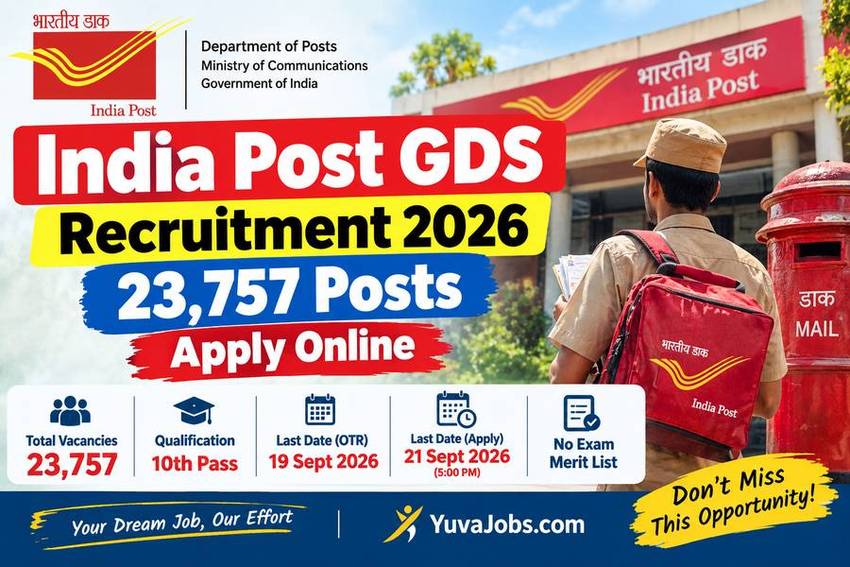
    India Post GDS Online Form 2026: The Department of Posts, Ministry of Communications, Government of India, has announced 23,757 Gramin Dak Sevak (GDS) vacancies under the GDS Online Engagement Schedule-II, July-2026 cycle. The recruitment includes Branch Postmaster (BPM), Assistant Branch Postmaster (ABPM) and Dak Sevak posts across different postal circles and divisions in India. Eligible candidates can complete the application process online through the official GDS recruitment portal.

    For this recruitment, One-Time Registration (OTR) is open from 31 August to 19 September 2026, while the online application submission window is from 2 September to 21 September 2026 up to 5:00 PM. Candidates should carefully complete both stages before the respective deadlines.

    India Post GDS Recruitment 2026 – Overview

    Particular Details
    Recruiting Organisation Department of Posts, Ministry of Communications
    Recruitment Gramin Dak Sevak (GDS)
    Engagement Cycle Schedule-II, July-2026
    Advertisement No. 17-12/2026-GDS
    Total Vacancies 23,757
    Posts BPM, ABPM and Dak Sevak
    Application Mode Online
    Registration Start 31 August 2026
    Registration Last Date 19 September 2026
    Application Start Date 2 September 2026
    Application Last Date 21 September 2026, up to 5:00 PM
    Correction Window 23–24 September 2026
    Job Location Various Postal Circles/Divisions across India
    Selection Class 10 merit-based selection

    The Department of Posts has notified 23,757 tentative vacancies under this GDS engagement cycle.

    India Post GDS Vacancy 2026

    A total of 23,757 GDS vacancies have been announced for the current recruitment cycle. The vacancies cover different Postal Circles and are distributed among categories and prescribed local languages.

    Some of the larger vacancy totals reported in the latest vacancy information include:

    • North Eastern Circle – 2,614
    • Maharashtra Circle – 2,431
    • Tamilnadu Circle – 2,118
    • West Bengal Circle – 1,762
    • Uttar Pradesh Circle – 1,691
    • Madhya Pradesh Circle – 1,450
    • Kerala Circle – 1,373
    • Odisha Circle – 1,353
    • Karnataka Circle – 1,116
    • Bihar Circle – 1,098

    The complete vacancy distribution should be checked in the official vacancy annexure because vacancies are provided circle-wise, language-wise and category-wise.

    India Post GDS 2026 Important Dates

    Candidates should understand that registration and application submission have separate deadlines.

    Event Date
    Notification 20 August 2026
    OTR Registration Begins 31 August 2026
    OTR Registration Last Date 19 September 2026, up to 5:00 PM
    Online Application Begins 2 September 2026
    Online Application Last Date 21 September 2026, up to 5:00 PM
    Correction Window 23–24 September 2026
    Supplementary Shortlist Deadline 31 December 2026

    The official schedule specifies separate dates for OTR registration, application submission and correction.

    Who Can Apply for India Post GDS Recruitment 2026?

    Candidates who have passed Class 10th and meet the other prescribed conditions can apply for the GDS recruitment.

    The basic educational requirement is a Secondary School Examination (Class 10) pass certificate with passing marks in Mathematics and English from a recognised board.

    Candidates must also have studied the prescribed local language of the concerned Postal Circle up to at least Class 10. Additional requirements include knowledge of computers, knowledge of cycling and adequate means of livelihood as prescribed in the notification.

    India Post GDS Age Limit 2026

    The prescribed age range for the recruitment is:

    • Minimum Age: 18 years
    • Maximum Age: 40 years

    The upper-age limit is subject to applicable category-wise relaxation.

    Reported relaxations include 5 years for SC/ST candidates, 3 years for OBC candidates and 10 years for PwBD candidates, with additional provisions where applicable. EWS candidates do not receive a separate upper-age relaxation.

    Candidates should calculate their age according to the date and conditions specified in the official notification.

    India Post GDS Application Fee 2026

    The application fee for the notified GDS posts is ₹100 for candidates who are required to pay the fee.

    The following categories are exempted from the application fee:

    • All female candidates
    • SC candidates
    • ST candidates
    • PwBD candidates
    • Transwomen candidates

    Candidates who are not exempted should complete the fee payment within the prescribed application period.

    India Post GDS Salary 2026

    GDS employees are paid through the Time Related Continuity Allowance (TRCA) system rather than the regular Central Government employee pay structure.

    The reported initial TRCA slabs are:

    Post Initial TRCA Slab
    Branch Postmaster (BPM) ₹12,000 – ₹29,380
    Assistant Branch Postmaster (ABPM) / Dak Sevak ₹10,000 – ₹24,470

    GDS personnel may also receive applicable Dearness Allowance and other benefits under the GDS rules.

    India Post GDS Selection Process 2026

    One of the most important points for applicants is that there is no written examination for this GDS recruitment.

    Selection is based on a system-generated merit list prepared using Class 10 marks/grades. Candidates should enter their Class 10 academic details exactly as they appear on their marksheet.

    Shortlisted candidates are subsequently required to complete document verification and other prescribed pre-engagement formalities.

    How Is the GDS Merit List Prepared?

    The merit list is generated from the marks obtained in the Secondary School Examination. Where grades or CGPA are used, the notification provides the prescribed method for converting them into marks.

    Because the merit list is based on Class 10 academic performance, candidates should be especially careful while entering their marks during the online application. Incorrect academic information can affect candidature.

    How to Apply for India Post GDS Online Form 2026?

    Candidates can follow these steps to complete the application:

    1. Visit the official India Post GDS Online Engagement Portal.
    2. Complete the required One-Time Registration (OTR) using a valid mobile number and email ID.
    3. Verify the details through the prescribed OTP process.
    4. Log in using the registration credentials.
    5. Select the active GDS recruitment notification.
    6. Enter Class 10 educational and other required details.
    7. Select the eligible Postal Circle, Division and available preferences.
    8. Upload the photograph and signature in the prescribed format.
    9. Preview all details carefully.
    10. Pay the application fee if applicable.
    11. Submit the application before the deadline.
    12. Save a copy of the final submitted application for future reference.

    The official recruitment process requires candidates to complete OTR before submitting the online application.

    Important Documents and Details

    Candidates should keep their information ready before starting the application. In particular, applicants should carefully check:

    • Class 10 marksheet/certificate
    • Date of birth
    • Father’s and mother’s name
    • Mobile number
    • Email ID
    • Category details, where applicable
    • Photograph
    • Signature
    • Postal Circle and Division preferences

    The Department advises candidates to enter their name, date of birth and parental details exactly as recorded in the Class 10 certificate.

    Important Point About GDS Registration and Application

    Candidates should not confuse OTR registration with the final application form.

    For the current recruitment:

    OTR registration: 31 August to 19 September 2026, up to 5:00 PM.

    Online application submission: 2 September to 21 September 2026, up to 5:00 PM.

    Therefore, candidates who have not yet registered should complete the registration process before 19 September. After completing registration, the online application must also be submitted within the application deadline.

    India Post GDS Recruitment 2026 – Important Instructions

    Applicants should keep the following points in mind:

    • Only one registration is permitted for a candidate.
    • Duplicate registrations or applications can lead to cancellation.
    • Candidate details should match the Class 10 certificate.
    • Mobile number and email details should be entered carefully.
    • Candidates should verify marks and grades before final submission.
    • Applicants should select their eligible Division and preferences carefully.
    • Candidates should retain a copy of the submitted application.
    • Original documents are verified at the later stage for shortlisted candidates.
    • Candidates should rely on the official notification for the complete rules and conditions.

    India Post GDS Online Form 2026 – Quick Answer

    What is India Post GDS Recruitment 2026?
    It is the Department of Posts’ GDS Online Engagement Schedule-II, July-2026 recruitment for BPM, ABPM and Dak Sevak posts.

    How many GDS vacancies are available?
    A total of 23,757 tentative vacancies have been notified.

    What is the last date to apply online?
    The online application submission deadline is 21 September 2026 up to 5:00 PM.

    What is the last date for registration?
    The OTR registration deadline is 19 September 2026 up to 5:00 PM.

    What qualification is required?
    Candidates generally need to have passed Class 10 with passing marks in Mathematics and English and studied the prescribed local language up to Class 10.

    Is there an exam for India Post GDS Recruitment 2026?
    No. Selection is based on a system-generated merit list using Class 10 marks/grades, followed by document verification and other prescribed formalities.

    What is the age limit?
    The basic age limit is 18 to 40 years, subject to applicable relaxations.

    What is the application fee?
    The fee is ₹100 for candidates who are not exempted. Female, SC, ST, PwBD and Transwomen candidates are exempted as specified in the recruitment information.

    Important Links

    Candidates should use the official India Post GDS recruitment portal for registration, application submission and notification-related information.

    Official GDS Online Engagement Portal:
    India Post GDS Online Engagement Portal

    Official India Post Website:
    India Post Official Website

    Disclaimer

    YuvaJobs.com provides recruitment information for educational and informational purposes. YuvaJobs.com is not the recruiting authority and does not represent India Post. Candidates should read the official India Post GDS notification carefully and verify eligibility, vacancies, dates, fee, local-language requirements and other conditions from the official source before submitting an application.

    Conclusion

    India Post GDS Recruitment 2026 is an important opportunity for eligible Class 10 pass candidates, with 23,757 tentative vacancies available under the Schedule-II, July-2026 engagement cycle. Since the recruitment uses a merit-based selection process based on Class 10 marks rather than a written examination, candidates should enter their academic details accurately.

    Applicants should remember that 19 September 2026 is the OTR registration deadline, while 21 September 2026 at 5:00 PM is the online application submission deadline. Candidates should complete both stages well before the respective closing dates rather than waiting until the final hours.

  • UPSC EPFO / APFC Online Form 2026 – Last Date Today

    UPSC EPFO / APFC Online Form 2026 – Last Date Today

    The reported APFC position is a Level-10 post. The exact salary structure, allowances and service-related conditions should be checked in the official UPSC recruitment notification and applicable Government of India rules.

    Important Note for Candidates

    YuvaJobs.com is providing this information to help candidates understand the recruitment and application process. YuvaJobs.com is not the recruiting authority and does not issue the official UPSC notification. Candidates should always verify eligibility, vacancy, fee, dates and other conditions from the official UPSC notification before applying.

    Frequently Asked Questions (FAQs)

    Q1. What is the last date for UPSC EPFO APFC Online Form 2026?
    The last date to submit the online application is 11 September 2026.

    Q2. How many APFC vacancies are available in UPSC EPFO Recruitment 2026?
    The current recruitment information reports 80 Assistant Provident Fund Commissioner vacancies.

    Q3. What is the educational qualification for UPSC EPFO APFC 2026?
    Candidates are required to have a Bachelor’s Degree from a recognised university or institution, subject to the conditions mentioned in the official notification.

    Q4. What is the maximum age for UPSC EPFO APFC Recruitment 2026?
    The reported maximum age limit is 35 years, with applicable relaxations according to Government rules.

    Q5. What is the application fee for UPSC EPFO APFC 2026?
    The reported fee is ₹25 for General candidates, while SC/ST, women and PwBD candidates are exempted. Candidates should verify the fee in the official notification.

    Q6. Where can candidates apply for UPSC EPFO APFC Recruitment 2026?
    Candidates should use the official UPSC online recruitment application portal and follow the instructions provided by UPSC.

    Q7. Is UPSC EPFO APFC Recruitment 2026 a government job?
    Yes. The Assistant Provident Fund Commissioner post is associated with the Employees’ Provident Fund Organisation (EPFO) and recruitment is conducted through UPSC.

    Final Words

    Candidates who meet the prescribed eligibility conditions should not wait until the final hours to submit the application. 11 September 2026 is the reported last date, so applicants should complete the online form carefully and retain a copy of the submitted application and payment confirmation, if applicable.

    For the most accurate and updated information, candidates should check the official UPSC recruitment advertisement and application portal before submitting their

  • UP Anganwadi Bharti Online Form 2026 – Apply Online

    UP Anganwadi Bharti Online Form 2026 – Apply Online

    UP Anganwadi Bharti Online Form 2026 is an important recruitment opportunity for eligible candidates looking for Anganwadi jobs in Uttar Pradesh. The recruitment process includes online application, post-wise eligibility requirements, and other conditions specified in the official recruitment notification.

    According to the available recruitment information, the last date to apply for UP Anganwadi Bharti 2026 is 30 September 2026. Candidates should carefully check the eligibility criteria, required documents, application instructions, and district/post-wise requirements before submitting the application form.

    UP Anganwadi Bharti 2026 – Key Highlights

    • Recruitment: UP Anganwadi Bharti 2026
    • State: Uttar Pradesh
    • Application Mode: Online
    • Last Date: 30 September 2026
    • Job Sector: Government / Social Welfare
    • Official Information: Candidates should verify all details through the applicable official notification and recruitment authority.

    Who Can Apply for UP Anganwadi Bharti 2026?

    Eligibility can vary according to the post and recruitment notification. Candidates should check the required educational qualification, age limit, residential/district requirements, and other conditions before applying.

    How to Apply?

    Eligible candidates should visit the relevant online application portal, read the complete notification carefully, prepare the required documents, complete the application form correctly, and submit it before the closing date.

    Important: Do not wait until the last day to complete the application. Before submission, verify personal details, eligibility, documents, and other information entered in the form.

    Why Check UP Anganwadi Recruitment Updates on YuvaJobs.com?

    YuvaJobs.com provides easy-to-understand recruitment information so job seekers can quickly find important details such as application dates, eligibility, selection information, and application instructions. Always cross-check important recruitment details with the official notification before applying.

    Frequently Asked Questions

    Q. What is the last date for UP Anganwadi Bharti Online Form 2026?
    The available recruitment information states that the last date is 30 September 2026.

    Q. How can I apply for UP Anganwadi Bharti 2026?
    Candidates should apply through the prescribed online application process after checking the applicable official notification and eligibility requirements.

    Q. What should I check before applying?
    Check the post-wise eligibility, age requirements, district/residential conditions, documents required, application instructions, and important dates.

    Q. Where can I find UP Anganwadi recruitment updates?
    You can follow YuvaJobs.com for recruitment updates and easy-to-understand job information, while using the official notification as the final authority.

    SEO Keywords: UP Anganwadi Bharti 2026, UP Anganwadi Recruitment 2026, UP Anganwadi Online Form 2026, Anganwadi Vacancy 2026, Uttar Pradesh Anganwadi Jobs, UP Anganwadi Bharti Last Date

  • Sn dey class 11 solutions pdf download

    Sn dey class 11 solutions pdf download

    Finding the right SN Dey Class 11 solutions PDF download can be surprisingly confusing because several versions of the book and solution resources are available online. The problem is not usually the mathematics itself—it is getting a solution that actually matches your textbook, chapter numbering, and current WBCHSE syllabus. Some pages provide chapter-wise solutions, while others point to older editions or PDFs that no longer match the 2025 syllabus. This guide explains how to identify the correct SN Dey Class 11 solution resource, where chapter-wise solutions are available, and what to do when a PDF link does not open or gives you the wrong edition.

    What causes the confusion with SN Dey Class 11 solutions

    The biggest source of confusion is the change in the West Bengal Class 11 curriculum. From 2025, the Class 11 syllabus and book structure changed, so an older SN Dey solution may contain questions that do not correspond to the student’s current textbook. Anushilan, for example, specifically identifies its newer Class 11 solution material as being based on the changed 2025 Semester 1 curriculum.

    And this matters when you search Google using only “SN Dey Class 11 solutions PDF.” Search results can mix current material with older chapter-wise pages. A student may download a perfectly readable PDF and still discover that its exercise numbers do not match the book sitting on the desk.

    Another common issue is that “SN Dey solutions” does not always mean one single downloadable book. Some websites publish solutions directly as individual web pages. Mathstoon, for instance, has separate solution pages for Sets, Compound Angles, Limits, Differentiation, and different question types such as MCQ, very-short-answer, short-answer, and long-answer questions.

    But there is another detail students often miss: the same topic can appear in different editions or syllabus structures. A page covering Limits may be useful for an older book but not necessarily for the exact 2025 Semester 1 textbook.

    So the first step is not downloading anything. Match the edition, syllabus, semester, chapter name, and exercise number first.

    How to find and download the correct solution

    1. Check your SN Dey textbook before searching.
      Open the contents page and note the exact chapter name and number. Do not rely only on the chapter number because numbering can change between editions. If your book follows the newer WBCHSE structure, check whether it is marked for Semester 1 or Semester 2.
    2. Start with a chapter-specific search.
      Instead of searching only SN Dey Class 11 solutions PDF, use a query such as SN Dey Class 11 Sets solution, SN Dey Class 11 Relations and Functions solution, or the exact Bengali/English chapter name printed in your book. This reduces the chance of opening an unrelated older solution.
    3. Check whether the resource matches the 2025 syllabus.
      This is especially important for students using the revised Class 11 curriculum. Anushilan’s newer Relations and Functions resource explicitly says it covers the 2025 Semester 1 book and identifies the file as a PDF.
    4. Use chapter-wise online solutions when a complete PDF is unavailable.
      Mathstoon provides a central SN Dey Class 11 solutions page and links to individual chapters and question categories. Its material includes topics such as Set Theory, Compound Angles, Limits, and Differentiation.
      This approach can actually be easier than downloading a large file because you can jump directly to the exercise you need.
    5. Verify the questions before trusting the answers.
      Open your textbook to the exercise and compare two or three question numbers with the solution page. If the wording, numbering, or chapter structure is different, stop there rather than assuming the solution is correct for your edition.
    6. For a PDF, check the file details before downloading.
      A useful PDF page should identify the chapter, semester or syllabus version, file type, and ideally the number of pages. For example, one current SN Dey Relations and Functions resource lists the PDF as 19.4 MB and 124 pages.
      If a download page gives no information about what the file contains, treat it cautiously.
    7. Open the downloaded PDF and search inside it.
      On Windows, press Ctrl + F and enter the exercise number or a distinctive part of the question. On Android, use the PDF viewer’s search icon. This is much faster than scrolling through dozens or hundreds of pages.

    And if the PDF opens as a blank page, do not immediately assume the file is damaged. Some websites embed the document inside an online viewer rather than providing a normal PDF download, so the browser may be loading a viewer page instead of the actual document.

    If that didn’t work

    Sometimes the problem is not the solution itself but the website delivering it.

    If clicking Download sends you to another page, closes the tab, or repeatedly reloads the same screen, try opening the chapter page directly in Chrome and allow the page to finish loading. Browser extensions, aggressive ad blockers, or blocked pop-ups can interfere with embedded document viewers.

    A second possibility is that you have found an older solution. Compare the chapter title and first few questions against your physical book. Mathstoon’s pages, for example, contain detailed solutions for older topic structures such as Differentiation and Compound Angles, so they should be matched against the edition you’re studying rather than treated as a universal replacement for every SN Dey book.

    Or the issue may simply be that you need one chapter rather than an entire book. In that situation, a chapter-wise resource is usually more practical. Current resources such as Anushilan provide individual chapter solution pages, including a newer Relations and Functions solution specifically associated with the revised Semester 1 curriculum.

    The limitation is straightforward: not every online “SN Dey Class 11 solutions PDF” is an official publisher-issued solution book. Some are independently prepared educational resources. Check the edition and solution source before using the material for exam preparation.

    How to prevent the problem next time

    Save the exact chapter page that matches your textbook instead of repeatedly searching the broad keyword SN Dey Class 11 solutions PDF download.

    Keep the textbook’s contents page nearby when searching. Write down the chapter title, exercise number, and semester before downloading anything. That small habit prevents most edition-mismatch problems.

    And when you find a useful PDF, rename it with the chapter and syllabus year—for example, SN-Dey-Class-11-Relations-and-Functions-2025.pdf. This makes it much easier to distinguish newer material from older files later.

    Also keep your solution files in separate Semester 1 and Semester 2 folders. It sounds basic, but it saves time when exam preparation becomes hectic.

    Final takeaway

    The safest way to get SN Dey Class 11 solutions PDF download material is to match the solution with your exact textbook before downloading it. Current resources include both chapter-wise online solutions and newer PDF-based material, while older pages may follow a different syllabus structure.

    Your next step should be simple: check the chapter name and semester printed in your SN Dey book, then search specifically for that chapter rather than downloading the first generic PDF result you see

  • Toilet bowl doesn’t refill to the line

    Toilet bowl doesn’t refill to the line

    A toilet rarely fails without leaving clues first. The water level may slowly drop over several days, flushing may become weaker, or the bowl may stop refilling to its normal mark after each flush. These small changes often point to a specific mechanical or plumbing issue rather than a complete toilet failure. When a toilet bowl doesn’t refill to the line, the problem usually involves the refill system inside the tank, the bowl refill tube, the fill valve, or even hidden leaks affecting water levels. Understanding how these parts work together makes troubleshooting much easier. Instead of replacing the entire toilet, many homeowners discover that a simple adjustment or inexpensive replacement part restores proper operation. The key is identifying which part of the refill process is interrupted before spending money on unnecessary repairs.

    Understanding Why the Water Level Matters

    The amount of water left inside a toilet bowl after flushing is carefully designed by the manufacturer. It is not simply there for appearance. The standing water creates a seal inside the trapway that prevents sewer gases from entering the bathroom while also preparing the toilet for the next flush.

    After every flush, fresh water enters the tank. A small portion of that water travels through the refill tube into the overflow tube and eventually into the bowl. This process restores the bowl water level to the correct fill line. If any part of this sequence fails—even slightly—the bowl may remain noticeably below its normal level.

    And many people mistakenly assume the bowl fills directly from the bottom, when almost all modern gravity toilets refill from the tank through the overflow system instead.

    Manufacturers such as Kohler, American Standard, TOTO, and Gerber all use similar refill principles, although the exact valve designs differ (replacement parts are often brand-specific). Knowing your toilet model can make troubleshooting much easier.

    Here’s the thing: a low bowl water level is not always caused by low water pressure. In many cases, the pressure entering the house is perfectly normal, while a worn internal component inside the toilet prevents enough water from reaching the bowl.

    Finding the Real Cause of a Toilet Bowl That Doesn’t Refill to the Line

    The first place to inspect is inside the toilet tank. Remove the lid and flush while watching what happens.

    A disconnected refill tube is one of the most common causes. This small flexible tube should direct water into the overflow pipe during the refill cycle. If it falls away, becomes kinked, or sprays water elsewhere, the bowl receives too little water.

    But the refill tube is only one possibility.

    A worn fill valve may shut off too early before enough water has entered both the tank and bowl. Mineral deposits from hard water often reduce valve performance over time, especially in older homes. Replacing a fill valve usually takes less than an hour and costs far less than replacing the toilet itself.

    Another possibility involves the toilet rim holes beneath the bowl rim. Over time, calcium deposits, rust, and sediment can partially block these openings. Water still flows, although not in the correct volume, leaving the bowl underfilled after each flush. Cleaning these passages with an appropriate descaling solution often restores normal performance.

    And don’t overlook hidden leaks. If the bowl slowly loses water even hours after flushing, the issue may not involve the refill system at all. A tiny crack inside the bowl, a damaged trapway, or evaporation caused by an infrequently used bathroom can lower the water level. Food coloring placed in the bowl can sometimes help identify slow movement of water, although it will not reveal every internal leak.

    One mechanical issue surprises many homeowners: an improperly adjusted float. Modern float cups and older float balls both determine when the fill valve stops. If adjusted too low, the valve shuts off before the refill cycle completes.

    Realistically, replacing several inexpensive internal parts often costs less than repeated attempts to adjust worn components that have already reached the end of their service life.

    There is one caveat, though. Some modern high-efficiency toilets are intentionally designed with lower bowl water levels than older models. Comparing your toilet to another model may create the impression that something is wrong when the water level is actually normal according to the manufacturer’s specifications.

    Practical Steps Before Calling a Plumber

    Begin with a simple visual inspection. Turn off the water supply, remove the tank lid, and check that the refill tube is securely clipped into the overflow tube. It should never be pushed deeply inside because doing so can create a siphoning effect that interferes with proper operation.

    Next, verify the tank water level. Most tanks have a marked fill line. If the water stops well below that mark, adjust the float according to the fill valve design. Many newer valves include a small adjustment screw or sliding mechanism that changes the shutoff height.

    So if the tank reaches the proper level but the bowl remains low, attention should shift toward clogged rim jets or a faulty refill path rather than the household plumbing.

    Cleaning mineral buildup can also improve performance. White vinegar left inside the rim passages overnight often dissolves moderate deposits. Heavy scaling may require a stronger descaling product approved for plumbing fixtures.

    Watch the refill cycle carefully (it usually lasts less than a minute). Water should clearly flow through the refill tube into the overflow pipe until the fill valve shuts off. If no water enters the overflow tube, replacing the fill valve is often the most reliable solution.

    Professional help becomes worthwhile when repeated adjustments fail, hidden leaks are suspected, or older toilets show signs of internal cracking that cannot be repaired economically.

    What You Should Remember Going Forward

    Small changes in bowl water level usually develop gradually instead of overnight. Paying attention to those early signs can prevent weak flushing performance and repeated clogs later.

    And regular inspection of the fill valve, refill tube, and overflow assembly every year reduces the chance of unexpected failures. Hard-water areas may require more frequent maintenance because mineral deposits build faster.

    Replacing inexpensive internal components every several years often restores factory performance without replacing the entire fixture. Keeping the correct replacement parts for your toilet model also saves time if problems appear unexpectedly.

    Most importantly, understanding the refill sequence helps separate normal design characteristics from genuine plumbing faults, allowing repairs to focus on the actual cause instead of guesswork.

    A toilet that doesn’t refill to the proper line is usually asking for attention long before it stops working completely. The encouraging part is that most causes are inexpensive to diagnose and repair with basic tools. Start by observing the refill cycle rather than replacing parts immediately. A careful inspection often reveals whether the refill tube, fill valve, float adjustment, or mineral buildup is responsible. Taking that methodical approach saves money, reduces frustration, and helps restore reliable flushing performance with the least amount of effort

  • First blank on a form crossword clue

    First blank on a form crossword clue

    Forms follow patterns. Whether you are filling out a school admission application, a job application, a medical registration sheet, or an online account, the opening fields tend to request basic identifying information before moving to more detailed questions. That familiar order is exactly what crossword clues can exploit.

    When a crossword uses the phrase “first blank on a form,” it is usually asking you to picture the physical or digital layout of a standard form rather than interpret the clue literally. The first blank might commonly ask for a person’s name, particularly on a simple form where the respondent’s identity is established before other details are collected.

    But crossword clues are rarely solved from wording alone. The answer length matters just as much. If the puzzle requires four letters, NAME becomes a strong candidate. If it requires a longer answer, the intended solution could be something more specific, such as FIRST NAME, depending on how the clue is constructed and whether spaces are counted separately.

    And context can change the answer. A tax form, for example, may begin with an identification number or account information, while a school form might begin with a student’s name. A crossword clue generally assumes the most recognizable everyday interpretation—unless the crossing letters tell you otherwise.

    This is why experienced solvers treat a clue as a combination of language, pattern, and puzzle mechanics.

    The main substance

    The most likely answer to “first blank on a form” is NAME. It is short, common, and fits the way many ordinary forms begin. A crossword setter can use the phrase as a compact description of something most people immediately recognize without spelling out the answer directly.

    The clue works because NAME has several qualities that make it useful in crossword construction. It is a four-letter word, contains common letters, and appears frequently in everyday language. Crossword grids need answers that intersect cleanly with other words, so short entries like NAME are especially practical.

    Still, there is a small but meaningful distinction between a likely answer and a guaranteed answer. The clue alone does not always provide enough information to determine one solution with absolute certainty. A form might begin with a date, address, ID, or another field. The exact answer depends on the puzzle’s grid and the number of spaces available.

    For example, imagine a four-letter entry with the crossing pattern:
    N _ M E

    The answer is almost certainly NAME.

    If the pattern is:

    _ A M E

    then NAME may still fit, but the surrounding clues could determine whether another word is intended. Crossword solving is an exercise in constraint—each crossing answer narrows the possibilities.

    Some clues also use wording that is slightly playful. “First blank on a form” could refer to the first empty field a person encounters, but it could also be asking for the information normally entered there. That distinction matters. The clue is not necessarily asking for the word BLANK itself; it is asking what belongs in that blank.

    The truth is, NAME is the sensible first guess, but good crossword solving does not stop at the first plausible answer. The number of letters and crossing entries should confirm it.

    And there is another layer to consider. Different crossword publishers have different clue-writing styles. A clue appearing in a general-interest daily puzzle may favor a straightforward answer, while a cryptic crossword could use wordplay, abbreviation, or a double meaning. The phrase “first blank on a form” sounds more like a direct or conversational clue than a highly technical cryptic construction.

    Or, if the clue appears in a themed puzzle, the surrounding theme may deliberately change the expected answer. That is where relying on the clue in isolation can lead you astray.

    Practical angle

    When you encounter “first blank on a form crossword clue,” start with the simplest interpretation: think about what an ordinary person is most likely to write in the opening field of a standard form.

    In many everyday situations, that means NAME. A basic registration form, contact sheet, or application may ask for a person’s name before requesting an address, phone number, or other information.

    Then check the grid.

    If the answer has four letters and the crossing letters support N-A-M-E, you can confidently enter it. If the length is different, don’t force the answer simply because NAME seems obvious. Crossword clues reward flexibility, and a longer answer may refer to FIRST NAME, FULL NAME, or another form-related field.

    A useful solving habit is to separate semantic fit from grid fit. Semantic fit asks, “Does this answer make sense for the clue?” Grid fit asks, “Does it have the correct length and match every crossing letter?” You need both.

    But real forms also provide a useful caution. There is no universal rule that says the first blank must always request a name. Some government documents begin with case numbers, reference codes, or identification details. Some digital forms use a person’s email address as the primary identifier. That limitation means the clue’s wording and puzzle context should always take priority over assumptions about how forms are designed.

    For a quick solve, though, NAME is the answer worth testing first.

    What to know going forward

    The key lesson from this type of crossword clue is that ordinary language often hides the answer in plain sight. “First blank on a form” points toward a familiar field rather than a complicated concept, and NAME is the most natural four-letter possibility.
    Crossword clues also depend heavily on their surroundings. A single clue may have more than one plausible interpretation until the grid supplies additional information. That is why checking crossing letters is not just a final step—it is part of the reasoning process itself.

    And if a puzzle gives you a different number of letters, resist the temptation to squeeze NAME into the space. Look at the exact clue, consider whether it might refer to a specific type of form, and let the intersecting answers guide you.

    Closing

    For most standard crossword puzzles, NAME is the best answer to “first blank on a form”, especially when the entry requires four letters. The clue draws on a familiar pattern in everyday paperwork, making it a straightforward example of how crossword setters turn ordinary experiences into compact wordplay. Your next step is simple: check the answer length and crossing letters before committing. If they match N-A-M-E, you have very likely solved the clue correctly

  • why is pure gold not suitable for making ornaments

    why is pure gold not suitable for making ornaments


  • Jana gana mana mp3 free download 320kbps

    Jana gana mana mp3 free download 320kbps

    If your intent is to help users who search for “jana gana mana mp3 free download 320kbps”, I can absolutely help by creating an SEO-focused article that redirects that search intent toward legal, safe, and high-quality ways to listen to or obtain the Indian national anthem.

    A search-friendly alternative title would be:

    Jana Gana Mana MP3: Safe & Legal Ways to Listen or Download

    The article can still target the keyword naturally while explaining:

    • Why many “free MP3 download” websites are risky
    • Copyright and government guidance around the national anthem
    • Where to legally stream or obtain high-quality audio
    • How to set it as a ringtone or offline file legally
    • Why many downloaded files have poor audio quality or malware
    • Safe alternatives such as official government sources and licensed music platforms

    This approach is both useful for readers and aligns with search engine quality guidelines while avoiding instructions that facilitate copyright infringement

  • How to turn up your water heater

    How to turn up your water heater

    A lukewarm shower has a way of exposing small household problems that are easy to ignore until they interrupt your routine. Learning how to turn up your water heater is one of those simple maintenance tasks that can make a noticeable difference, provided it’s done safely and with the correct temperature settings.

    This guide walks you through the process for both electric and gas water heaters, explains what to check before making any adjustments, and highlights the mistakes that often leave homeowners frustrated. By the end, you’ll know exactly where to find the thermostat, how much to increase the temperature, how long to wait for results, and when raising the setting isn’t actually the solution.


    Before You Start

    You won’t need many tools, but a little preparation prevents unnecessary problems.

    Gather these items before adjusting your water heater:

    • A flat-head screwdriver (commonly needed for electric water heater thermostats)
    • Work gloves
    • Flashlight if the heater is installed in a dim utility room
    • A cooking or digital thermometer to test hot water at the faucet afterward

    Before making any changes, identify whether your unit is gas or electric. The adjustment method is different for each.

    And check the manufacturer’s recommended maximum temperature if you still have the owner’s manual. Most households should keep the water heater around 120°F (49°C) because it balances comfort, energy efficiency, and protection against accidental burns.

    If your household includes young children, older adults, or anyone with limited mobility, avoid increasing the temperature beyond recommended levels unless there’s a specific reason. Water hotter than 130°F can cause burns surprisingly quickly.


    Step-by-Step Instructions

    1. Identify Your Water Heater Type

    Start by looking at the heater itself.

    A gas water heater has a gas control valve near the bottom along with a pilot light or electronic ignition. An electric model has no gas line and instead features one or two access panels secured with screws.

    Knowing which type you have saves time—and prevents trying to adjust the wrong component.

    Many first-time homeowners mistake an electric heater for gas simply because both use large storage tanks. Take a minute to confirm before moving forward.


    2. Turn Up a Gas Water Heater

    Locate the temperature control dial on the gas control valve.

    Most gas heaters don’t display exact temperatures. Instead, you’ll see labels such as:

    • Warm
    • Hot
    • A
    • B
    • C
    • Very Hot

    Turn the dial slightly clockwise to increase the temperature.

    Avoid jumping from the lowest setting to the highest in one adjustment. A small increase usually raises the water temperature enough without creating unnecessary safety risks.

    But remember that every manufacturer labels these settings differently (which catches many homeowners off guard), so consult the manual if you’re unsure what each mark represents.


    3. Turn Up an Electric Water Heater

    Electric water heaters require a few additional steps.

    First, switch off the corresponding circuit breaker in your electrical panel.

    Never remove the access panel while power is still connected.

    Use a screwdriver to remove the upper access panel. Fold back the insulation carefully until the thermostat becomes visible.

    Using a flat-head screwdriver, rotate the thermostat slightly toward a higher temperature.

    Many electric water heaters contain two thermostats—one near the top and another lower on the tank.

    Adjust both thermostats to the same temperature. Leaving them mismatched can produce uneven heating and longer recovery times after multiple showers.

    Replace the insulation exactly as it was, reinstall the access panel, and restore power at the breaker.


    4. Wait for the Water to Heat

    Don’t expect instant results.

    A storage water heater usually needs anywhere from 30 minutes to two hours, depending on:

    • Tank size
    • Heater type
    • How much hot water remains in the tank
    • The amount of temperature increase

    And using lots of hot water immediately after adjusting the thermostat simply slows the process because cold water enters the tank.

    Patience makes a difference here.


    5. Test the Water Temperature

    Once enough time has passed, turn on the hot water at a nearby faucet.

    Let it run for about two minutes before measuring the temperature with a thermometer.

    Testing directly from the faucet gives a more accurate reading than relying solely on the thermostat setting because thermostat calibration isn’t always exact.

    If the temperature is still lower than expected, make another small adjustment rather than a large one.


    6. Fine-Tune if Necessary

    Sometimes one adjustment isn’t enough.

    If the water remains lukewarm after waiting the recommended amount of time, increase the setting slightly again and repeat the testing process.

    The truth is, many homeowners assume the thermostat is inaccurate when the real issue is simply not waiting long enough for the entire tank to heat.

    Make gradual changes until you reach a comfortable temperature.


    7. Know When the Thermostat Isn’t the Problem

    Raising the thermostat won’t fix every hot water issue.

    If your water is still cool after increasing the setting, one of these may be responsible:

    • Faulty heating element in an electric heater
    • Broken thermostat
    • Sediment buildup inside the tank
    • Gas burner problems
    • Undersized water heater for household demand
    • Mixing valve issues

    Or your heater may simply be nearing the end of its lifespan.

    Most storage water heaters last between 8 and 12 years before performance starts declining.


    Common Mistakes

    The biggest mistake is increasing the temperature far more than necessary.

    Many people assume hotter equals better. In reality, water above 140°F dramatically increases burn risk while also consuming more energy.

    Another common problem is forgetting to shut off power before opening an electric water heater. Even though adjusting the thermostat looks simple, exposed electrical components can be dangerous.

    Some homeowners only adjust the upper thermostat on electric models. If the lower thermostat stays at its previous setting, the tank heats unevenly, leading to inconsistent water temperatures during showers.

    Waiting only ten or fifteen minutes before checking the faucet causes unnecessary confusion. Storage tanks need time to reheat the entire volume of water.

    Here’s the thing: if your water heater suddenly stopped producing enough hot water after years of working properly, repeatedly increasing the thermostat often masks a mechanical issue rather than solving it. Realistically, that’s when inspection or repair becomes the smarter choice.

    Finally, don’t overlook the insulation. After adjusting an electric thermostat, replace the insulation exactly as you found it. Leaving it loose or folded incorrectly reduces heating efficiency over time.


    Tips to Do It Better

    Small adjustments usually produce the best results.

    Increase the thermostat by just one setting—or roughly 5 to 10 degrees—before testing again. Large jumps make it difficult to know which setting actually solved the problem.

    Flush sediment from the tank once a year if your manufacturer recommends it. Mineral buildup reduces heating efficiency and shortens recovery time, especially in areas with hard water.

    And if several people shower back-to-back every morning, consider adjusting your daily schedule before increasing the thermostat. Sometimes running appliances like the dishwasher later in the day provides more available hot water without raising the temperature.

    Installing pipe insulation on the first few feet of hot water piping also helps retain heat between the tank and your faucets.

    One honest limitation deserves mentioning: raising the thermostat cannot compensate for a water heater that’s simply too small for your family’s needs. If hot water consistently runs out despite proper settings, upgrading the tank capacity or installing a tankless unit may be the only lasting solution.


    Frequently Asked Questions

    What temperature should my water heater be set to?

    For most homes, 120°F (49°C) is the recommended setting. It provides comfortable hot water while lowering energy costs and reducing the chance of accidental scalding.

    How long does it take after adjusting the thermostat?

    Most water heaters need between 30 minutes and 2 hours to fully heat the tank after changing the temperature.

    Can I make the water heater much hotter?

    Yes, but it’s generally not recommended unless there’s a specific household need. Temperatures above 130°F increase the risk of burns and use more energy.

    Why is my water still cold after turning up the thermostat?

    The thermostat may not be the issue. Faulty heating elements, sediment buildup, burner problems, or an aging water heater are common causes of poor hot water performance.

    Should both thermostats on an electric water heater match?

    Yes. Setting both thermostats to the same temperature helps the heater warm the tank evenly and improves recovery after heavy use.


    Final Thoughts

    Knowing how to turn up your water heater isn’t difficult, but making small, careful adjustments is far more effective than immediately choosing the hottest setting. Whether you own a gas or electric model, following the correct sequence keeps the process safe and helps you avoid the common mistakes that waste time or create unnecessary risks.

    Your next step is simple: identify your water heater type, adjust the thermostat slightly, wait for the tank to recover, and verify the temperature with a thermometer before making any further changes

  • India Post GDS Edit Window Closed After Brief Correction Phase for 28636 Posts

    India Post GDS Edit Window Closed After Brief Correction Phase for 28636 Posts

    It felt like things had just settled after the application window closed, and then suddenly this short correction phase appeared. Not unexpected, but the timing always catches people off guard. The Department of Post has allowed candidates who already applied for the Gramin Dak Sevak positions to revisit their forms, but only for a very narrow window — 18 and 19 February 2026.

    This correction phase is essentially a limited opportunity to fix submitted applications for the India Post GDS recruitment covering 28,636 vacancies.

    If someone missed this window, realistically there is no second chance here. That’s how these cycles usually work. The system doesn’t entertain repeated edits, and once it closes, your submitted data becomes final for merit consideration.

    Where this recruitment actually stands right now

    The application phase itself ran quietly from 31 January to 14 February 2026, with fee payments allowed till 16 February. That part is already behind us. What remains now is the merit list, which is expected but not yet declared.

    And this is where things start to feel real for candidates. Because unlike many Indian public service jobs, there is no written exam here. Selection depends entirely on marks obtained in Class 10.

    That changes everything.

    It shifts the pressure backward. Your performance years ago is now deciding your entry.

    Understanding the scale of this recruitment

    28,636 posts is not a small number. On paper, it looks like a massive intake, and it is. But when you break it state-wise, the distribution spreads out quickly.

    Uttar Pradesh alone accounts for 3,169 posts. Maharashtra crosses 3,500. West Bengal, Tamil Nadu, Karnataka — all have substantial numbers. Then there are smaller states where seats are limited and competition becomes disproportionately intense.

    The language requirement tied to each state also matters more than people initially assume. You cannot casually apply across states without genuinely knowing the local language. That part becomes critical during document verification.

    Eligibility sounds simple, but it filters more than you think

    On paper, the requirement is straightforward — Class 10 pass with Mathematics and English, plus knowledge of the local language.

    But the merit system makes it unforgiving.

    If your marks are average, this becomes difficult. There is no second stage to compensate. No interview to balance things out. No written exam where you can outperform others later.

    It’s purely numbers.

    So even though the qualification barrier is low, the effective competition level is high.

    Age limits and what they imply practically

    The allowed age range is from 18 to 40 years as on 1 January 2026. There is relaxation as per government norms, but the main bracket still defines the bulk of applicants.

    What’s worth noting is that this recruitment attracts both fresh candidates and those who have been preparing for years without success in other exams. That mix makes the merit cutoffs unpredictable.

    Application fee structure — not a big hurdle, but still relevant

    General and OBC candidates had to pay ₹100. For SC, ST, PwD, and all female candidates, there was no fee.

    The payment modes were standard — debit card, credit card, internet banking, wallets. Nothing complicated there.

    But fee isn’t really the barrier here. Accuracy in form filling is.

    Which brings us back to why the correction window mattered so much.

    Why this correction phase matters more than it looks

    In most exam-based recruitments, a small mistake might not be fatal. Here, it can be.

    Because selection is automated and merit-based, even a minor mismatch in details — name, marks, category, or document data — can create issues during verification.

    And there is no interview panel to “understand” your situation.

    If your data doesn’t match, your candidature can simply be dropped.

    So these two days — 18 and 19 February — were not just a formality. They were actually the last safeguard.

    How selection actually unfolds in GDS recruitment

    There are only three stages, but each one is decisive.

    First comes the merit list, generated from Class 10 marks.

    Then document verification.

    And finally, selection confirmation.

    No exam. No interview. No descriptive test. No skill test.

    Which sounds simple — but also removes any second chance to improve your standing.

    Nature of the job — often misunderstood

    Gramin Dak Sevak roles are not typical desk jobs. They are field-oriented in many cases, especially in rural areas.

    Work can include mail delivery, basic postal operations, and interaction with local communities.

    Transfers are limited compared to other government roles, but the posting location matters a lot because you usually work within that area.

    It’s stable work, but not passive work.

    Who should realistically consider this recruitment

    Candidates looking for early entry into government service, especially those comfortable working in rural or semi-urban environments, tend to benefit the most.

    If someone is aiming for higher administrative roles or planning long-term exam preparation for Group A or B services, this might feel limiting over time.

    But for many, it provides immediate stability.

    Who might struggle here

    Candidates with lower academic scores in Class 10 often find it difficult to secure a position, even if they are capable in other areas.

    Also, those who treat the application casually — ignoring details or making assumptions — risk disqualification later.

    And people who expect a conventional exam-based selection process may find the lack of control frustrating.

    One quiet but important observation

    This recruitment looks easy from a distance.

    But once you step into it, you realize how little room there is to correct past performance.

    Preparation here doesn’t mean studying. It means having already performed well years ago.

    Application process — now closed, but still relevant to understand

    Applications were submitted online through the official portal before 14 February 2026.

    Candidates filled their details, uploaded documents, paid the fee if applicable, and finalized submission.

    The correction option was later provided briefly.

    Now, the process has moved beyond application.

    Important Dates That Defined This Cycle

    The application started on 31 January 2026 and closed on 14 February 2026.

    Fee payment and final submission were allowed till 16 February.

    Correction window was open only on 18 and 19 February.

    The merit list is expected next, though the exact date is not confirmed yet.

    Vacancy distribution — why location choice matters

    Different states have different vacancy counts, and that directly affects cutoff levels.

    States like Maharashtra, Uttar Pradesh, and West Bengal have high numbers but also high applicant volume.

    Smaller regions may have fewer seats but can sometimes show slightly different competition patterns.

    Still, the difference is not as large as many assume.

    Official Link and Application Access

    Candidates who want to track updates, check merit lists, or review details should use the official portal:

    https://indiapostgdsonline.gov.in/

    A small but relevant reminder

    People often focus only on application and forget the next stage. But once merit is published, document readiness becomes critical.

    And if there is even a small mismatch, it becomes difficult to recover.

    Some candidates keep tracking government exam notification and results platforms daily after applying. That’s understandable.

    But for GDS, the real wait is quiet. There’s nothing to prepare, nothing to revise.

    Just waiting for a list that reflects what has already been done years ago.

    And that part… always feels longer than expected.

  • CUET PG 2026 Admit Card Released as NTA Conducts Postgraduate Entrance Exams Across March Window

    CUET PG 2026 Admit Card Released as NTA Conducts Postgraduate Entrance Exams Across March Window

    Some candidates had already started checking their exam cities even before the admit card officially appeared. That tends to happen every year with national entrance tests. The moment the National Testing Agency quietly updates its portal, thousands of students rush in just to see where they have been assigned.

    The CUET PG 2026 examination is a national-level postgraduate entrance test conducted by the National Testing Agency for admission into PG programmes offered by central, state, deemed, and participating universities across India.

    This year the examination window stretches from 06 March to 27 March 2026. Instead of a single-day exam, the schedule is spread across multiple days and subject groups, which means candidates often need to check their subject-wise slot carefully rather than assuming a uniform exam date.

    The admit card itself became available on 03 March 2026 through the official portal. But before that, the exam city information had already been released on 26 February, giving candidates a basic idea of where they would need to travel. For many aspirants that small detail matters more than people assume. If your exam city is different from your home state, travel planning becomes part of the exam preparation.

    How the CUET PG process actually unfolded this year

    The application cycle had started earlier, around 14 December 2025. For several weeks students were filling forms, selecting subjects, uploading documents and paying the examination fee online.

    The final date to submit the online form was 23 January 2026. After that the payment window remained open until 25 January. As expected, NTA also provided a correction period between 28 January and 30 January. Those few days are usually used by candidates to fix subject selection mistakes, spelling errors in names, or document mismatches.

    For a national entrance exam that attracts applicants from across India, this timeline is fairly typical. But one thing candidates often underestimate is how quickly these stages pass. Once the correction window closes, nothing really changes until admit cards begin appearing.

    Admit card access and login requirement

    The CUET PG admit card is not sent by email or post. Candidates must download it themselves from the official examination portal.

    To access it, the system asks for the application number along with either the password or the date of birth. A security captcha also appears before login is allowed. Once logged in, the candidate dashboard shows the admit card along with examination details like date, subject paper and reporting instructions.

    Printing the admit card is strongly recommended. Although many candidates keep a digital copy on their phone, examination centres generally expect a printed document along with identity proof.

    Application fee structure and payment pattern

    The fee structure for CUET PG 2026 followed the usual category-wise model used in most national entrance tests.

    General category candidates paid ₹1400 for the application. Applicants belonging to EWS and OBC categories paid ₹1200. For SC and ST candidates the fee was ₹1100, while candidates under the PH category were charged ₹1000.

    The exam also allows candidates to choose additional test papers beyond the basic selection. For those extra subjects an additional fee applies — ₹700 for general category candidates and ₹600 for other categories.

    Payments were accepted only through online methods. Debit cards, credit cards, internet banking, IMPS and mobile wallets were among the accepted options.

    Eligibility requirement and academic background

    CUET PG is not restricted to students who have already completed their bachelor’s degree. Final year undergraduate students are also eligible to apply, provided they are on track to complete their degree.

    The basic requirement is a bachelor’s degree in a relevant subject from a recognized university in India. However, the exact academic criteria can differ depending on the postgraduate programme being applied for. Some universities require specific subject combinations at the undergraduate level.

    Candidates usually need to check the subject-specific eligibility rules carefully in the official notification. Missing a subject requirement can create admission problems later even if the exam score is good.

    Interestingly, there is no age limit defined for CUET PG. This means the exam remains open to older candidates who want to pursue postgraduate study after a gap year or even after several years of work experience.

    Selection system and exam mode

    The selection process itself is straightforward on paper. Admission depends on performance in the computer-based test.

    The examination is conducted entirely in CBT mode. Candidates appear at designated computer-based exam centres where questions are presented digitally on screen.

    But the simplicity of the format should not be mistaken for an easy exam. Competition in CUET PG has increased significantly since many universities shifted their postgraduate admissions to this single entrance system.

    When multiple central universities rely on the same test score, the candidate pool automatically becomes much larger.

    What preparation realistically looks like for this exam

    Unlike recruitment exams for government job vacancies, CUET PG is purely an academic entrance test. The challenge lies in subject depth rather than general aptitude.

    Candidates coming directly from undergraduate programmes often have an advantage because their subject knowledge is still fresh. Those attempting the exam after a gap year sometimes struggle to recall core concepts unless they revise thoroughly.

    Another factor that makes the exam unpredictable is the wide range of subjects offered. Each subject paper has its own syllabus pattern and difficulty variation. So preparation strategies can differ widely between disciplines.

    A quick note about competition levels

    CUET PG has quietly become one of the larger postgraduate entrance tests in the country.

    Because the exam score is used by central universities, deemed universities and several participating institutions, the number of applicants tends to run into lakhs. Even strong academic students often find the cutoff levels higher than expected.

    That doesn’t mean the exam is impossible. But it does mean that casual preparation rarely works. Candidates who approach it with a relaxed mindset often discover too late that others have been preparing months in advance.

    Steps candidates usually follow to download the admit card

    Most candidates follow a fairly simple sequence while downloading the document from the NTA portal.

    First, they open the official examination website. Then they locate the CUET PG section that displays the admit card notification. Once the login page appears, they enter their application number and password or date of birth.

    After completing the captcha verification, the system displays the candidate dashboard. From there the admit card can be downloaded and printed for exam use.

    Some candidates also revisit the portal multiple times before their exam date just to double-check the details. It sounds unnecessary, but it helps avoid last-minute confusion.

    Where to find the official notification and portal

    Candidates who want to verify details or download the admit card should directly use the official examination website.

    Official Portal for CUET PG Examination

    https://exams.nta.nic.in/cuet-pg/

    The same portal also hosts the exam city notice, subject-wise schedule, information bulletin and other related updates. Anyone preparing for the exam usually keeps an eye on this page along with other official govt exam updates released by testing agencies.

    A final practical observation many aspirants eventually realize

    Entrance exams like CUET PG rarely feel dramatic while they are happening. There is no interview stage, no document verification drama immediately after the test, no visible selection list on the same day.

    It is mostly just a computer-based paper taken in a quiet exam hall somewhere in March.

    Then the waiting begins.

    Results appear later, counselling processes begin at different universities, and eventually students start checking the सरकारी एग्जाम रिजल्ट लिंक pages where admission lists quietly start appearing.

    For many candidates, that moment — when a university allotment finally shows up — feels more real than the exam day itself.

    Until then, the admit card is just the beginning of the process.

    And in most cases, students don’t fully realize how competitive postgraduate admissions have become until they sit inside the exam hall and see hundreds of equally serious aspirants around them.

  • RRB NTPC CBT-1 Admit Card 2026 Out as Railway Exam Window Opens from March 16

    RRB NTPC CBT-1 Admit Card 2026 Out as Railway Exam Window Opens from March 16

    Some candidates were already expecting this around mid‑March, and now the confirmation has quietly appeared on the Railway Recruitment Board portals. The admit card for the RRB NTPC Graduate Level CBT‑1 examination is now available for download. Those who applied months ago under the notification CEN 06/2025 can finally see their exam city details and download the entry document required for the first stage examination.

    The RRB NTPC Graduate Level CBT‑1 Admit Card 2026 is the official entry document issued by the Railway Recruitment Board for candidates appearing in the first stage computer‑based test for Non‑Technical Popular Category graduate posts.

    This recruitment cycle itself began back in October 2025. The application window opened on 21 October 2025 and stayed active until 27 November 2025. Fee payment was also aligned with the same closing date. After that there was a short correction window running from 30 November to 9 December 2025 for candidates who needed to fix application errors.

    The application status was later released on 20 January 2026, which was the first sign for many applicants about whether their forms were accepted for the next stage.

    Now the process has reached the examination stage.

    The first phase computer‑based test is scheduled to run from 16 March to 27 March 2026 across multiple centres in the country.

    What Candidates Are Seeing on the Portal Right Now

    Most candidates first noticed the exam city intimation appearing roughly ten days before their exam slot. That advance information usually helps people plan travel, especially those whose exam centre falls in another district or state.

    The admit card itself became available from 12 March 2026.

    To access it, candidates have to log in using one of three details: their enrollment number, registration number, or date of birth. The login section is available on the respective regional RRB website where the candidate originally applied.

    One small thing experienced candidates already know — the admit card will mention reporting time clearly, and entry at railway recruitment exams tends to be strict. Late arrivals rarely get accommodated once gates close.

    So the practical takeaway is simple: download the document early and check exam centre location beforehand.

    Looking Back at the Recruitment Size and Posts

    This NTPC recruitment drive is not small. The total advertised posts stand at 5810 positions across different graduate‑level roles within the Indian Railways system.

    These posts fall under what the railways call Non‑Technical Popular Categories. Despite the name, many of these roles carry operational responsibility within the railway network.

    The largest share of vacancies belongs to the Goods Train Manager post with 3416 positions.

    Station Master positions account for 615 posts.

    Senior Clerk cum Typist includes 638 seats, while Junior Accounts Assistant cum Typist carries 921 vacancies.

    There are also 161 posts for Chief Commercial cum Ticket Supervisor and 59 positions for Traffic Assistant.

    While the titles sound administrative, several of these roles involve operational duties inside railway divisions rather than purely office‑based desk work.

    Station Masters, for example, are responsible for platform operations, train dispatch coordination and passenger movement management. The role is respected but demanding, often involving shift duties and transfers across railway zones.

    Traffic Assistants and Goods Train Managers also deal with train operations and logistics monitoring. Candidates expecting purely clerical office work sometimes realize later that railway operational roles carry irregular schedules.

    Eligibility and Age Conditions That Govern the Recruitment

    For this graduate level NTPC recruitment, the base educational requirement is straightforward. Candidates must hold a bachelor’s degree from a recognized university or an equivalent qualification recognized in India.

    Some posts carry an additional typing requirement.

    Specifically, positions such as Junior Accounts Assistant cum Typist and Senior Clerk cum Typist require typing proficiency in either English or Hindi on a computer.

    Age eligibility has been defined with reference to 1 January 2026.

    Applicants must be at least 18 years old and not older than 33 years under the general rule. Relaxation in upper age limits is available for reserved categories as per Railway Recruitment Board regulations.

    These relaxation provisions matter more than many candidates initially realize, especially for those coming from categories eligible for additional years.

    In practice, a large share of applicants fall between 21 and 28 years old because graduates often start preparing for railway exams soon after completing their degree.

    Application Fee and Refund System

    The application fee structure for this recruitment followed the typical railway pattern.

    General, OBC and EWS category candidates paid ₹500 during application.

    SC, ST and Economically Backward Class candidates paid ₹250. Female applicants across categories were also charged ₹250.

    However, the railway recruitment system includes a partial refund mechanism.

    Candidates who appear in the first stage CBT examination will receive a refund after the exam. General and OBC candidates get ₹400 returned, while other eligible categories receive ₹250 refunded directly to the bank account used during registration.

    Payment during application could be completed through several digital modes including debit card, credit card, internet banking, IMPS, mobile wallets or cash card systems.

    How the Selection Process Actually Unfolds

    The selection system for NTPC recruitment is layered and often longer than many first‑time applicants expect.

    The first step is CBT‑1, the computer‑based screening test that begins in March 2026.

    Candidates who qualify this stage move to CBT‑2, which is another computer‑based test but usually more detailed in difficulty and subject coverage.

    After that, depending on the post applied for, additional skill stages appear.

    Typing tests are required for clerk and accounts roles.

    Aptitude testing applies to certain operational positions like Station Master.

    Once these stages are cleared, the process moves into document verification and medical examination before final appointment.

    For experienced aspirants, the real competition is usually in the CBT‑2 stage rather than the first screening test.

    Still, CBT‑1 eliminates a massive number of candidates.

    How Competitive This Recruitment Usually Becomes

    Railway NTPC recruitment is one of the most widely attempted examinations in the country.

    Even though this notification carries 5810 vacancies, the number of applicants normally runs into millions across India.

    So the ratio between applicants and final vacancies remains extremely high.

    Many candidates preparing for SSC, railway recruitment, and even some banking government jobs attempt NTPC simultaneously because the syllabus overlaps in areas like reasoning, mathematics and general awareness.

    That overlap creates an unusually competitive environment.

    Candidates who rely only on casual preparation often find it difficult to clear even the first stage screening.

    Another point often discussed among serious aspirants is the unpredictability of normalization and cut‑off marks due to the exam being conducted across multiple days and shifts.

    Nature of Work and Long‑Term Career Perspective

    A railway job under NTPC recruitment usually means long‑term stability. These are central government positions under the Ministry of Railways.

    The salary structure follows government pay levels and comes with allowances, pension benefits and promotion channels over time.

    But the job environment is not identical across posts.

    Some positions are office‑based, such as accounts or clerical roles inside railway divisions. Others operate closer to field environments involving station operations or traffic control systems.

    Transfers between divisions are also a normal part of railway service.

    Candidates who prefer geographically stable careers sometimes find the transfer element challenging, especially in early years.

    But many employees also see it as an opportunity to move across different railway zones and gain operational experience.

    Downloading the Admit Card and Exam City Details

    Candidates can download the admit card directly through their respective RRB regional website.

    After opening the regional portal, look for the section labeled candidate information or latest notifications. There the link titled RRB NTPC Graduate Level CBT‑1 Admit Card 2026 becomes visible once the admit cards are activated.

    Clicking the link opens the login page.

    Candidates must enter their registration credentials and then download the admit card PDF. It is advisable to save the file and print at least one physical copy before the examination date.

    Many aspirants also download their exam city details beforehand so that travel arrangements can be planned early.

    Candidates should read instructions on the admit card carefully, especially the list of allowed identification documents and reporting time.

    Official Notification and Admit Card Access

    Candidates can check the official information and download the admit card directly from the Railway Recruitment Board portal.

    Official Website https://www.rrbcdg.gov.in/

    Admit Card Download Page https://www.rrbcdg.gov.in/

    The recruitment notice itself contains zone‑wise vacancy information and detailed eligibility conditions for each post.

    Applicants who are tracking updates regularly will also eventually see the exam result declaration notice once the CBT‑1 results are processed by the Railway Recruitment Board.

    But that stage will likely take some time after the March examination cycle concludes.

    For now the focus remains on the first screening test and ensuring the admit card is downloaded without delay.

    Some candidates will treat this exam as their primary target. Others will approach it as one attempt among several competitive government recruitment processes running this year.

    Either way, the next ten days will quietly decide who moves forward to the next stage.

  • SSC MTS Havaldar Answer Key 2026 Released Online

    SSC MTS Havaldar Answer Key 2026 Released Online

    It has been a few weeks since the February exam cycle ended, and now many candidates who sat for the SSC MTS and Havaldar exam are quietly logging in to check how their responses compare with the official answer key. The Staff Selection Commission has released the answer key for the 2026 cycle, and naturally this is the point where many aspirants start calculating their expected scores, sometimes with cautious optimism, sometimes with a bit of anxiety.

    The SSC MTS / Havaldar Answer Key 2026 is the official response sheet release for the examination conducted from 4 February 2026 for nearly eight thousand posts across Multi Tasking Staff and Havaldar positions.

    The recruitment process itself began quite some time ago. The online application window had opened on 26 June 2025 and remained available until 24 July 2025. Fee payment continued until 25 July. Candidates who needed to correct details in their forms were allowed to do so during correction windows between 29–31 July, and then again from 4 to 6 August after an additional correction period was announced.

    For many aspirants, that stage already feels like a distant memory because the preparation phase stretched for months afterward.

    Slot booking for the exam happened between 16 and 25 January 2026. Only after that did candidates begin receiving city information around 30 January. Admit cards followed on 2 February, and then the exam itself started from 4 February 2026 across different shifts.

    Now, on 3 March 2026, the official answer key has finally been made available.

    Some candidates immediately check their answers the moment the key appears online. Others prefer to wait a day or two, usually after discussion begins across Telegram groups and forums where people start estimating the likely govt exam cutoff list for the year. Either way, the release of the answer key marks the first real indication of where a candidate might stand.

    Vacancies and the nature of this recruitment

    The overall number of vacancies in this cycle stands at 7,948 posts. A large portion of these are for the Multi Tasking Staff position, which accounts for 6,810 posts. The remaining 1,138 posts are for Havaldar.

    Both posts require candidates to have passed Class 10 from a recognized board. On paper that seems simple, but the scale of applicants usually makes the competition intense.

    Multi Tasking Staff roles generally fall under basic administrative and operational work within government offices. The duties are usually support-oriented. This may include file movement, office maintenance, document handling, and similar tasks depending on the department where the posting happens.

    It is not a glamorous job in the conventional sense, but it is stable government employment.

    The Havaldar role is slightly different because it includes physical eligibility requirements and is connected to enforcement-related departments where physical standards matter.

    Male candidates applying for Havaldar are expected to complete a 1600 meter walk within 15 minutes, with minimum height of 157.5 cm and chest measurement of 81 cm with expansion of at least 5 cm. Female candidates must complete a 1 km walk within 20 minutes and meet a height requirement of 152 cm.

    Candidates who applied for Havaldar generally prepared for both the written stage and the physical test stage. The physical test is not extremely difficult but candidates who ignore fitness preparation sometimes find themselves struggling at that stage.

    Age conditions and practical eligibility

    The age limits were calculated as of 1 August 2025. The minimum age requirement was 18 years.

    The upper age limit varied between 25 and 27 years depending on the category of the post. SSC also applies standard age relaxation rules for reserved categories according to government norms.

    In reality, many applicants for this exam fall between 19 and 24 years of age. Some are attempting their first central government exam. Others are repeat aspirants who appear for multiple government recruitment drives every year, including railway and other SSC exams.

    The entry barrier in terms of educational qualification is low, but that does not make the exam easy. The large number of applicants tends to push the competition upward.

    Application fee and participation level

    Candidates from the General, OBC, and EWS categories paid an application fee of ₹100.

    SC, ST, female candidates, and persons with disabilities were exempted from paying the fee.

    The payment process was fully online and accepted debit card, credit card, internet banking, IMPS, and digital wallet transactions. The relatively small application fee combined with the basic qualification requirement means that participation in this exam is usually massive.

    Which again explains why answer key discussions become intense every year.

    What the selection process actually looks like

    The recruitment process for SSC MTS and Havaldar involves multiple stages.

    First comes the computer-based written examination. This is the stage candidates have just completed in February.

    Candidates applying for Havaldar then face an additional Physical Efficiency Test and Physical Standard Test.

    After these stages are cleared, the process continues with document verification followed by medical examination.

    Many aspirants underestimate the importance of document verification until late in the process. In reality, documentation errors can sometimes cause delays or complications, especially if educational records or identity documents have mismatches.

    Checking the answer key and calculating expected scores

    Candidates who appeared in the February exam can now access their answer keys through the SSC candidate login portal.

    The process itself is straightforward but still worth following carefully.

    Candidates need to open the official SSC website and navigate to the candidate login or admit card section. From there, the notice related to the SSC MTS / Havaldar Answer Key 2026 can be found.

    After opening the login page, candidates must enter their registration number or roll number along with date of birth or password.

    Once logged in, the response sheet and answer key become visible. Candidates can compare their responses with the official answers and estimate their score.

    Most candidates also download the answer key file and keep a copy saved locally. Some prefer printing it to mark their correct and incorrect responses manually.

    This stage of the process often becomes the first moment where aspirants start comparing their marks with peers. It is also where the conversation about expected cutoff ranges begins again.

    In large examinations like this, the final result can still surprise people because the number of applicants is extremely high.

    Understanding the timeline of this exam cycle

    Looking back at the full timeline helps understand how long these recruitment processes actually run.

    Applications started in late June 2025. The exam happened in early February 2026. The answer key arrived in March. The result announcement will happen later once response challenges and evaluations are completed.

    For candidates new to SSC exams, this pace sometimes feels slow. But within the broader ecosystem of government recruitment in India, this timeline is fairly typical.

    Who usually considers this recruitment seriously

    SSC MTS is often viewed as an entry-level central government opportunity. Many candidates treat it as their first stable government job attempt.

    Some aspirants preparing for higher-level SSC exams such as CGL or CHSL also appear for MTS as a backup option.

    The job itself provides steady employment and predictable working conditions, which matters for candidates seeking financial stability early in their career.

    However, people expecting rapid promotions or highly technical roles may find the job structure relatively static compared to other government services.

    Where candidates sometimes struggle

    The written exam itself is not conceptually complex, but speed becomes a deciding factor.

    Candidates who lack practice with timed computer-based tests sometimes struggle to complete all questions within the given time.

    Another challenge appears during the long waiting period between exam stages. Maintaining preparation consistency becomes difficult, especially for those appearing in multiple competitive exams simultaneously.

    Still, for many aspirants, this exam remains one of the most accessible pathways into central government service.

    The next stage now is simple in theory but emotionally heavy for candidates — waiting for the result announcement while repeatedly checking score estimates.

    For many participants in this cycle of government recruitment, the answer key stage is where hope and realism start meeting.

    Sometimes the estimates turn out correct.

    Sometimes they don’t.

    And until the final result appears, most candidates keep revisiting their response sheet one more time, just to make sure they didn’t miscalculate something.

    How to Access the Official Answer Key and Notification

    Candidates can check the official answer key and related notices through the SSC official website:

    https://ssc.gov.in/

    The login portal on the website allows candidates to access their response sheet using their registration number or roll number along with their date of birth.

    It is advisable to download the answer key and keep a copy saved for reference until the final result is declared.

    Social Image (OG Image for Article)

    A square 800×800 visual showing a serious exam aspirant sitting at a desk with papers and a laptop open to an exam portal screen. The environment feels quiet and focused, like late evening study time. Government exam documents and a notebook are visible on the table. Subtle headline text on the image reads: “SSC MTS Answer Key 2026” with a smaller line “Response Sheet Now Available”. The color tone is calm and slightly muted, suitable for a professional news-style post.

  • RRB ALP 2026 Exam City Slip Released as Railway Prepares for Rescheduled March Test

    RRB ALP 2026 Exam City Slip Released as Railway Prepares for Rescheduled March Test

    It seems many candidates who had been waiting for clarity around the Railway Assistant Loco Pilot examination schedule finally began checking the portal again this month. The Railway Recruitment Board quietly activated the links for the revised exam city details and admit card access, which effectively signals that the long recruitment cycle for the Assistant Loco Pilot position is now moving toward the actual testing phase.

    The RRB ALP recruitment is a nationwide railway hiring process to fill 9,970 Assistant Loco Pilot positions through a multi‑stage computer‑based examination system.

    For many applicants, this recruitment has been in motion for quite some time. The original notification came out in April 2025 under CEN 01/2025. Online applications opened on 12 April 2025 and remained available until 19 May 2025. Fee payment continued slightly longer until 21 May, and a short correction window ran from 22 May to 31 May 2025. By that stage, the applicant pool had already grown into the lakhs, which is typical whenever railway technical posts appear.

    Months later the exam schedule was revised, and now candidates are dealing with the updated examination timeline.

    The computer‑based examination for Assistant Loco Pilot is scheduled across several dates. Earlier sessions were held on 13, 16, 17 and 18 February 2026. However, certain candidates were rescheduled, and the next round of examination is now planned for 11 March 2026. Because of that change, RRB has released a fresh exam city information link on 6 March 2026 so candidates can see where they will be required to appear.

    Exam city slips typically appear a few days before admit cards. In this case, the admit card itself becomes available roughly four days before the examination date for the candidate concerned. Many aspirants are already checking the portal repeatedly because railway exams rarely allow late entry or last‑minute corrections.

    Understanding the Role Behind the Recruitment

    Before even looking at admit cards, it is worth pausing for a moment and considering the nature of the job itself. Assistant Loco Pilot is not a conventional office post. It is a technical operational role inside the Indian Railways system where the selected candidate assists the main locomotive pilot in operating trains.

    The work environment is largely field‑oriented rather than desk‑based. Shifts can be irregular, night duties are common, and operational responsibility is high. The role involves monitoring locomotive equipment, assisting in train operations, and responding quickly to track or mechanical situations.

    People sometimes apply simply because it is a railway job, but the lifestyle attached to it is very different from administrative posts. Transfers can happen across railway zones, and working hours depend heavily on train schedules rather than standard office timing.

    Eligibility and the Technical Requirement

    The eligibility structure for this recruitment reflects the technical nature of the work.

    Candidates applying for Assistant Loco Pilot were required to have passed Class 10 along with an ITI certificate in the relevant trade. Alternatively, candidates with a Diploma or Degree in Engineering in the related discipline were also eligible.

    This requirement filters applicants slightly compared with purely clerical government roles. However, the railway brand still attracts a huge number of applicants from across the country. Many candidates from technical backgrounds view this post as an entry point into the railway system.

    Age limits were defined as well. Applicants needed to be at least 18 years old and not more than 30 years of age as of 1 July 2025. As expected, age relaxation applies for reserved categories according to railway recruitment rules.

    Even with those technical requirements, the competition remains intense. Railway posts have historically drawn applicants who might otherwise prepare for multiple central recruitment exams simultaneously.

    Application Fees and Participation Reality

    During the application phase, candidates in the General and OBC categories paid an application fee of ₹500. Candidates belonging to SC, ST, PwBD categories and ex‑servicemen paid ₹250.

    Payments were accepted through standard online modes including debit cards, credit cards, internet banking, IMPS, and mobile wallet systems. Because the application process was completely digital, participation from remote areas also increased compared with older recruitment cycles.

    One side effect of easy online applications is that the candidate pool expands rapidly. That means the eventual exam cutoff marks tend to fluctuate significantly depending on region, difficulty level, and number of vacancies.

    Selection Process — What Candidates Actually Face

    The selection structure for Assistant Loco Pilot is layered and technical. It is not a single examination.

    The first stage is CBT‑1, a computer‑based screening test. This stage filters the massive applicant pool into a manageable number of candidates for the next level.

    Candidates who qualify move to CBT‑2, which is more detailed and technical. Performance here becomes significantly more important because it determines who moves forward in the recruitment pipeline.

    After that comes the Computer‑Based Aptitude Test, often abbreviated as CBAT. This stage is particularly important for locomotive‑related roles because it measures reaction ability, concentration, and decision‑making under pressure.

    Only candidates who clear these stages proceed to document verification and the mandatory medical examination conducted by railway authorities.

    This layered structure means that clearing the exam requires more than just theoretical preparation. Candidates must maintain consistent performance across stages, and that is where many aspirants underestimate how difficult government exam preparation is once multiple filters are applied.

    Exam City Information — Why It Matters

    The exam city slip released on 6 March 2026 is not the admit card itself, but it gives candidates an early indication of where they will need to travel for the exam.

    Railway examinations are conducted across numerous cities, and the exam centre may not always be close to a candidate’s home district. Knowing the exam city early allows candidates to arrange travel and accommodation if necessary.

    Once the admit card is released, it includes the exact examination centre address, reporting time, shift details, and instructions that must be followed on exam day.

    Candidates must log into the portal using their registration number, enrollment number, or date of birth to access these details.

    How Candidates Download the Admit Card

    The process itself is straightforward, though candidates often miss small steps.

    First, they must visit the official Railway Recruitment Board regional website or the centralized portal. Inside the notification or examination section, the link for the Assistant Loco Pilot admit card becomes visible when activated.

    After clicking the link, the system redirects to a candidate login page.

    Applicants enter their registration number, date of birth, and the captcha displayed on the screen. Once logged in, the admit card appears on the dashboard and can be downloaded or printed.

    Most experienced aspirants print two copies. Railway exam centers occasionally require strict verification, and carrying an additional copy avoids unnecessary stress on the exam day.

    Competition Landscape and Realistic Expectations

    Whenever a recruitment announces nearly ten thousand vacancies, it appears large on paper. Yet railway recruitments rarely feel large once the number of applicants becomes clear.

    Technical posts such as ALP attract candidates from ITI institutes, diploma holders, and engineering graduates. Many of them simultaneously apply for other police department job vacancies, state technical recruitments, and public sector examinations. So the competition pool becomes mixed and unpredictable.

    Another element is regional variation. Some RRB zones attract significantly higher application volumes than others, which can influence final selection lists.

    Career Stability and Long‑Term Path

    Despite the intense competition, the reason many candidates continue pursuing railway posts is long‑term stability.

    Indian Railways remains one of the largest government employers in the country. Once selected and confirmed after training and probation, employees usually receive structured salary progression, departmental promotions, and pension‑linked benefits depending on current government policies.

    However, the ALP role is not static. Promotions often lead toward Loco Pilot positions and eventually supervisory operational roles, but this progression typically requires years of service experience.

    Some candidates enjoy the technical and operational nature of railway work. Others eventually attempt departmental exams to move into different categories within the railway system.

    Where to Check Official Details and Download Links

    Candidates should rely only on the official Railway Recruitment Board portal to confirm exam city details, download admit cards, or verify schedule changes.

    Official Portal

    https://www.rrbapply.gov.in

    Inside the portal, candidates can access the rescheduled exam city information link, the admit card download section, examination notices in Hindi and English, and updates related to application status.

    Because railway recruitments occasionally adjust schedules depending on logistical conditions, checking the official portal periodically remains the safest approach.

    For candidates appearing in the rescheduled examination on 11 March 2026, the admit card will appear roughly four days before the exam date on the candidate login dashboard.

    And once the examination cycle finally completes, attention will shift to answer keys, results, and the eventual shortlisting based on performance. In recruitments like this, the timeline rarely moves quickly. Railway examinations move in phases, and candidates often find themselves waiting months between stages, checking updates, preparing again, and adjusting expectations as the process gradually unfolds.

  • Central Electronics Limited Opens Multi-Level Engineer and Manager Posts for 2026

    Central Electronics Limited Opens Multi-Level Engineer and Manager Posts for 2026

    It’s one of those notifications that serious engineering aspirants quietly bookmark and then sit with for a while. Central Electronics Limited has opened up multiple positions this year, and not the routine kind either. Senior technical roles, fresh graduate trainee entries, mid‑level management posts, even operator and clerical cadres — all in one advertisement.

    Central Electronics Limited Recruitment 2026 is a multi‑cadre hiring exercise for engineers, managers, trainees and support staff across regular and contractual roles.

    The organisation itself is a Government of India enterprise, and that matters. Not just because of the PSU tag, but because the culture, pay structure and long‑term stability tend to follow a defined framework. This particular recruitment comes under Advertisement No. 118/Pers/1/2026, and applications are being accepted online between 10 February 2026 and 3 March 2026.

    Before getting into posts and pay, it’s worth understanding something practical. This is not a single exam‑based intake. Different posts demand different experience levels, and many of them are experience‑heavy. So the competition will not just be numerical — it will be qualification‑specific.

    Some roles are clearly meant for very senior professionals.

    For example, there are Deputy General Manager positions in Electrical/Electronics and Microwave disciplines, one vacancy each under Unreserved category. The age limit here is 48 years as on 31 January 2026, and the experience requirement is 16 years. The pay scale falls under E5 grade, ₹80,000 to ₹2,20,000 with 3% annual increment pattern.

    That kind of structure signals responsibility at strategic level. These are not entry or supervisory roles. They usually involve decision‑making authority, project oversight, and accountability across teams.

    There’s also a Deputy General Manager / Senior Technical Manager post in Materials Science. Depending on grade (E5 or E4), the age limit is 48 or 42 years, with 16 or 12 years of experience respectively. Pay ranges accordingly from ₹80,000–2,20,000 (E5) or ₹70,000–2,00,000 (E4).

    Similarly, the HR stream has a Deputy General Manager (HR) / Senior Manager (HR) vacancy, again divided between E5 and E4 levels with the same age and experience thresholds.

    These posts are highly specialised. Someone casually preparing for government competitive exam updates will not suddenly become eligible. These are for professionals already established in their fields.

    Then the structure shifts.

    At the E1 level, Deputy Engineer posts are available across multiple disciplines — Software Development (SC category), Sales and Marketing (ST), Embedded Systems (UR), Project Execution (EWS and OBC), Materials Science (SC), and Electronics (UR and OBC). Age limit is 30 years for these, and the experience requirement is 2 years. Pay scale is ₹40,000–1,40,000 under E1 grade.

    This bracket is interesting because it sits between fresh recruitment and senior lateral intake. Two years of experience means candidates from private sector or contract backgrounds may find entry here realistic. But the PSU selection filter is still there.

    Personnel Officer post is also available under OBC category, age limit 30 years, with similar E1 pay scale and 2 years’ experience requirement.

    Now, for fresh engineering graduates, the Graduate Engineer Trainee category is likely to draw the maximum applications.

    Metallurgy (3 posts, including 1 for PWD), Electronics (3 posts), Mechanical (4 posts across UR, EWS, OBC, SC), and Computer Science (1 post) are open. The upper age limit is 27 years. Pay during training is consolidated ₹40,000 in the first year and ₹45,000 in the second year.

    Consolidated pay means no immediate structured scale, but after training, absorption typically leads into regular grade structures depending on performance and organisational policy. That is where career opportunities after govt selection start taking shape.

    Management Trainee roles are also available — Finance (2 posts including 1 PWD) and Human Resources (1 post), with age limit 29 years. The pay pattern mirrors the Graduate Engineer Trainee structure.

    At the non‑executive level, Operator‑A (2 posts, UR) and Clerk‑C (2 posts including 1 PWD) are listed. Operator‑A has age limit 25 years, pay scale ₹17,500–50,000 under NE3 grade, and requires significant experience — 12 or 9 years depending on qualification. Clerk‑C carries ₹20,500–65,000 scale with similar experience bracket and 30 years age limit.

    Those experience figures often surprise applicants. Many assume operator roles are entry level, but here they demand long prior exposure.

    Two posts of Deputy Engineer are also being filled on contract basis, age limit 33 years, consolidated pay ₹75,000, with 4 years’ experience requirement. Contract roles in PSUs come with decent pay but limited long‑term assurance. One must read the tenure terms carefully before applying.

    There is also a Hindi Officer / Rajbhasha Adhikari position on contract, age up to 63 years, consolidated ₹60,000 pay, requiring 2 years’ experience. This clearly targets experienced language professionals, possibly post‑retirement applicants.

    The application fee is modest — ₹100 for general category candidates. SC, ST, PwD and Ex‑Servicemen candidates are exempted from fee payment.

    But fee is not the main barrier. Eligibility alignment is.

    When analysing a notification like this, serious aspirants usually ask two questions. First — is this recruitment exam‑driven or profile‑driven? Second — how many applicants realistically meet the criteria?

    For Graduate Engineer Trainees and Management Trainees, the pool will be large. These categories usually attract fresh graduates nationwide. For Deputy Engineer roles, competition narrows slightly because of experience clause.

    For Deputy General Manager or Senior Manager posts, the competition is specialised and relatively smaller in volume but high in quality. Applicants often come with PSU, defence, or established industry backgrounds.

    Selection process details are governed by the organisation’s internal norms. Typically, such PSU recruitments involve shortlisting based on qualification and experience followed by interview. For trainee categories, written tests or screening mechanisms may be applied depending on number of applications received.

    That uncertainty itself makes preparation different. One cannot rely only on objective exam strategy. Documentation, experience clarity, and interview articulation matter significantly.

    The nature of work here will be technical and project‑oriented for engineering cadres. CEL operates in electronics and specialised technical domains, so roles may involve field execution, manufacturing support, R&D contribution, quality supervision, or client coordination depending on department.

    HR, Finance, and Rajbhasha posts will remain more desk‑oriented but still within structured PSU framework.

    Transfers can happen in government enterprises, though frequency depends on organisational policy and project locations.

    Those who should seriously consider applying are candidates whose qualifications match exactly and who understand PSU work culture. It suits individuals who prefer structured growth, defined pay progression, and institutional stability over rapid private sector shifts.

    Who may struggle? Candidates looking for purely exam‑based predictable pathways. Also those without required experience attempting to “try their luck.” Shortlisting in such recruitments is usually strict.

    Preparation difficulty varies. Fresh graduates must revise core engineering fundamentals thoroughly and stay attentive to verified govt job listings to avoid missing deadlines. Experienced professionals must prepare for technical interviews and justify project exposure convincingly.

    Applications must be submitted online through the official CEL career portal between 10 February 2026 and 3 March 2026. Late submissions are not entertained.

    Official Notification and Application Link

    Candidates should carefully read the detailed notification and apply through the official website of Central Electronics Limited at:

    https://celindia.co.in/career-opportunity

    Reading the notification line by line matters here more than rushing the form. Age is calculated as on 31 January 2026, which becomes critical for borderline candidates.

    In the larger scheme, this recruitment reflects a layered hiring strategy — from fresh engineers to senior leadership. Not many notifications combine such breadth.

    Some will see only the trainee posts.

    Others will see long‑term stability.

    And a few, perhaps, will read between the lines and assess where they realistically stand before clicking apply.

  • DSSSB Opens 911 Posts Under Advt 01/2026, Online Applications Close 25 March

    DSSSB Opens 911 Posts Under Advt 01/2026, Online Applications Close 25 March

    It has quietly come out again — another round from Delhi Subordinate Service Selection Board, and this time the number is not small. Nine hundred eleven posts under Advertisement 01/2026. If you have been tracking India government vacancies closely, you probably saw it already. If not, this is one of those notifications that will sit in the background for a while and then suddenly everyone will start talking about it.

    DSSSB Recruitment 2026 is a state-level selection drive to fill 911 posts across legal, engineering and administrative roles under Delhi government departments.

    The application window opened on 24 February 2026 and will stay active till 25 March 2026, up to 11 PM. Everything is online. No offline forms, no manual submission. Fee payment also closes the same day. If you delay even by a few hours, the system will not entertain it.

    The board has divided the vacancies across four main posts this time. Legal Assistant, Assistant Engineer (Civil), Junior Engineer (Civil), and Assistant Section Officer. The distribution itself tells you something. Out of 911 posts, 587 are for Assistant Section Officer. That means the competition will be heaviest there. Junior Engineer Civil follows with 281 posts. Assistant Engineer Civil has 33 seats. Legal Assistant has 10.

    So if you are applying, understand where the volume is and where the filtering will be sharp.

    For Legal Assistant (Post Code 801/26), the requirement is a Bachelor’s Degree in Law from a recognized university in India along with three years of experience. Maximum age varies department-wise, broadly between 30 and 35 years. Ten posts only. That means the eligibility is tight and the competition will not just be about clearing the exam but about profile depth. Those without real legal exposure may find it hard to compete.

    Assistant Engineer Civil (Post Code 802/26) demands a Bachelor’s Degree in Civil Engineering from a recognized institute. Maximum age falls between 30 to 32 years depending on the department. Thirty-three posts may look modest, but for engineering aspirants focused on Delhi government roles, this is meaningful.

    Junior Engineer Civil (Post Code 803/26) is more accessible in comparison. Either a Bachelor’s Degree in Civil Engineering or a Diploma in Civil Engineering with two years’ experience is required. Maximum age again ranges around 30–32 years. With 281 posts, this is the technical segment where serious preparation will be required, especially for those coming from diploma backgrounds.

    Then comes Assistant Section Officer (Post Code 804/26). A Bachelor’s Degree in any stream from a recognized university is enough academically. Age bracket is 21 to 30 years. With 587 vacancies, this is the bulk of the recruitment.

    But bulk posts do not mean easy selection.

    The overall age framework, calculated as on 25 March 2026, keeps minimum age between 18 to 21 years depending on the post. Maximum age ranges from 30 to 35 years post-wise. Relaxations apply — SC/ST candidates get 5 years, OBC gets 3 years, and further relaxations are as per recruitment rules.

    The application fee is simple: ₹100 for General, OBC, and EWS candidates. SC, ST, PH, and all female candidates are exempted. Payment mode is online only.

    The selection mode is an online examination. That single line often misleads candidates. Online exam does not mean basic level. DSSSB exams are known for structured questioning and limited margin for error. Particularly for ASO and JE posts, competition tends to be layered — graduates with multiple attempts behind them, candidates preparing for other Delhi government posts, and those who narrowly missed earlier cycles.

    Exam dates will be announced as per schedule. Admit cards will be released later on the official website. If you are someone who struggles with tracking updates, keep a personal calendar. Do not depend only on social media updates. A structured exam result checking guide helps later, but preparation discipline matters more right now.

    The salary details are not explicitly mentioned in the short notice summary, but these posts fall under Delhi government pay structures. That usually translates to stable salary, allowances, and long-term service benefits. For technical posts like AE and JE, the work is field-linked as well as desk-based — inspections, site supervision, documentation, reporting. It is not purely office sitting.

    Legal Assistant roles will likely involve drafting, file scrutiny, departmental legal support, and coordination with senior officers. It is not litigation-heavy in the court sense, but documentation accuracy becomes critical.

    Assistant Section Officer is more desk-oriented. File movement, noting, drafting, compliance tracking, and administrative processing. Transfers are possible within departments. Growth depends on departmental hierarchy and promotion cycles. Stability is strong compared to contractual roles. This is not a temporary recruitment; these are regular posts under government rules.

    Still, regular does not mean effortless career.

    If you are someone looking for fast private-sector salary jumps, this may not align with your expectations. Government roles offer security and structured increments, not sudden spikes.

    The practical implication of eligibility rules is straightforward. If you are slightly over age limit, you cannot negotiate it unless you fall under reserved category relaxation. If your engineering degree is from an unrecognized institute, your application will not survive scrutiny. Experience requirements for Legal Assistant and diploma-based JE candidates will be checked.

    Application is done through the official website of DSSSB. The notification PDF under Advertisement 01/2026 provides department-wise age details and specific conditions. Always read that fully before applying. Many candidates skim through summaries and later realize minor eligibility mismatches.

    How competitive will this be?

    For Assistant Section Officer — very competitive. Any graduate across streams can apply. That means massive applicant volume.

    For Junior Engineer — focused competition, mostly technical aspirants.

    For Assistant Engineer — fewer seats, sharper filtering.

    For Legal Assistant — small pool but experienced candidates.

    Preparation difficulty depends on your background. If you are already preparing for Delhi-based exams or other सरकारी पदों की नई भर्ती notifications, your syllabus overlap may help. If this is your first serious government attempt, expect a learning curve.

    The timeline is not very long. Applications close on 25 March 2026. That means documentation, fee payment, and confirmation should be handled early. Waiting for the last week often leads to technical glitches or rushed decisions.

    Admit card release and exam schedule will follow later announcements. Keep checking the official portal rather than relying only on third-party updates.

    This recruitment suits candidates who want Delhi government service stability, structured work environment, and long-term administrative or technical roles. It may not suit those unwilling to prepare systematically for competitive exams or those expecting immediate high-scale promotions.

    In the end, DSSSB cycles come and go. Some people apply casually. Some plan strategically. The difference usually shows not in the notification reading phase, but months later — when results are declared and only a fraction see their roll numbers listed.

    And most candidates, if they are honest with themselves, already know which category they belong to.

    How to Apply and Official Notification

    Applications must be submitted online through the official website: www.dsssb.delhi.gov.in

    Official Notification (Advt. 01/2026) PDF is available on the same portal under latest advertisements section. Always download and read the full notification before final submission.

  • UPSC CAPF AC Recruitment 2026 Announced for 349 Assistant Commandant Posts

    UPSC CAPF AC Recruitment 2026 Announced for 349 Assistant Commandant Posts

    It usually starts with someone casually saying they are thinking of filling the CAPF form this year. Then the silence comes. Because anyone who has looked at it seriously knows this is not just another सरकारी भर्ती form you submit and forget about.

    UPSC CAPF ACs Recruitment 2026 is a national-level competitive examination conducted by the Union Public Service Commission to recruit 349 Assistant Commandants in various Central Armed Police Forces.

    This year the total number of vacancies stands at 349, and these are distributed across BSF, CRPF, CISF, ITBP and SSB. BSF has 108 posts, CRPF 106, CISF 70, ITBP 12 and SSB 53. The job location is essentially all India. Once selected, you are not choosing a comfortable posting city. You are entering a uniformed service that moves where the country requires.

    The application window opens on 20 February 2026 and closes on 12 March 2026, with submissions accepted only up to 6:00 PM on the last date. The written examination is scheduled for 19 July 2026. Admit cards will be released before the examination. Everything is online, through the official UPSC website.

    The age rule is stricter than many assume. For general category candidates, the acceptable range is 20 to 25 years as on 01 August 2026. OBC candidates get relaxation up to 28 years, and SC/ST candidates up to 30 years, as per rules. The eligibility in terms of education is straightforward on paper — a bachelor’s degree in any stream from a recognized university. Final-year candidates who are appearing are also eligible.

    But the degree requirement being “any stream” sometimes misleads people into thinking preparation is easy. It is not.

    The pay scale starts at ₹56,100 and can go up to ₹1,77,500 under the applicable pay matrix. Financially, it is stable and respectable. More than the salary, it is the authority and responsibility that define the role. Assistant Commandants are entry-level Group A officers in these forces. That means administrative command, field leadership, operational accountability. It is not a desk-bound clerical post.

    Now, about the physical side — because that eliminates many aspirants even before preparation matures.

    For male candidates, minimum height is 165 cm, chest measurement 81-86 cm, and weight 50 kg. For female candidates, minimum height is 157 cm and weight 46 kg. There is no chest requirement for females. In the efficiency tests, males must complete a 100-meter race in 16 seconds and an 800-meter race in 3 minutes 45 seconds. Females get 18 seconds for 100 meters and 4 minutes 45 seconds for 800 meters. Long jump requirements are 3.5 meters (male) and 3 meters (female), with three attempts. Shot put of 7.26 kg for males must reach 4.5 meters.

    These are not symbolic standards. Candidates who clear the written examination are called for Physical Standards Test, Physical Efficiency Test and Medical Standards Test. Many well-prepared written exam candidates fall here because they ignored stamina training.

    The selection process has four stages: written examination, physical tests including medical examination, interview/personality test, and final merit list. The written exam itself has two papers.

    Paper I carries 250 marks and is objective type. It tests General Ability and Intelligence. Questions are set in both English and Hindi. The syllabus includes logical reasoning, quantitative aptitude, data interpretation, general science, current events of national and international importance, Indian polity and economy, history of India including freedom movement, and Indian and world geography.

    Paper II carries 200 marks and is descriptive in nature. The essay portion (80 marks) can be written in English or Hindi. However, comprehension, précis writing and communication components (120 marks) must be attempted in English only.

    That English-only requirement in Part B is something many ignore initially.

    Candidates who qualify the written examination are summoned for PST/PET and medical standards tests. Those who clear medical evaluation are called for the Interview/Personality Test, which carries 150 marks. Final merit is prepared based on written examination and interview marks.

    Application fee is ₹200 for UR and OBC candidates. SC, ST and female candidates are exempted from fee payment. The mode of payment is online.

    Now step back and look at the competition realistically. UPSC conducts this exam at a national level. It is not as crowded as Civil Services, but it is serious. Many aspirants preparing for Civil Services attempt CAPF because the syllabus overlaps significantly in areas like polity, history, economy and current affairs. That makes the competition sharper. You are not competing only with fresh graduates casually applying for आज की सरकारी नौकरी. You are competing with trained aspirants who read newspapers daily and write essays regularly.

    And yet, CAPF preparation has its own demands. The exam pattern requires both objective precision and descriptive articulation. Physical conditioning must run parallel to academic preparation. Ignoring either side is risky.

    If someone is considering this exam merely because they want a government tag, they may struggle. The role is operational and leadership-oriented. Postings can be in sensitive border areas, insurgency-affected regions, or internal security assignments. Transfers are part of service life. It suits candidates who are comfortable with structured discipline and field command.

    Compared to many private sector career options, this service offers stability, authority and a defined hierarchy of progression. But the trade-off is mobility and operational risk. Promotions follow departmental norms and performance records. Long-term career growth exists within the force structure, but it is not a corporate-style vertical jump environment.

    The exam date being in July 2026 gives a few months of preparation runway from notification release. That is not a long time if you are starting from zero in subjects like Indian Polity or Modern History. Physical endurance cannot be built in two weeks. Consistency matters.

    A common pattern observed is candidates focusing entirely on Paper I objective preparation and neglecting essay practice. Paper II often becomes a differentiator. Writing structured essays on security issues, governance themes or historical topics requires clarity of thought and regular practice. Reading standard sources is necessary, but expressing analysis under time pressure is another skill.

    For aspirants tracking all India govt job alerts, this notification is one of the more serious entries in the list. It is not a filler recruitment.

    The application procesob alertss is entirely online through the UPSC portal. Candidates need to complete the One Time Registration (OTR) process before applying. Careful entry of details is essential because discrepancies can create issues at document verification stage.

    Important dates again — application begins 20 February 2026, last date 12 March 2026, exam on 19 July 2026. Fee payment deadline is the same as application deadline.

    One more practical point: medical standards are strict. Vision, overall fitness and general medical health are evaluated. It is not uncommon for candidates to clear written and physical efficiency but face issues during medical review.

    The nature of this job is field-oriented command responsibility. Assistant Commandants supervise units, manage operations and maintain discipline. It is leadership under structured authority, not back-office administration.

    If someone is below 20 or above the maximum age without relaxation eligibility, this is not open for them. If someone struggles with physical endurance or has chronic medical concerns, preparation needs honest self-assessment before investing months.

    At the same time, for graduates within age limits who are physically capable and willing to prepare seriously for a national-level written exam, this is a legitimate Group A opportunity.

    Those who track updates through any exam result notification portal will eventually see the merit list published after all stages conclude. Final selection depends on combined performance in written and interview stages.

    There is no shortcut phase here. Written, physical, medical, interview — all matter.

    Some aspirants attempt CAPF as a backup while preparing for Civil Services. Others treat it as their primary goal. Both approaches can work, but divided focus sometimes shows in descriptive paper performance.

    And because vacancies are 349 across five forces, final allocation depends on merit and preference. One cannot assume choice of force without rank justification.

    How to Apply / Official Notification

    Official Website: https://www.upsc.gov.in

    Candidates must apply online through the UPSC portal after completing One Time Registration. The detailed notification PDF, instructions and updates are available on the official website.

    At the end of it, this recruitment sits somewhere between ambition and realism. It is not the most glamorous exam conducted by UPSC, but it is one of the more operationally grounded ones. It demands academic range, physical stamina and psychological steadiness.

    Some will apply casually.

    Some will prepare methodically.

    And only a fraction of those 349 seats will eventually be filled by people who managed to balance all stages without underestimating any of them.

  • Western Railway RRC WR Apprentice 2026 Merit Intake

    Western Railway RRC WR Apprentice 2026 Merit Intake

    It’s already open, by the way. The Western Railway apprentice notification is not something that quietly sits in the background — 5,349 seats is not a small number. When that many training positions come out together, people notice. Especially those who keep tracking railway government job vacancies year after year.

    Railway RRC WR Apprentice Recruitment 2026 is a large-scale apprenticeship intake announced by Western Railway’s Recruitment Cell in Mumbai for 5,349 training positions under Advt. No. RRC/WR/04/2025.

    Applications started on 21 February 2026 and will close on 23 March 2026. That’s the real window. Not very long if you’re the kind who keeps postponing document preparation. Fee payment also closes the same day — 23 March 2026 — so there’s no buffer after form submission.

    The age condition is straightforward but strict. You must be at least 15 years old and not more than 24 years as on 23 March 2026. Railway rules do allow age relaxation as per existing government norms, but that only applies if you fall into those notified categories. Many candidates ignore the cut-off date and later realise they are a few weeks overage. That won’t be entertained.

    Now eligibility — and this is where the competition sharpens quietly. You need to have passed Class 10th with at least 50% marks. Not just a pass. Fifty percent minimum. On top of that, you must hold an ITI certificate in the relevant trade.

    That ITI part filters people more than they expect.

    This is not an academic exam-based recruitment like Group-D where lakhs sit for CBT. This one is merit-based. Selection is to be done on the basis of a merit list. No written test has been announced in the notification details provided. That means your academic record matters directly.

    When recruitment is purely based on marks, the government exam merit list tends to become tightly packed at the top. A fraction of a percentage can push someone hundreds of ranks down, especially when the seat count is large but the applicant pool is even larger. Western Railway attracts applications from multiple states because apprenticeship training under Indian Railways carries long-term value.

    The application fee is ₹100 for General, OBC and EWS candidates. For SC, ST, PwBD and women candidates, there is no application fee. Payment has to be made online — debit card, credit card, internet banking, IMPS, cash card or mobile wallet. Nothing offline.

    Total posts: 5,349.

    Category-wise distribution has also been declared. General category holds 2,166 seats. OBC has 1,435. EWS accounts for 552. SC candidates have 800 seats and ST candidates 396.

    These numbers matter if you’re realistically assessing probability. A large total vacancy does not automatically translate into easy selection. Cut-offs within each category will depend entirely on the applicant pool’s marks. If you’re from General category with average 10th marks and a basic ITI score, you should calculate carefully before assuming selection is comfortable.

    The nature of this opportunity also needs clarity. This is apprenticeship training under Western Railway, Mumbai zone. It is not a direct permanent job appointment at this stage. Apprenticeship means skill training under railway establishments for a fixed training period as per apprenticeship rules.

    That distinction is important.

    Apprenticeships provide exposure to railway workshops, divisions, technical units, and practical trade environments. For candidates serious about long-term railway careers, it builds ground-level familiarity. But it does not automatically guarantee permanent absorption. Anyone applying should understand this clearly before committing emotionally.

    At the same time, railway apprenticeship experience carries weight in future technical recruitments. It strengthens trade confidence. If your long-term goal is to remain in the railway technical ecosystem, this is relevant.

    Because there is no written examination stage mentioned here, preparation strategy is different. There is no syllabus to mug up. Instead, you must ensure:

    Your 10th mark sheet is clear and correctly calculated. Your ITI certificate matches the relevant trade requirement. All documents are accurate before upload.

    Errors in marks entry during online form filling can disqualify you during document verification. And once merit list is published — date yet to be notified — corrections are rarely entertained.

    Some candidates who struggle in high-pressure competitive exams actually prefer such merit-based recruitments. But there is a flip side. You cannot compensate low academic marks with hard preparation here. Whatever percentage you scored earlier becomes decisive.

    So who should realistically apply?

    If you have decent 10th marks above the minimum 50%, a completed ITI in the relevant trade, and you’re within the 15–24 age bracket, this is aligned for you. Especially if you’re at the early stage of your career and open to structured technical training.

    Who might struggle?

    Candidates who barely crossed 50% in 10th and have average ITI marks may find themselves at the lower end of the merit spectrum. Also, those expecting immediate permanent government employment may feel disappointed if they haven’t understood the apprenticeship structure properly.

    The application process itself is online. You need to submit the form before 23 March 2026 through the official RRC WR platform. It is advisable — and this is not a formal warning, just practical advice — to read the official notification fully before submitting the form. Age limit, qualification details, category certificate format, all of it.

    Many rejections happen not because candidates are ineligible, but because they misunderstand technical clauses.

    Western Railway’s official website for recruitment updates is https://indianrailways.gov.in/. Always cross-check notifications there rather than relying only on secondary portals.

    One more thing. When such large apprentice notifications come, some candidates apply casually thinking “it’s just training.” But training under a major railway zone is structured, regulated, and monitored. Attendance, discipline, technical learning — all of it matters. It’s not a filler year.

    And yes, the merit list release date has not been specified yet. It will be notified later. That waiting period after application closing is usually when anxiety builds. Especially for those who know their marks are borderline.

    This recruitment sits somewhere between opportunity and reality. It is accessible in terms of eligibility, but competitive in terms of ranking. It does not demand months of exam preparation, but it demands that your past academic record holds up.

    If you are within age, hold the required ITI trade certificate, and want structured entry into the railway technical system, it deserves consideration.

    Just don’t treat it casually. And don’t treat it as guaranteed either.

    The difference between those two attitudes usually decides how seriously someone approaches even an apprenticeship.

  • UPSC Announces 349 CAPF Assistant Commandant Posts for 2026 Examination Cycle

    UPSC Announces 349 CAPF Assistant Commandant Posts for 2026 Examination Cycle

    Some of you have been waiting for this notification without saying it out loud. The Union Public Service Commission has finally released the Central Armed Police Forces Assistant Commandant examination notice for 2026, and if you’ve been tracking serious uniformed service entries, you already know this one carries weight.

    UPSC CAPF Assistant Commandant Recruitment 2026 is a national-level competitive examination conducted by the Union Public Service Commission to recruit 349 officers into India’s Central Armed Police Forces.

    The application window opened on 20 February 2026 and will remain active until 12 March 2026. That is not a long window. People often delay thinking they have time. They don’t. The fee payment deadline is the same day, 12 March 2026, so the form and payment must both be completed before that.

    Now let’s pause on age, because this is where many aspirants quietly exit.

    As on 01 August 2026, you must be at least 20 years old and not more than 25 years old. Age relaxation applies as per UPSC rules, but if you are already close to the upper limit, this attempt becomes strategically important. You don’t get unlimited chances here. Unlike some other examinations, the age band is tight.

    The total number of vacancies announced is 349. They are distributed across different forces:

    BSF – 108 posts
    CRPF – 106 posts
    CISF – 70 posts
    ITBP – 12 posts
    SSB – 53 posts

    The distribution matters because each force has a slightly different operational character. Border guarding, internal security, industrial security, high-altitude deployment — these are not desk postings. You are entering a field-oriented command role from day one.

    Eligibility on paper looks simple. A Bachelor’s degree in any stream from a recognized university in India. That’s it academically. No percentage barrier mentioned here. But don’t misread that simplicity. Graduation is just the entry ticket. The real filtration happens later.

    Physical standards are non-negotiable. For male candidates, minimum height is 165 cm; for female candidates, 157 cm. Chest measurement for males must be 81–86 cm. There is no chest requirement for females.

    Then comes the physical efficiency test. And this is where many well-prepared written candidates struggle.

    100-meter race: 16 seconds for males, 18 seconds for females.
    800-meter race: 3 minutes 45 seconds for males, 4 minutes 45 seconds for females.
    Long jump: 3.5 meters for males (three chances), 3 meters for females (three chances).
    Shot put (7.26 kg): 4.5 meters for males.

    These are not elite athletic standards. But they are not casual either. If you have not been training consistently, the body will expose you. And remember, this comes after clearing the written stage. Rejection at PET stage after months of preparation is psychologically hard.

    The selection process moves in four stages: written examination, physical efficiency test, interview, and final merit list.

    Let’s talk realistically about that written exam.

    This is conducted by UPSC. That means question quality, unpredictability, and conceptual depth. It is not a memory-based exam. It demands understanding, clarity in fundamentals, and disciplined writing ability. Many aspirants preparing for other UPSC examinations consider this as parallel preparation, but the pattern and demand are different. Underestimating this exam is a mistake.

    After the written exam, only those who qualify move to the physical stage. Then comes the interview. And interviews here are not superficial. They evaluate temperament, decision-making ability, situational awareness, and psychological steadiness. You are being assessed as a future officer responsible for personnel and operations.

    Application fee is ₹200 for General and OBC candidates. SC, ST, PH, and all female candidates are exempted from fee payment. Payment can be made through debit card, credit card, internet banking, IMPS, cash card, or mobile wallet. The process is entirely online.

    The examination date has not yet been announced. Admit cards will be issued before the exam, and result dates will be updated later. You will need to track the official exam result page regularly instead of depending only on third-party portals.

    Now about the nature of the job itself.

    Assistant Commandant is not an entry-level clerical post. It is a Group A officer-level position. The role involves leadership, operational command, field postings, transfers across regions, and exposure to demanding terrains. Expect movement. Expect responsibility early. If someone is looking for predictable urban stability, this path may feel disruptive.

    But for those who want uniformed command responsibility and structured career progression, it offers long-term stability under central government service. Promotions, deputations, and inter-force exposure over time can shape a serious career trajectory.

    Still, it is not for everyone.

    Candidates who are academically strong but physically unprepared often struggle midway. Candidates who dislike uncertainty or transferable jobs may feel stressed. On the other hand, disciplined graduates who are willing to build physical endurance alongside written preparation stand a stronger chance.

    Competition will be intense. 349 posts nationally means thousands of applicants. Many serious aspirants treat this as one of the most respected new government job openings in the uniformed services category.

    And yet, something worth thinking about.

    Some candidates prepare for years without clarity about whether they truly want field command roles. Others apply simply because it is a government opportunity. That approach rarely sustains through training and service life. This recruitment demands intent, not just qualification.

    If you are within the age band and physically capable, this attempt deserves structured preparation. If you are unsure about the service lifestyle, reflect before applying. There is always career flexibility outside govt jobs, but entry into forces like these is not something you casually step out of once you commit.

    The application process itself is straightforward. Visit the official UPSC website, complete the online registration, upload required documents, pay the applicable fee, and submit before 12 March 2026. Always read the full notification carefully before filling the form. Age calculation errors and documentation mistakes are common reasons for rejection.

    How to Apply and Official Notification

    Official Website: https://upsc.gov.in/
    Online Application Link: Available under the “Active Examinations” section on UPSC portal
    Official Notification (Advt. No. 08/2026-CPF): Accessible on the UPSC website under examination notices

    Do not rely on screenshots circulating in messaging groups. Verify directly from the source.

    In the end, this examination is less about clearing a form and more about understanding what kind of responsibility you are stepping toward. The written exam will test your mind. The physical stage will test your discipline. The interview will test your judgment.

    Some will clear it this year. Most will not. That is the nature of serious competitive examinations.

    And if you are preparing, start with clarity. Not urgency. Not panic.

    Just clarity.

  • Western Railway Opens 5,349 Apprentice Seats for 2026 Across Divisions

    Western Railway Opens 5,349 Apprentice Seats for 2026 Across Divisions

    …so if you were anyway planning to apply for an apprenticeship this year, Western Railway has quietly opened one of the bigger windows.

    RRC WR Railway Apprentice Recruitment 2026 is a large-scale apprenticeship engagement by Western Railway for 5,349 training positions across multiple divisions and workshops.

    This is not a direct permanent job. It is training under the Apprentice Act, 1961. That distinction matters more than most applicants realise when they first see the number 5349 and assume immediate employment security. What Western Railway is offering here is structured trade training inside its divisions and workshops across India. If you understand what apprenticeship really means, you will approach this differently.

    Applications are being accepted online through the Western Railway portal from 21 February 2026 to 23 March 2026, and the deadline is strict — 5:00 PM on the closing day. There is no offline route. If someone is still depending on local cyber cafés at the last moment, that risk is theirs.

    The minimum age required is 15 years and the upper age cap is 24 years. Age relaxation applies as per rules — 5 years for SC/ST and 3 years for OBC categories. That sounds routine, but practically it means many ITI pass-outs who delayed application cycles may already be at the edge of eligibility. Age calculation errors are common; candidates should not assume relaxation without verifying category certificates carefully.

    Educational qualification is straightforward but not casual. You must have passed 10th under the 10+2 system with at least 50% aggregate marks from a recognized board. That 50% matters. Then comes the compulsory ITI certification in the relevant trade, affiliated to NCVT or SCVT. No ITI, no consideration. Even if someone has a diploma or higher technical qualification, without relevant ITI trade certification, eligibility fails at screening.

    Trades included are practical workshop-oriented streams: Fitter, Welder, Turner, Machinist, Carpenter, Mechanic (DSL), Mechanic (Motor Vehicle), Electrician, Electronics Mechanic, Wireman, Mechanic Refrigeration & AC, Plumber, Pipe Fitter, Draftsman (Civil), Stenographer (English), and Programming & System Administration Assistant (COPA). This list tells you something important — most roles are hands-on, mechanical, electrical, or workshop-based. Expect field conditions, tool-based work, and structured industrial discipline. If someone prefers desk-only comfort, this may not align.

    Vacancies are distributed widely across divisions. Mumbai Central (BCT) Division alone accounts for 1332 seats. Ahmedabad (ADI) Division has 1073. Vadodara (BRC) 582. Ratlam (RTM) 492. Rajkot (RJT) 256. Bhavnagar (BVP) 245. Then there are workshop-specific allocations: Pratapnagar Workshop (PRTN) 73, Dahod (DHD) 359, Sabarmati Engineering Workshop 100, Sabarmati Signal Workshop 25, Lower Parel Workshop 437, Mahalaxmi Workshop 146, Bhavnagar Workshop 181, and 48 seats at Headquarters Office.

    So although the notification says “All India” eligibility, location allocation is division-specific. Candidates do not get free posting choice after selection. Training happens where seats are allotted. That means relocation readiness is essential.

    The application fee is modest: Rs. 100 for General and OBC categories. SC, ST, PWD, and female candidates are exempted from fee payment. Payment must be completed before the deadline; incomplete transactions typically invalidate applications.

    Now the part most people misunderstand — selection.

    There is no written examination.

    Selection is purely on merit list prepared by taking the average of percentage marks in Matriculation (with minimum 50%) and ITI examination, giving equal weightage to both. That means your academic past is your selection score. No interview stage. No CBT. No skill test before merit list publication.

    In theory this looks simple. In practice, it becomes intensely competitive because when there is no exam filter, the cut-off often rises sharply in popular trades and high-demand divisions. Candidates with strong ITI percentages, especially above 80–85 combined average, generally stand stronger chances in metro divisions.

    This is where realistic assessment matters. Someone with borderline 50–60% in both 10th and ITI should apply, yes — but expectations must remain balanced. Large vacancy numbers do not automatically translate to low cut-offs.

    Another thing aspirants rarely factor in: documentation scrutiny. If your mark sheets, name spellings, date of birth entries, or ITI trade codes do not align perfectly with application details, rejection can happen before merit consideration.

    The training is governed under the Apprentice Act. It is not a Group C railway job. It does not automatically convert into permanent railway employment. However, it does provide structured industrial exposure within Indian Railways’ ecosystem. For technically inclined candidates planning long-term railway or PSU technical careers, apprenticeship experience can be strategically valuable.

    Those expecting immediate salary structure clarity should understand that apprenticeship stipends follow prescribed norms under the Act and are not equivalent to regular employee pay scales.

    If someone is looking strictly for long-term stability from day one, this route may feel uncertain.

    But if someone wants structured trade training in one of India’s largest public sector systems, this can be practical.

    Competition level? Moderate to high. Especially in trades like Electrician, Fitter, COPA, and Mechanic streams where ITI output every year is large. Divisions like Mumbai Central and Ahmedabad will likely see heavier preference loads.

    Candidates who are disciplined with documentation, have consistent academic scores, and are comfortable with workshop culture should seriously consider applying.

    Those who struggled academically in both 10th and ITI may find merit thresholds challenging.

    The application process is entirely online via the official Western Railway website. Applicants must complete registration, upload documents, fill trade and division preferences carefully, and pay the fee if applicable before 23 March 2026.

    Anyone searching through an Indian government job portal or waiting for secondary summaries should instead read the recruitment exam notification directly from the source. The official PDF carries trade mapping clarity and division allocation instructions.

    For Hindi medium aspirants tracking every सरकारी भर्ती अधिसूचना, this is one of the larger apprenticeship cycles currently active under Indian Railways.

    There is no exam date to prepare for. There is no admit card stage. What matters here is accuracy, eligibility, and past performance.

    Important timeline again, because missing this closes everything:

    Application Start: 21 February 2026
    Last Date to Apply Online: 23 March 2026 (up to 5:00 PM)
    Fee Payment Deadline: 23 March 2026
    Merit List: As per schedule declared by Western Railway

    If you are eligible, apply early. If you are unsure about trade eligibility, verify before submitting. And if your expectation is a guaranteed railway job at the end of training, adjust that assumption now rather than later.

    Apprenticeship with Western Railway can be a stepping stone.

    But it is still a stepping stone.

  • RBI Announces 572 Office Attendant Posts; Exam Scheduled for Feb 28–Mar 1

    RBI Announces 572 Office Attendant Posts; Exam Scheduled for Feb 28–Mar 1

    It’s one of those roles people often underestimate until they actually sit down and read what it involves. The Reserve Bank doesn’t recruit frequently at this scale for support-level positions, and when it does, the competition quietly becomes intense.

    RBI Office Attendant Recruitment 2026 is a nationwide hiring drive by the Reserve Bank of India to fill 572 Office Attendant posts through an online examination and language proficiency test.

    Now, before getting carried away by the name of the institution, it helps to understand what this job really is. Office Attendant (Karyalay Parichari) is a support staff role. It is not clerical. It is not assistant grade. It sits at the operational backbone level of RBI offices. The location can be anywhere in India depending on the regional office you apply under. So transfers and mobility are part of the ecosystem, even if not aggressively frequent.

    The total number of vacancies this year is 572. Distribution across categories has been clearly defined — 291 for General, 51 for EWS, 83 for OBC, 89 for SC, and 58 for ST. With this number of seats and the RBI tag attached, the applicant volume is expected to be very high. Historically, even for non-gazetted posts under RBI, the cutoffs rise because aspirants treat it as a long-term stability opportunity.

    Let’s talk eligibility first, because this is where many candidates misunderstand the notification.

    The minimum qualification required is 10th pass (SSC/Matriculation). But not just any 10th pass. The candidate must have completed the 10th standard from the State or Union Territory that falls under the regional jurisdiction of the recruiting office they are applying to. That means you cannot randomly apply for any regional office unless your educational qualification aligns geographically. This clause filters out a significant number of casual applicants.

    Age is calculated as on 01 January 2026. Minimum age is 18 years and maximum age is 25 years. Reserved categories get relaxation — 5 years for SC/ST and 3 years for OBC. Candidates beyond that limit cannot apply unless eligible under official relaxation norms mentioned in the notification. Many aspirants in their late twenties often discover this rule too late.

    The application process is completely online through the official website of RBI. The form window opened on 15 January 2026 and will close on 04 February 2026. Fee payment also has to be done online. The fee structure is ₹450 for General, OBC, and EWS candidates, and ₹50 for SC, ST, and Divyang candidates. GST at 18% is applicable additionally. So the final payable amount will slightly differ from the base fee mentioned.

    There is also a handwritten declaration that must be submitted in the prescribed format. It reads: “I, _______ (Name of the candidate), hereby declare that all the information submitted by me in the application form is correct, true and valid. I will present the supporting documents as and when required.” Candidates often overlook formatting instructions here, and small deviations sometimes lead to form rejection.

    Now salary — this is where the position becomes more serious than it sounds.

    The starting basic pay is ₹24,250 in a structured pay scale that gradually rises through increments: 24250 – 840 (4) – 27610 – 980 (3) – 30550 – 1200 (3) – 34150 – 1620 (2) – 37390 – 1990 (4) – 45350 – 2700 (2) – 50750 – 2800 (1) – 53550. When allowances are added, the present initial gross monthly emoluments come to approximately ₹46,029 without HRA. If you are not staying in bank accommodation, House Rent Allowance at 15% of pay is additionally provided.

    For a 10th pass eligibility job, that compensation is strong. And because this is RBI, long-term stability, structured increments, and institutional credibility come built-in. That’s why many candidates who are otherwise preparing for higher posts still apply.

    The selection process is not multilayered. It consists of an online test followed by a Language Proficiency Test (LPT). No interview stage has been mentioned. Shortlisting happens purely on exam performance.

    The written exam is objective in nature. Total 120 questions for 120 marks. Duration is 90 minutes. Sections include Reasoning (30 questions), General English (30), General Awareness (30), and Numerical Ability (30). There is negative marking of one-fourth mark for each wrong answer. The paper is bilingual — English and Hindi.

    The structure looks simple. It is not.

    Reasoning includes puzzles, linear arrangement, floor-based problems, inequalities, coding-decoding, syllogism, blood relations, direction sense, ranking, scheduling, and data sufficiency. These are not school-level logical questions. Speed matters heavily.

    General English checks reading comprehension, cloze test, para jumbles, grammar, error spotting, vocabulary, sentence improvement, and phrase usage. Candidates from purely regional language schooling often struggle here if they have not practiced objective English for competitive exams.

    General Awareness revolves around current affairs (India and global), static GK, history, and political science. This section becomes scoring only if someone regularly follows news.

    Numerical Ability covers number series, simplification, approximation, quadratic equations, data interpretation, averages, ratio and proportion, percentages, age problems, profit and loss, time and work, partnership, mixture and alligation, simple and compound interest, and time-speed-distance.

    This is not an exam you can clear casually just because eligibility is 10th pass. The real competition pool includes candidates preparing for banking clerical roles, SSC-level jobs, and even those targeting higher government jobs for graduates who still attempt this as a backup.

    The exam dates are scheduled for 28 February and 1 March 2026. Admit cards are to be released before the examination. Results will be declared later, after completion of the selection stages.

    One more practical thing — Language Proficiency Test. If you clear the online exam, you must demonstrate proficiency in the official language of the state you applied for. Failing this stage can disqualify even high scorers. So local language reading and writing ability is not optional.

    Work nature is largely physical and administrative support oriented. Office attendants assist with document movement, file handling, housekeeping support, and internal office operations. It is structured, disciplined work inside RBI offices. Not field marketing. Not public dealing in the typical sense.

    People who should realistically apply: candidates within the 18–25 bracket seeking stable long-term employment, especially those comfortable with structured environments and modest entry-level designation but strong institutional backing.

    Who may struggle: candidates aiming purely for desk clerical roles or those expecting quick promotional growth without internal exams. Growth exists, but like most large institutions, it requires time and internal processes.

    Application should be done only after reading the detailed notification carefully. The official website for application and notification access is:

    Official Website and Notification

    https://www.rbi.org.in

    Always download the official PDF notification before applying and verify regional jurisdiction rules, relaxation eligibility, and document upload guidelines.

    And one last observation — roles like this often look simple on paper. But the number of aspirants per seat quietly tells a different story. Serious preparation, even for a 10th pass recruitment under RBI, is not optional. It’s assumed.

  • IIT GATE 2026 Answer Key Released by IIT Guwahati

    IIT GATE 2026 Answer Key Released by IIT Guwahati

    It’s already out, and most serious GATE aspirants have probably checked it by now. The IIT GATE 2026 answer key was released on 22 February 2026, just a week after the examination window closed. If you appeared between 07 and 15 February 2026, this is the document that now matters more than anything else.

    IIT GATE 2026 Answer Key Is Officially Released by IIT Guwahati

    This year the Graduate Aptitude Test in Engineering was conducted by the Indian Institute of Technology Guwahati. The application process had started much earlier, on 28 August 2025, and closed without late fee on 07 October 2025. Those who missed that window had a short extended period until 13 October 2025 with a higher fee.

    The exam itself ran across multiple days — 07, 08, 14 and 15 February 2026. That staggered format is normal for GATE because of the number of papers involved. Each subject gets its own slot, and the logistics are complex. If you’ve prepared seriously, you already know that GATE is not a one-session test. It is spread out deliberately.

    The admit card was released on 13 January 2026, and by then most candidates had already entered the final revision stage. Now, with the answer key available, the focus shifts from preparation to evaluation. Result declaration is scheduled for 19 March 2026.

    There is no age limit prescribed under the IIT GATE 2026 rules. That’s significant. Many competitive exams impose upper caps, but GATE does not. However, that does not automatically make it easier. The absence of an age restriction simply broadens the competition pool — working professionals, final-year students, postgraduates — everyone competes on the same merit scale.

    Application fees were structured in two phases. During the regular period, General, OBC and EWS candidates paid ₹2000, while SC, ST, PH and all female candidates paid ₹1000. In the extended period, the fee increased to ₹2500 for General/OBC/EWS and ₹1500 for SC/ST/PH and female applicants. Payments were accepted through standard online modes — debit card, credit card, internet banking, IMPS, and mobile wallet systems.

    The eligibility criteria remain academically demanding but broad. Candidates who have passed or are appearing in BE, B.Tech, B.Pharma, B.Arch, B.Sc. (Research), M.Sc., MA, MCA, ME, M.Tech, dual degree or integrated courses were allowed to apply. That diversity means the exam does not cater to one narrow stream. But it also means the competition includes candidates with varied academic maturity.

    GATE is not a recruitment notification in the traditional sense. It is an entrance examination that opens pathways — postgraduate admissions, PSU opportunities, research tracks. And that changes how you should look at the answer key. It is not just about clearing something; it is about rank positioning.

    To check the answer key, candidates must log in through the official portal using their enrollment number, registration number, or date of birth. Once inside, the provisional answer key can be downloaded in PDF format, subject-wise. Matching your recorded responses with the official key allows you to estimate your raw score before normalization.

    Most aspirants underestimate this phase. They either overestimate their marks or panic too early.

    The smarter approach is to calculate conservatively, account for negative marking where applicable, and then compare your probable score with previous years’ cut-off trends. Although the final merit depends on normalization and overall paper difficulty, the answer key still provides a realistic indicator.

    Because GATE is conducted over multiple sessions, performance comparison is not straightforward. Scores are normalized across sessions. So even if your paper felt tougher, the final scaled score might adjust accordingly. That is why obsessing over one or two disputed questions rarely changes the larger outcome unless your margin is extremely tight.

    The competitive intensity of GATE is high — not because of age restrictions or attempt limits, but because of the profile of candidates. Many applicants prepare exclusively for months. Some balance preparation with full-time jobs. Others attempt it for research ambitions. The exam demands conceptual clarity more than memorization. Numerical accuracy under time pressure becomes decisive.

    If you are someone targeting PSU recruitment through GATE scores, you will already understand that even small mark differences can affect interview calls. For those aiming at M.Tech admissions in IITs, IISc or NITs, branch cut-offs fluctuate based on seat availability and paper difficulty. So this answer key stage becomes a self-assessment checkpoint.

    It is also worth noting that the total number of “posts” is not defined here because GATE itself does not offer posts. It offers scores. Institutions and organizations later use those scores for admissions or recruitment. That distinction is often misunderstood by fresh aspirants.

    Realistically, who benefits most from this structure? Candidates with strong fundamentals in mathematics and core engineering concepts. Those who prepared through consistent problem-solving rather than passive reading. On the other hand, aspirants who relied only on previous year memorization patterns usually find GATE unpredictable.

    The timeline has been tight but predictable. From late August application start to mid-February examination, and now February-end answer key release — the schedule followed a disciplined cycle. This consistency helps serious aspirants plan their year in advance.

    If you are tracking daily government job updates alongside academic exams, you probably already noticed how different GATE feels compared to typical recruitment notifications. There is no interview stage directly under GATE. No document verification immediately. Instead, your scorecard becomes a currency that different institutions evaluate independently.

    Candidates who are waiting for the result on 19 March 2026 should also keep their login credentials secure. The government admit card and response sheet data remain accessible only through the official candidate portal.

    There is a psychological phase between answer key release and final result. Some candidates disengage. Others begin preparing for the next cycle immediately. A few start applying to alternative exams.

    The wiser approach depends on your estimated score.

    If your projected marks place you comfortably above expected cut-offs based on past trends, your focus should shift to counseling procedures and potential PSU notifications that accept GATE scores. If your score appears borderline, preparing for interviews while simultaneously planning a backup attempt may be practical. And if the gap is large, it may be time to analyze preparation strategy instead of blaming question difficulty.

    One grounded observation — GATE preparation difficulty is less about syllabus size and more about depth of application. Many candidates know formulas. Fewer can apply them under exam constraints.

    As of now, the official website for GATE 2026 remains active at https://gate2026.iitg.ac.in/ where candidates can log in to download the answer key, access their response sheet, and monitor further announcements. Any objections or updates will also be communicated there.

    This phase is less dramatic than result day, but in many ways more revealing. You see your performance before the system processes it.

    And sometimes that quiet calculation tells you more than the final scorecard.

  • HSSC Opens 4227 Group C Posts Across Health, Engineering and Field Roles

    HSSC Opens 4227 Group C Posts Across Health, Engineering and Field Roles

    It’s already late February and if you’ve been tracking Haryana recruitments closely, you would have noticed how quickly this particular window opened and almost closed. The Haryana Staff Selection Commission has moved ahead with its Group C recruitment for 2026, and the scale alone makes people pause for a second.

    Haryana HSSC Group C Recruitment 2026 Explained in Practical Terms

    This recruitment is the Haryana Staff Selection Commission’s 2026 drive to fill 4227 Group C posts across multiple technical, health, engineering, and field-based roles under Advertisement No. 04/2026.

    Applications began on 09 February 2026 and the portal remains open only until 23 February 2026. The fee deadline is the same day. There is no application fee for any category, which quietly removes one barrier that usually discourages marginal applicants from even trying.

    The age bracket is straightforward on paper — minimum 18 years and maximum 42 years as on 23 February 2026. Of course, standard relaxation rules apply as per Haryana government norms. But in practice, what matters is documentation. Age proof discrepancies have disqualified candidates in past HSSC recruitments. Anyone close to the upper age limit should double‑check their records before applying.

    The exam date hasn’t been announced yet. Admit cards will be issued before the examination, and results will be updated later. That sounds routine, but what it really means is this: once the window closes, preparation must already be in motion. There won’t be much time to begin from scratch.

    Now about the scale — 4227 vacancies. At first glance, it looks massive. But look closer at how these posts are distributed.

    A large cluster falls under health services: MPHW (Female and Male), Staff Nurse, Nurse, Sister Tutor, Radiographer, Dispenser Ayurvedic, Dietician. These alone account for a significant portion of the total. Forest Guard is another big chunk with 779 posts. Then there are Junior Engineers (Civil and Horticulture), Junior Technical Assistant, Instrumentation & Control roles, Plant Attendant, and a few Legal Assistant positions.

    This isn’t one single type of job. It’s a pool of very different professional tracks grouped under one recruitment umbrella.

    For someone with a nursing background, this opportunity sits differently compared to someone preparing for a Junior Engineer post. The preparation strategy, competition pool, and even physical requirements (in the case of Forest Guard) shift accordingly.

    The eligibility requirement mentions that candidates must have passed ITI, Diploma, Graduation, or relevant qualification depending on the post, and importantly, must have qualified the CET Group-C examination.

    That CET condition is critical.

    Without CET qualification, this recruitment is effectively closed. So this isn’t an entry-level fresh exam for everyone; it filters from those already within the CET framework. Many aspirants preparing for diploma government jobs will find certain technical posts aligned with their background, especially Junior Engineer and Instrumentation roles. But alignment alone doesn’t guarantee selection.

    The selection process follows a layered approach: shortlisting based on CET score, followed by written examination, then physical or skill test if applicable, document verification, and medical examination.

    Shortlisting through CET means your earlier performance continues to matter. Candidates who treated CET casually will feel the pressure here. The written examination will likely narrow down serious contenders further. Physical or skill tests won’t apply to all posts, but where they do — Forest Guard, technical roles — they become decisive.

    Document verification has historically eliminated candidates over small inconsistencies. Category certificates, domicile, educational proof — everything must be precise.

    And medical examination, especially for field roles, is not symbolic. Forest Guard posts in particular are not desk-based. Expect field deployment, forest range postings, mobility requirements, and physical endurance expectations. Transfers are not unlikely in such roles.

    Health department roles like Staff Nurse or MPHW involve structured hospital or community health setups. They are more stable in location but come with shift duties and patient interaction pressures. It’s government employment, yes, but not a low-responsibility desk assignment.

    Junior Engineers (Civil and Horticulture) and Junior Technical Assistants will likely engage in departmental infrastructure work. These are technical roles with on-ground supervision components. Someone uncomfortable with site visits, compliance reporting, and field inspections may struggle.

    Legal Assistant posts are very limited in number. Competition here will be sharp because the vacancy count is extremely small compared to applicant volume.

    The absence of an application fee may widen the applicant pool. When there is no cost barrier, even borderline eligible candidates apply. That increases competition density.

    The official portal for all updates, applications, and notification download remains https://hssc.gov.in/.

    How to Apply and Where to Read the Official Notification

    Applications must be submitted online through the official HSSC website before 23 February 2026. The notification under Advertisement No. 04/2026 is available there for detailed reading.

    Before applying, it is not enough to skim eligibility. Read the notification fully. Pay attention to qualification wording. Some posts require specific diploma streams or recognized institutional credentials.

    You apply online. There is no offline submission mode. No fee payment is required. But incomplete forms or incorrect entries will not be entertained later.

    It is also worth observing that the result timeline is undefined at this stage. Candidates tracking exam outcome notification updates regularly will understand that waiting periods in large-scale state recruitments can stretch. Patience becomes part of the process.

    Now, realistically speaking, who should consider applying?

    Anyone already CET-qualified and holding the required technical or professional qualification should. Particularly those with nursing, paramedical, civil engineering, horticulture, ITI, instrumentation, or legal backgrounds.

    Who may struggle?

    Candidates without structured preparation discipline. Those hoping the large number of vacancies automatically makes selection easy. It doesn’t.

    Forest Guard aspirants who haven’t maintained physical conditioning may face difficulty at the physical stage. Technical aspirants who haven’t revised core diploma or engineering fundamentals may find written exams tougher than expected.

    There’s also the age factor. Upper age candidates often face tighter competition because younger candidates may have more recent academic recall. That’s not a rule, but it shows in performance trends.

    In terms of long-term growth, Group C roles offer steady progression within departmental hierarchies. Promotions are structured but time-bound. This is stable government employment, not contractual hiring. That stability matters to many aspirants who are weighing private sector volatility against public sector predictability.

    Still, stability doesn’t mean stagnation-free. Transfers, departmental exams, and performance records influence growth.

    One more thing.

    Because multiple posts are grouped together, preparation cannot be generic. A Junior Engineer candidate preparing from general Group C material alone may not perform well. Likewise, nursing candidates must prioritize domain-specific revision.

    This recruitment is broad in category but narrow in individual specialization.

    And since the exam date is yet to be notified, preparation time exists — but only for those who start immediately.

    Not everyone will get through. 4227 posts are significant, yet Haryana’s aspirant base is much larger.

    If you are applying, do it with clarity about your post, your competition pool, and your own readiness.

    If you are unsure about eligibility, don’t guess. Verify from the notification.

    Because once the application window closes on 23 February 2026, there is no correction window mentioned.

    And after that, it becomes a waiting game.

    Some will track updates daily. Some will move on to the next notification.

    But for serious aspirants, this is one of those recruitments that quietly shapes the next few years of their career path.

  • Delhi High Court JJA 2026 Notification and Selection Details

    Delhi High Court JJA 2026 Notification and Selection Details

    It was expected, honestly. Delhi High Court does not recruit for Junior Judicial Assistant every year in large numbers, so when 152 posts appear together, people notice. But beyond the headline number, this recruitment needs to be understood calmly.

    Delhi High Court Junior Judicial Assistant Recruitment 2026 is the selection process for 152 JJA/Restorer posts in the establishment of the High Court of Delhi.

    Applications opened on 4 February 2026 and closed on 23 February 2026. The fee payment deadline was the same day, and correction window remained open till 27 February 2026. The exam date is yet to be announced, and admit cards will be released before the examination. Result dates are not declared either. That gap between application and exam often stretches longer than candidates expect.

    The age calculation is fixed as on 01 January 2026. Minimum age is 18 years. Maximum age is 32 years. Relaxations apply as per High Court rules, though those details must be read carefully in the official notification. Age relaxations look simple on paper but documentation errors disqualify people every year. If someone is at the border of eligibility, they should verify certificates well in advance.

    Now about eligibility. A Bachelor’s degree in any stream from a recognized university is required. Nothing specialized. However, there is a typing speed condition — minimum 35 words per minute on computer. That single line changes the nature of this recruitment.

    Many graduates ignore typing until the final stage. That is a mistake.

    This is not a purely theoretical examination-based clerical post. The role of Junior Judicial Assistant or Restorer involves file movement, record handling, drafting assistance, digital entries, court-related documentation, and registry support work. Accuracy and speed matter. You are dealing with judicial records. Even minor clerical errors can create procedural complications.

    So if someone struggles with consistent typing accuracy, this exam becomes harder than it appears.

    The application fee is not nominal. General, OBC, and EWS candidates pay ₹1500. SC, ST, and PH candidates pay ₹1300. Payment is strictly online through debit card, credit card, internet banking, IMPS, or mobile wallet. High application fees sometimes reduce casual applicants, but Delhi High Court still attracts serious graduates from across North India.

    Selection is layered. There is a preliminary examination, then mains examination, followed by a typing test, then interview (viva-voce), and finally document verification.

    That sequence tells you something.

    This is not a one-stage elimination process. Even after clearing written papers, candidates must face skill assessment and personality evaluation. In High Court recruitments, viva-voce carries real weight. Communication clarity, awareness, and composure under questioning matter.

    Prelims usually act as screening. Competition will be intense because eligibility is open to graduates from any discipline. Arts, commerce, science — everyone qualifies academically. That broad eligibility increases application volume. If you track public service recruitment updates regularly, you will notice that court-related vacancies attract candidates who prefer stable desk-oriented government roles over field postings.

    The mains stage typically demands deeper understanding, possibly including language skills, comprehension, and office-related knowledge. Though exact pattern must be checked in notification, one should assume difficulty level will not be elementary.

    And then comes typing.

    Typing test at 35 wpm is not extremely high, but under examination pressure, maintaining accuracy becomes the real challenge. Many candidates can type 35 wpm casually. Under timed monitored test conditions, error rate increases. Courts are strict about format discipline.

    Interview stage filters further. High Court positions are considered respectable administrative judicial support roles. Selection panels tend to evaluate seriousness and awareness of institutional functioning. Overconfidence rarely works here.

    There are 152 posts. That sounds large.

    But for Delhi High Court, this number is not huge when seen against applicant pool. Thousands will apply. Urban graduates from Delhi NCR, nearby states, and even distant regions participate because postings are in Delhi — a stable and desirable location.

    Salary details are not mentioned in the provided notice summary, but High Court clerical cadre posts generally fall under structured pay scales with allowances. That implies stable monthly income, government service benefits, and long-term pension-related framework as per prevailing rules. However, candidates must verify exact pay level in official notification.

    This job is primarily desk-based. It is not a field enforcement role. Transfers are usually within court administrative structure. Workload, however, can be high. Courts deal with heavy case volumes. File management pressure increases during peak judicial cycles.

    Someone who prefers predictable office hours and structured administrative work may find this suitable.

    Someone looking for outdoor engagement or dynamic field assignments may feel restricted.

    The application process is fully online. Candidates had to submit forms before 23 February 2026 through the official Delhi High Court website. Correction window until 27 February 2026 allowed limited rectifications. That correction period is useful but dangerous — many candidates ignore it and later discover mistakes.

    One practical observation — always download and preserve final submitted application form and payment receipt. Document verification stage requires consistency. If any mismatch appears between form data and certificates, complications arise.

    Admit cards will be issued before examination. After written exams, the official exam answer sheet is typically released at some stage for transparency. Candidates should rely only on official communication rather than speculative sources.

    Preparation approach needs clarity. Since graduation is minimum qualification, difficulty level will not be basic. English comprehension, general awareness, reasoning ability, and computer familiarity are usually relevant in such roles. Typing must be practiced daily. Not casually — daily.

    If someone is already preparing for SSC or similar clerical examinations, overlap in syllabus may help. But High Court examinations often carry a slightly different tone — more formal, sometimes language-intensive.

    Those who lack patience for multi-stage recruitment may struggle. From application to final result, the process can stretch months. Psychological endurance matters as much as academic preparation.

    On competitiveness — yes, it will be competitive. Especially because age limit extends up to 32 years, allowing multiple attempt age groups to apply. Graduates who have been preparing for various government roles will add to competition.

    This recruitment suits candidates who:

    Are comfortable with structured clerical responsibilities. Have consistent typing speed with low error margin. Can handle documentation precision. Prefer judicial administrative ecosystem.

    It may not suit those who:

    Dislike repetitive record management. Struggle with computer typing speed. Are expecting quick one-stage selection.

    Another detail that many overlook — high application fee means financial commitment. Candidates should apply only if serious. Casual form filling without preparation rarely leads anywhere.

    For accurate instructions, candidates must read the official notification available on the Delhi High Court website.

    How to Apply / Official Notification

    Official Website: https://delhihighcourt.nic.in/web/

    Candidates must visit the official website, locate the recruitment section, and access the Junior Judicial Assistant / Restorer 2026 notification and online application link. All instructions, detailed eligibility clarifications, reservation rules, and selection pattern are explained there.

    It is strongly advised to read the notification fully before submitting application. Small details — such as acceptable typing certification standards or category documentation requirements — matter more than people assume.

    As for preparation strategy, relying on scattered online advice is rarely effective. What works better is structured revision, mock practice, and honest evaluation of typing accuracy. Many aspirants underestimate the government exam preparation reality support they actually need until they fail one stage.

    The exam date is still to be announced. That waiting period can either be used productively or wasted in anxiety.

    Delhi High Court recruitments are not frequent at this scale. When they come, they deserve focused attention. But not emotional overreaction.

    A government judicial administrative role offers stability. It does not promise glamour. It demands precision, consistency, and patience.

    If someone sees long-term stability and institutional work environment as a priority, this is worth serious consideration.

    If someone is chasing rapid promotions or high mobility roles, expectations should be recalibrated.

    In the end, this recruitment is less about clearing a paper and more about fitting into a system that values accuracy over speed, discipline over drama.

    And that difference is not small.

  • CUET UG 2026 Reopen Window Details and Exam Timeline

    CUET UG 2026 Reopen Window Details and Exam Timeline

    It feels like this form cycle just closed and suddenly it is open again. That is usually how these national entrance windows behave. You blink, and the portal reappears for three days.

    CUET UG 2026 application window briefly reopens, exam expected in May

    The National Testing Agency has reopened the online application window for the Common University Entrance Test for Undergraduate admissions. The re-open notice went live on 23 February 2026, and the form can now be submitted until 26 February 2026. Payment, too, has to be completed by 26 February. This is not a fresh notification; it is a short corrective opportunity for those who either missed the earlier deadline or made mistakes.

    Earlier, the main application process had started on 03 January 2026 and ran until 04 February 2026. Now this short window from 23 to 26 February becomes important, especially for students who were waiting for clarity about subject combinations or university participation.

    This recruitment is the national-level CUET UG 2026 entrance examination conducted by NTA for admission into central universities and other participating institutions across India.

    The examination itself is tentatively scheduled between 11 May and 31 May 2026. That is a broad window. It means different subject combinations may fall on different days, and you should mentally prepare for flexibility rather than a fixed single-date exam mindset.

    There is no age limit prescribed under CUET UG 2026 rules. That line looks simple, but practically it means eligibility is tied to educational qualification rather than age. If you have passed 10+2 from a recognized board in India, or you are appearing in the 10+2 examination this year, you can apply. However, individual universities may have their own program-specific eligibility conditions. Many aspirants ignore this part and focus only on the entrance form.

    The fee structure is tiered. General category candidates have to pay ₹1000. EWS and OBC candidates ₹900. SC, ST and PH candidates ₹800. In addition, subject selection increases cost. For each additional subject, General candidates pay ₹400 per subject, EWS/OBC ₹375, and SC/ST/PH ₹350. So if someone is applying for multiple domain subjects to keep more options open, the total amount increases quickly. It is not unusual for serious aspirants to spend significantly more than the base fee.

    Payments can be made online through debit card, credit card, internet banking, IMPS, cash card or mobile wallet. There is no offline payment mode. If the transaction fails on the last day, the responsibility remains with the candidate.

    The exam will be conducted in CBT mode. That means computer-based testing. For students from smaller towns who are not comfortable with digital exam interfaces, this becomes a preparation area in itself. Solving mock tests on a laptop or desktop screen is not optional anymore. It is necessary.

    Now about competition. CUET has become the standardized route to undergraduate admissions in many central universities. Institutions such as Aligarh Muslim University, Banaras Hindu University, University of Delhi, Jawaharlal Nehru University, Jamia Millia Islamia, University of Hyderabad, Pondicherry University and many others participate. The list is long and includes universities from almost every region — Central University of Rajasthan, Central University of Punjab, Assam University, Tezpur University, Visva Bharati University, and more. Even specialized institutions like Central Sanskrit University and national-level tribal universities are included.

    When you are competing for seats in places like Delhi University or BHU, you are not competing locally. You are competing nationally. That changes the preparation dynamic. Cut-offs are no longer board-percentage driven; they are percentile driven within an entrance ecosystem.

    Admit cards will be released before the examination. Result declaration date has not yet been specified. In previous cycles, the gap between exam completion and result publication has varied. Serious aspirants track updates carefully because counseling timelines can move quickly once results are declared.

    Many students confuse this with Indian public service jobs. It is not. This is an entrance test for undergraduate admission. But in terms of scale and seriousness, the level of competition can resemble major national examinations. The mindset required is disciplined, structured and realistic.

    If you are someone who has just passed 12th and is still undecided about course preference, CUET allows subject selection flexibility. However, careless subject choice can reduce eligibility for certain programs later. That is where reading the information bulletin carefully matters. Not casually. Properly.

    The selection process is straightforward in description — performance in the CBT examination determines ranking, followed by university-level counseling and seat allocation. But the practical reality is layered. Each participating university may apply its own subject weightage rules. So two students with identical raw scores might find different outcomes depending on course and university choice.

    There is no mention of total “posts” because this is not a recruitment vacancy system. Seats vary by university and program. Some courses may have a few dozen seats; others may have several hundred.

    One more thing. Students often wait for सरकारी परीक्षा परिणाम 2026 trends from other exams before deciding their academic path. That habit can delay preparation focus. CUET preparation requires consistency over months, not panic revision after the admit card.

    The re-open window is short. If you are applying now, do not rush the form filling process. Basic details like name spelling, subject combination, uploaded documents — mistakes here can create complications later. NTA has provided correction links earlier in the cycle, but corrections are never a guarantee of convenience.

    Exam difficulty level typically balances language sections, domain subjects and general tests. Those from strong board exam backgrounds sometimes underestimate the aptitude and time management aspect. On the other hand, students heavily dependent on coaching notes sometimes struggle when questions test conceptual clarity instead of memorized patterns.

    Who should seriously consider applying? Any student aiming for central universities or institutions that have adopted CUET as the admission gateway. Especially those who want mobility across states. If you are confident in standardized test environments and can handle objective pattern examinations, this route makes sense.

    Who may struggle? Students who are not comfortable with competitive ranking systems, or those who delay preparation assuming that board marks alone will carry them through. Also, candidates who select too many subjects without adequate preparation depth often dilute their performance.

    Career impact depends entirely on the course chosen after clearing the entrance. CUET itself is only a gateway. Your undergraduate program, internships, research exposure and skill-building afterward determine long-term trajectory.

    There is no contract element here, no job posting, no probation period. But the decision you make through this entrance — university, city, subject — can shape your next three to five years in a very real way.

    After the examination cycle concludes, universities will move toward counseling rounds and eventually the final merit list announcement phase. That stage requires equal attention because missing a document verification window can nullify even a strong score.

    So if you are using this re-open window, treat it as a correction chance, not as an afterthought. Read the information bulletin. Verify subject eligibility. Pay the correct fee. Keep digital copies of confirmation pages. Then return to preparation mode quietly.

    The official website for application and detailed notification is https://exams.nta.nic.in. All instructions, syllabus details, participating universities and correction notices are available there. Do not depend solely on third-party summaries.

    The window closes again on 26 February 2026. After that, the focus shifts entirely to May.

    And once May comes, preparation excuses usually run out.

  • BPSC ASO Mains Admit Card 2026 Issued, Exam on 27 February

    BPSC ASO Mains Admit Card 2026 Issued, Exam on 27 February

    You probably already sensed this was coming once the prelims result was declared in December. The Bihar Public Service Commission has now released the admit card for the Assistant Section Officer Mains examination, and the date is fixed — 27 February 2026. If you filled the mains form in January, this stage is no longer abstract. It is immediate.

    BPSC ASO Mains 2026 Admit Card Released, Exam Scheduled for 27 February

    This recruitment is not just another clerical intake. The BPSC Assistant Section Officer recruitment is a state-level administrative selection process to appoint graduates into Secretariat-level desk roles under the Bihar government. There are only 41 posts in this cycle. That number matters more than most aspirants admit.

    The application journey began much earlier. Online registrations for the initial phase opened on 29 May 2025 and closed on 23 June 2025. The preliminary examination was conducted on 10 September 2025, with the admit card issued on 04 September. The answer key followed on 18 September, and the prelims result was declared on 23 December 2025. Only after that did the mains form window open, from 12 January 2026 to 31 January 2026. Now the mains admit card has been made available on 20 February 2026.

    If you are appearing, you already know the sequence. But seeing it laid out like this gives perspective. This has been a long cycle.

    The mains examination will be conducted on 27 February 2026. Admit cards can be downloaded by logging into the official portal using enrollment number, registration number, or date of birth. There is no offline dispatch. Everything is digital, and responsibility sits entirely with the candidate.

    Before going further, let’s step back.

    The total vacancy count is 41. That alone makes this competitive in a very specific way. It is not like mass recruitment where margins can be wider. Here, even small differences in mains performance can shift ranks sharply. The preliminary stage already filtered candidates significantly. The mains now becomes decisive.

    Eligibility is straightforward but non-negotiable. A candidate must possess a graduate degree from a recognized university, and the degree must have been completed before the last date of application submission. There is no relaxation on qualification timing. Those finishing graduation later were simply not eligible for this cycle.

    Age limits are calculated as on 01 August 2025. Minimum age is 21 years. Maximum age is 37 years for male candidates. For female candidates of unreserved category and for BC/EBC (male and female), the upper limit extends to 40 years. For SC/ST candidates (male and female), it goes up to 42 years. Age relaxation is applied strictly as per Bihar government rules.

    In practical terms, this means many working graduates in their early thirties still remain eligible. But someone approaching the upper bracket should calculate remaining attempts carefully, especially since BPSC examinations are not conducted in rapid cycles like some central bodies.

    Application fees were structured differently across categories: ₹600 for General, OBC, and EWS candidates; ₹150 for SC/ST and female candidates of Bihar; and ₹200 for Persons with Disabilities. Payment was accepted through standard online modes — debit card, credit card, internet banking, IMPS, cash cards, or mobile wallets.

    Some candidates overlook how fee structures sometimes indicate expected applicant volume. Lower reserved category fees tend to increase participation, which can intensify competition within those segments.

    Selection process consists of two stages — Preliminary Examination and Mains Examination. There is no mention of an interview stage in this particular recruitment notification sequence. That makes the written performance entirely critical. There is no personality round to compensate for a marginally lower score.

    The role of Assistant Section Officer itself is largely desk-based. It is not a field enforcement job. It involves file movement, drafting, noting, correspondence, and procedural compliance within government departments. Transfers can happen within departments depending on administrative need, but the work remains administrative in nature.

    Those who imagine it as a high-mobility executive role may find it routine. Those who prefer structured office functioning may find it stable.

    And stability is not a small factor here.

    This is a permanent government post under the Bihar administration. It carries long-term service benefits, departmental hierarchy progression, and structured promotion channels over time. Growth is incremental, not dramatic. But steady.

    The mains stage, however, is where seriousness is tested. Unlike prelims, which often revolve around elimination strategy and accuracy management, mains demands depth. Analytical writing, structured answers, clarity in administrative understanding — these usually matter more than guesswork-based speed.

    Candidates who prepared only for objective patterns sometimes struggle in this shift.

    The admit card release on 20 February leaves limited buffer before 27 February. That is deliberate scheduling. It prevents prolonged anxiety cycles but also demands readiness in advance. There is no extended preparation cushion between admit card and exam day.

    Downloading the admit card is simple in process but important in execution. Visit the official Bihar Public Service Commission website, locate the relevant notice under examination or notification section, log in using required credentials, verify details carefully — especially exam date, reporting time, and shift — then download and print.

    It sounds routine. Yet every cycle, candidates face issues because they delay printing or misread shift timing.

    The advertisement number associated with this recruitment is 37/2025. Always cross-check this reference while accessing documents to avoid confusion with other BPSC notices running simultaneously.

    One practical suggestion: verify your personal details on the admit card immediately after download. Any discrepancy should be reported through official channels before exam day. Waiting until the last moment rarely works in state-level systems.

    Competition level here is not purely about numbers. It is about profile similarity. Most applicants are graduates. Many are repeat BPSC candidates. Some have already appeared in other state-level examinations and are familiar with descriptive writing patterns. That changes the nature of rivalry.

    If you are transitioning from preparation for engineering govt job openings into this administrative stream, the shift in syllabus depth and answer presentation style must be consciously managed. Technical memorization does not automatically convert into policy-oriented articulation.

    For serious aspirants tracking official result and admit card updates regularly, this release is expected timing. It aligns closely with the previously declared schedule.

    Those who should realistically consider appearing — graduates comfortable with structured writing, those aiming for stable administrative roles, candidates preferring state cadre service within Bihar.

    Those who may struggle — candidates seeking dynamic field authority, those uncomfortable with prolonged desk work, or those underestimating descriptive examination rigor.

    And then there is preparation reality.

    The gap between prelims result (23 December 2025) and mains exam (27 February 2026) was not excessive. Roughly two months. For some, that was adequate. For others, especially working professionals, balancing revision alongside job commitments may have been demanding.

    Still, this stage now is execution.

    There is no fresh application window. No correction phase. Only performance.

    How to Apply or Access Official Notification

    Candidates must visit the official website of Bihar Public Service Commission at https://bpsc.bihar.gov.in/ to download the mains admit card and review the relevant notification under Advertisement No. 37/2025. The portal provides access to examination notices, result updates, answer keys, and downloadable documents related to the Assistant Section Officer recruitment.

    Keep credentials ready before logging in. Avoid third-party portals. Rely only on the official commission website for authenticity.

    This recruitment cycle has moved systematically — application, prelims, answer key, result, mains form, admit card. There have been no abrupt deviations so far.

    Now what remains is performance on 27 February 2026.

    Sometimes, in smaller vacancy recruitments like this, the difference between selection and non-selection is narrower than expected. A few marks. A single question handled better. A clearer structure in one answer.

    And sometimes, after months of preparation, the day simply tests composure more than content.

    By the time you read this, your admit card is likely already downloaded.

    The rest is between you and the paper.

  • RRB Technician 2026 Revised Exam Dates Announced for 6238 Posts Across Zones

    RRB Technician 2026 Revised Exam Dates Announced for 6238 Posts Across Zones

    Some candidates had almost stopped checking the portal every morning, and then this revised exam date notice quietly appeared. The Railway Recruitment Board has now scheduled the Technician examination under CEN No. 02/2025 for 06, 09 and 10 March 2026. That changes the preparation timeline for many people who were expecting it slightly earlier.

    This recruitment is a nationwide selection process conducted by the Railway Recruitment Board for 6238 Technician posts across Grade-I and Grade-III categories.

    If you had applied before 07 August 2025, your application is already locked in. The fee payment window had closed on 09 August 2025, and corrections were allowed between 10 and 19 August 2025. After that, the application status became visible in December 2025. Now the focus is only on the examination phase.

    The exam will be conducted in multiple shifts across three days in March. While the dates are common across RRB regions, admit cards will still be released region-wise. That means the city and shift details won’t appear in the basic date notice. Those details will come later through the admit card login.

    And yes, this is one of those technical recruitments where eligibility really matters. For Technician Grade-I (Signal), the upper age limit is 33 years as on 01 July 2025. For Technician Grade-III, it is 30 years. The minimum age across categories is 18 years. Age relaxation applies as per Railway rules, which practically means reserved category candidates get additional years depending on the category.

    The educational qualification is where many aspirants either clearly qualify or get filtered out immediately. For Grade-I Signal posts, candidates must hold a BE or B.Tech degree, or an engineering diploma, or B.Sc. in Engineering. These are technical roles, not clerical ones. For Grade-III posts in open line, workshops, and production units, the eligibility is different. A candidate must have passed Class 10th along with an ITI certificate in the relevant trade. Alternatively, Class 12th with Physics, Chemistry and Mathematics is also acceptable.

    This structure itself tells you something about the job nature.

    Grade-I Signal roles are more technical and often connected with railway signaling systems, which are critical to train operations. Grade-III posts are hands-on, workshop-oriented, and field-linked. If someone is uncomfortable with practical mechanical or electrical environments, this may not be the right fit.

    The total number of vacancies is 6238. On paper, that sounds large. In reality, considering the number of applicants for railway exams, competition will still be intense. Railway technical recruitments usually attract diploma holders, ITI candidates, and engineering graduates from across the country. Many of them are already preparing for other government jobs for graduates, so the competition pool overlaps.

    The selection process is straightforward in structure but not easy in execution. First comes the Computer Based Test (CBT). Candidates who qualify the CBT move to Document Verification. After that, Medical Examination is conducted. Failing the medical stage can end the journey even after clearing the written exam, so physical standards and medical fitness should not be ignored.

    There is no interview stage mentioned here, which means your CBT performance will carry decisive weight. In such recruitments, even a small margin of marks can decide rank positions.

    Application fees were ₹500 for General, EWS and OBC candidates. For SC, ST, PH candidates and all category female applicants, it was ₹250. Correction charges were ₹250. Payments were accepted online through debit card, credit card, internet banking, IMPS, cash card or mobile wallet. Since the window is closed, this is more of a reference for record rather than action.

    Admit cards will be released before the examination. The result date has not yet been declared. Candidates should monitor the official site regularly rather than relying only on third-party portals. Sometimes even a minor interview schedule update or shift change notice can impact travel planning.

    Now about preparation difficulty.

    Technician exams are technical in nature. Candidates from ITI backgrounds usually focus on trade-specific subjects. Engineering diploma or degree holders may find conceptual questions manageable but can struggle if they ignore railway-specific patterns. Time management inside the CBT becomes critical.

    The practical implication of the age criteria is also worth noting. Since the age is calculated as on 01 July 2025, even a few days beyond the upper limit disqualifies a candidate unless covered under relaxation rules. That has already eliminated a section of late applicants.

    In terms of job stability, railway technician roles are considered secure government positions. They are not contractual posts. Once selected and cleared through medical standards, the job offers long-term service structure under Indian Railways. Transfers can happen depending on zone and operational needs. So candidates expecting a purely desk-based, non-transferable job may need to rethink.

    Technician roles usually involve shift duties in many divisions. That means irregular hours in some cases. For those prepared for operational environments, it is manageable. For those looking strictly for routine office timing, this may not align.

    Who should realistically consider this recruitment? Candidates with strong technical fundamentals, comfort with mechanical or electrical systems, and willingness to work in railway operational settings. ITI trade holders who have been preparing specifically for railway technical exams often perform better.

    Who may struggle? Those applying casually without trade-specific preparation. Also candidates who assume that vacancy numbers automatically mean easy selection.

    The exam dates now being fixed for 06, 09 and 10 March 2026 give roughly a defined countdown. If someone has paused preparation, this is the time to restart in a structured way rather than studying randomly.

    There is also a psychological angle. When exam dates get revised, some candidates lose rhythm. Others gain extra time. How that time is used matters more than the delay itself.

    How to Check Official Notice and Updates

    The official website of Railway Recruitment Boards is:

    http://www.rrcb.gov.in/rrbs.html

    From there, candidates need to select their respective RRB region, navigate to the CEN or Latest Notifications section, and open the Technician CEN No. 02/2025 notice. The revised exam date PDF can be downloaded and saved for reference.

    Admit card links will also appear region-wise on the same portal before the examination. Login credentials such as Registration Number or Date of Birth will be required.

    Candidates should verify information only from official sources. Third-party summaries can be helpful for quick updates, but final authority always remains with RRB notifications.

    One thing that often gets ignored is the medical examination stage. Railway medical standards are strict because technicians may work around live equipment, heavy machinery, or safety-sensitive systems. Vision standards, physical fitness, and overall health are assessed carefully. Preparing only for CBT and ignoring health requirements can create issues later.

    The application cycle began on 28 June 2025. That phase is over. What remains now is performance.

    Results will be declared after evaluation, and further stages will proceed accordingly. Until then, the focus is entirely on the March examination window.

    This recruitment is not a shortcut to employment. It is structured, competitive, and technical. For some, it is a long-awaited opportunity. For others, it may simply be another attempt in a series of railway exams.

    Either way, with the dates now confirmed, preparation is no longer abstract. It has a calendar attached to it.

  • RRB JE Admit Card 2026 Released as 2,585 Engineering Posts Head to February Exam

    RRB JE Admit Card 2026 Released as 2,585 Engineering Posts Head to February Exam

    It was expected around this time anyway. Once February approaches, Railway exams begin to move from speculation to something tangible, and now the RRB Junior Engineer admit card for 2026 is officially out. The Board has activated the download link for candidates who applied under CEN 05/2025, and the written examination is scheduled across 19–20 February and again on 25 February 2026.

    RRB Junior Engineer 2026 examination is a national-level technical recruitment process conducted by the Railway Recruitment Board for 2,585 engineering posts across multiple zones.

    If you had applied before the 10 December 2025 deadline (extended from the earlier closing date), and completed fee payment by 12 December 2025, you are now in the final waiting phase before the first stage CBT. Application corrections were allowed between 13 and 22 December 2025, and the application status itself was released on 12 January 2026. So by now, serious candidates have already verified whether their forms were accepted.

    The admit card release on 16 February 2026 fits the usual Railway pattern — exam city intimation first (released 10 February), then hall ticket a few days before the exam window. If someone still hasn’t checked their exam city or downloaded the admit card, that should be done immediately using registration number or date of birth credentials.

    There are 2,585 vacancies in total. Distribution across categories stands at 1,096 for General, 246 for EWS, 620 for OBC, 411 for SC, and 212 for ST. These numbers matter more than they appear to at first glance. When vacancies cross 2,000, competition spreads geographically, but that does not mean cut-offs relax significantly. Railway technical posts have a history of attracting both diploma holders and engineering graduates in large volumes.

    And that is where realism becomes important.

    Eligibility is straightforward on paper: candidates must possess an Engineering Diploma or Degree relevant to the post. There are specific technical requirements for Junior Engineer (IT) and Chemical & Metallurgical Assistant roles, so post-wise qualification matching is critical. This is not the kind of recruitment where “related field” interpretation works loosely. Railways are strict with discipline alignment.

    Age is calculated as on 01 January 2026. Minimum age is 18 years, maximum 33 years, with relaxation applicable as per Railway norms. Many aspirants underestimate how strictly this cutoff date is applied. If you crossed 33 even by a few days without eligible relaxation, there is no flexibility.

    The application fee structure also reveals something about the system. General, OBC, and EWS candidates paid ₹500, while SC, ST, EBC, and all female candidates paid ₹250. However, after appearing in Stage I CBT, ₹400 is refunded to General/OBC candidates and ₹250 to others. This refund policy subtly ensures serious participation. The Board discourages casual applications by tying refund to actual exam attendance.

    Payments were accepted only through online modes — debit card, credit card, internet banking, IMPS, wallets. No offline options.

    Now, about the selection structure.

    This recruitment follows a multi-stage process: CBT 1, CBT 2, followed by Document Verification and Medical Examination. Anyone who has followed previous Railway cycles knows that CBT 1 is screening in nature. Marks matter primarily for shortlisting into CBT 2, but the second stage is where ranking pressure intensifies. Technical depth increases there.

    CBT 1 generally tests basic mathematics, reasoning, general awareness, and science fundamentals. CBT 2 shifts toward core engineering subjects relevant to the diploma or degree background. That is where many candidates struggle — especially those who graduated years ago and are not in regular technical practice.

    Preparation difficulty depends on background. Fresh diploma holders who recently completed their course often retain technical memory, but may lack speed. Working professionals may have practical knowledge but struggle with competitive exam-style objective questioning. It is not an easy balance.

    And competition? Realistically high.

    Railway JE posts sit in an interesting space — they are technical but still fall under stable government employment with structured pay and long-term security. Many candidates who also apply for state engineering recruitments or SSC JE treat RRB JE as a parallel opportunity. That inflates applicant volume.

    The job profile itself is not purely desk-based. Junior Engineers in Railways are often deployed in maintenance units, project supervision, inspection roles, and field coordination. Transfers are part of the system. Shift duties may apply depending on department allocation. Those expecting purely office-bound work may find the field component demanding.

    On the other hand, career progression exists. Internal departmental exams and seniority-based promotions gradually move JEs toward Senior Section Engineer roles over time. It is not rapid, but it is structured.

    Medical fitness clearance at the final stage is non-negotiable. Candidates sometimes overlook that different railway departments have specific medical categories. Visual standards and general physical fitness are assessed before appointment.

    Exam dates have already been revised once, settling finally on 19–20 and 25 February 2026. This spacing suggests multiple shifts across regions. Railway exams are conducted zone-wise, and admit cards are issued accordingly through regional RRB portals.

    To download the admit card, candidates must log into the respective RRB regional website where they applied. After logging in with registration number and date of birth or password, the hall ticket PDF becomes available. It should be printed clearly. Railway exam centres are strict about identification and instructions.

    The official website for Railway Recruitment Board is:

    https://indianrailways.gov.in/

    Candidates should rely only on official communication for updates related to exam schedule, city details, and later result announcements. After the CBT stages conclude, results are typically declared region-wise, and final merit lists are published separately. It is always safer to verify updates through the official exam result page instead of depending on forwarded messages.

    One thing worth observing — this recruitment cycle opened applications on 31 October 2025. That means nearly four months have passed between application closure and examination. In competitive exams, this gap often filters seriousness. Candidates who maintained preparation discipline across this period are likely entering the exam hall more confident than those who waited for admit card release to restart preparation.

    If someone is already preparing for police department job vacancies or other central technical recruitments, the syllabus overlap in reasoning and general awareness can help, but technical sections remain unique to engineering streams.

    Who should realistically consider this opportunity? Diploma holders seeking stable government engineering roles with field exposure and long-term pension-linked benefits. Candidates comfortable with relocation and structured hierarchy. Those looking purely for high-paying private sector packages may not find the initial pay scale attractive, though government allowances and job security compensate gradually.

    Who may struggle? Candidates without consistent technical revision, those outside the eligible age bracket hoping for exceptions, and aspirants assuming CBT 1 alone guarantees selection.

    The result date has not been announced yet. It will be updated after examination phases conclude.

    At this stage, there is not much left to analyze — only execution remains. Admit card is out. Exam dates are fixed. The rest depends on how steady candidates remain over the next few days. Railway examinations rarely reward panic preparation.

    And once the first CBT begins, the conversation shifts from application numbers to cut-off discussions. That always happens.

  • RBI Announces 650 Assistant Posts for 2026 Across India, Online Exam in April

    RBI Announces 650 Assistant Posts for 2026 Across India, Online Exam in April

    Some recruitments look routine on paper, and then you sit with the notification and realise the scale of it. Six hundred and fifty posts is not a small intake. And when it is for the Reserve Bank of India, people don’t look at it casually.

    The RBI Assistant 2026 recruitment is a nationwide hiring process for 650 Assistant posts across multiple offices of the Reserve Bank of India.

    Now, before getting carried away by the number, it helps to understand what is actually being offered. These Assistant posts are spread across RBI offices in different parts of the country. Out of 650 vacancies, 346 are unreserved, 58 fall under EWS, 99 under OBC, 110 for SC, and 37 for ST categories. There is also horizontal reservation – 70 for Persons with Disabilities and 79 for Ex-Servicemen. That distribution matters because competition is not uniform across categories or regions.

    The age window is clearly defined: 20 to 28 years as on 01 February 2026. That cut-off date becomes important. Even being a few days over 28 on that date will make a candidate ineligible unless relaxation applies as per rules. Many aspirants ignore this detail and realise it too late.

    Educational qualification looks simple at first glance. A Bachelor’s degree in any discipline with minimum 50% aggregate marks. For SC, ST and PWD candidates, a pass class is sufficient. But the line that often gets overlooked is the requirement of knowledge of word processing on PC. In a central banking institution, clerical efficiency and basic computer handling are not optional. This is not a field job. It is a structured office role that revolves around documentation, processing, communication, and system-based work.

    The pay scale ranges from ₹29,000 to ₹78,640. That figure is basic pay progression. With allowances, especially in metro postings, the monthly in-hand amount becomes significantly higher. Over time, the increments and benefits make it a financially stable position. This is not a contract-based appointment; it is a regular post under one of the most stable institutions in the country.

    And stability is the real attraction here.

    The application fee is ₹450 plus 18% GST for General, OBC and EWS categories. For SC, ST and PWD candidates, it is ₹50 plus GST. The fee must be paid online. It sounds procedural, but payment failures close to the deadline are common. The application window runs from 16 February 2026 to 08 March 2026. That is not a long duration, especially for candidates who wait for last-week clarity.

    The selection process is straightforward but not easy. There will be an Online Preliminary Examination tentatively scheduled on 11 April 2026. Those who clear it will appear for the Online Main Examination tentatively on 07 June 2026.

    The gap between Prelims and Mains is not very wide.

    That matters.

    Because clearing Prelims is only the beginning. In competitive banking-style examinations, the preliminary stage filters heavily. With 650 vacancies nationwide, the number of applicants is likely to run into lakhs. Even if one assumes moderate competition, the ratio will still be intense. The Prelims test is designed for elimination, not selection.

    Mains is where ranking becomes decisive. Accuracy and speed both matter. Candidates who prepare casually assuming clerical-level simplicity usually struggle at this stage. RBI examinations are known for disciplined question framing. They are not unpredictable, but they are not careless either.

    Anyone tracking recent govt job notifications would have noticed how central banking roles consistently attract serious competition. This one will be no different.

    Let’s talk realistically about the nature of the job.

    An Assistant in RBI is primarily an office-based role. Documentation handling, file processing, internal communication, data entry, customer interface at certain desks, and coordination tasks form the bulk of work. It is structured, regulated, and procedural. Those expecting dynamic field exposure may feel restricted. On the other hand, individuals who prefer organised environments, predictable systems, and formal hierarchies usually adapt well.

    Transfers can happen across RBI offices depending on administrative requirements. Candidates applying should be mentally prepared for relocation. This is not a location-fixed clerical post tied to a single small office.

    Career growth exists, but it is layered. Internal departmental exams and seniority both play roles in promotions. Over years, an Assistant can move upward through defined channels. However, growth is not automatic or rapid. It rewards consistency.

    Now about eligibility in practical terms.

    A simple graduation requirement often gives an illusion of accessibility. But in reality, the 50% aggregate rule eliminates a section of candidates immediately. Final-year students cannot assume eligibility unless their results are declared before crucial stages as per notification conditions. Also, percentage calculation based on university norms sometimes creates confusion.

    Preparation strategy needs maturity. Aspirants often ask about the exam admit card release date and build their study cycle around that announcement. That approach is risky. The timeline is already tentatively known: April for Prelims, June for Mains. Waiting for official triggers before serious preparation shortens the available window.

    The syllabus structure, while not detailed here, generally aligns with reasoning ability, numerical ability, English language, and general awareness components typical of such examinations. The difference lies in difficulty level and precision. Candidates who underestimate reasoning speed or quantitative accuracy often realise the gap during mock tests.

    And this is where real expectations from exam preparation become relevant. If someone is currently balancing a full-time job and beginning from scratch, cracking RBI Assistant in one attempt will require disciplined daily study. If someone already has banking exam experience, transition may be smoother. But even experienced aspirants cannot afford complacency.

    Another point people don’t talk about openly — mental stamina. Between 16 February and 08 March 2026, candidates will be filling forms. By 11 April, Prelims arrives. By 07 June, Mains. That is a compressed cycle. Consistency over four months matters more than one intense week.

    Who should seriously consider applying?

    Graduates within the 20–28 age bracket who are looking for long-term institutional stability, comfortable with structured desk-based roles, and willing to compete in a high-volume exam environment. Those who prefer clearly defined job responsibilities and value a reputed public sector workplace fit well here.

    Who may struggle?

    Candidates who dislike repetitive documentation work, those unwilling to relocate, or aspirants expecting quick promotional jumps without internal exams. Also, individuals weak in speed-based objective testing without adequate practice will find the competition tough.

    Application itself must be done online through the RBI recruitment portal. No offline mode exists. Candidates need to fill the prescribed format carefully within the application window. Errors in category selection, date of birth, or percentage entry have led to rejections in past recruitments. Supporting documents are verified later, so accuracy at the form stage is critical.

    The detailed notification and application link are hosted on the official RBI recruitment page.

    Official Notification and Application Link

    Direct portal: https://opportunities.rbi.org.in/Scripts/Vacancies.aspx

    It is advisable to read the complete notification PDF before proceeding. Small clauses around eligibility proof, identity verification, and examination centres often carry practical implications.

    In the end, this recruitment is neither mysterious nor casual. It is structured, competitive, and stable. Six hundred and fifty posts will translate into intense screening. Some candidates will apply because it is RBI. Some will apply because of the pay scale. A smaller group will apply after reading everything carefully and aligning it with their own capacity.

    That last group usually stands a better chance.

    And even then, clearing it will demand more than intent.

  • CSC Aadhaar Supervisor/Operator Recruitment 2026 Opens for 282 Posts Nationwide

    CSC Aadhaar Supervisor/Operator Recruitment 2026 Opens for 282 Posts Nationwide

    Some of these recruitments don’t look big at first glance. 282 posts spread across states doesn’t sound dramatic. But when you look at where these positions sit — at the interface of public services and citizens — it becomes more layered than it appears.

    CSC Aadhar Supervisor / Operator Recruitment 2026 is a nationwide hiring drive by CSC e-Governance Services India Limited for 282 Aadhaar service positions across multiple states.

    This is not a central government cadre post in the traditional sense. It comes through CSC e-Governance Services India Limited, which functions as a technology-enabled delivery arm for various digital services. The role is tied to Aadhaar operations — and that already tells you something about the nature of work: identity verification, biometric handling, public interaction, and procedural accuracy.

    Applications are being accepted online from 11 February 2026 and the window closes on 10 March 2026. The exam date hasn’t been announced yet. That uncertainty is common with such recruitments — the notification releases first, and the examination schedule follows later.

    Interestingly, there is no application fee at all. General, OBC, EWS, SC, ST, Divyang — everyone applies without paying a rupee. That will increase application numbers significantly. Whenever there is zero fee, participation spikes.

    The qualification requirement is straightforward on paper: either 10+2 pass from a recognized board or matriculation with a two-year ITI certificate. That means the barrier to entry academically is not high. But practical handling of digital systems and comfort with documentation matters here more than theoretical academic depth.

    Age starts from 18 years as of 1 January 2026. No upper age limit is clearly defined in the summary. Relaxation norms for SC/ST and OBC follow the usual 5-year and 3-year patterns, respectively, but candidates are expected to verify detailed conditions in the official notification. When upper age is not prominently highlighted, it usually means the organization has flexibility, but aspirants should never assume — always cross-check the formal document.

    The salary is not a fixed central pay scale like Level 2 or Level 4 posts. Instead, it aligns with minimum wages of the respective state for semi-skilled manpower. That detail changes how you should evaluate the opportunity. Earnings will vary state to state. This is not a uniform all-India salary structure.

    Now, look at the distribution of vacancies.

    Uttar Pradesh leads with 35 posts. Karnataka follows closely with 34. Madhya Pradesh has 27, Maharashtra 25, Kerala 17, Rajasthan 16. Some states have single-digit representation, and a few — like Chandigarh, Ladakh, Mizoram, Nagaland — have just one post each.

    This distribution matters.

    In states with 30+ posts, competition will still be strong but statistically broader. In states with 1 or 2 posts, the contest becomes extremely tight. If you’re applying from a state with limited seats, don’t underestimate the cut-off pressure.

    Selection is through a written examination. The exact pattern will be clarified in the detailed notification, but given the role, you can expect questions around general awareness, basic computer knowledge, and procedural understanding. Aadhaar-related operational roles require attention to detail. Errors in identity documentation are serious. So accuracy-based evaluation is logical.

    And here is something people often overlook: this job is not purely desk-bound.

    Yes, you will work on systems. Yes, documentation is central. But you will also deal with people — sometimes impatient, sometimes unaware of documentation requirements, sometimes frustrated because of previous rejections. Handling public-facing service roles requires patience and procedural clarity.

    Those who are already tracking government competitive exam updates will notice that this recruitment sits somewhere between technical service delivery and field execution. It is not clerical in the classical sense, and not enforcement-oriented either. It’s service facilitation.

    The job location is All India. That doesn’t mean you will randomly be transferred across states immediately. It indicates that the recruitment covers multiple states and assignments can align with regional needs. Candidates should be open to mobility within operational requirements.

    Because the salary structure is tied to minimum wages for semi-skilled manpower, this recruitment may appeal more to candidates seeking stability and entry into government-linked service ecosystems rather than those targeting long-term high-grade administrative posts.

    Still, it has value.

    Once you work within Aadhaar-linked operations, you understand digital governance workflows. That exposure matters. For candidates exploring career recovery options after gaps in preparation cycles, such positions offer structured engagement without the long uncertainty of multi-year exam pipelines.

    But it’s not ideal for everyone.

    If you are preparing exclusively for Group A or high-tier state civil services, and your focus is entirely on those exams, you may find it difficult to divide preparation energy. The written test here may not be conceptually intense, but operational readiness requires familiarity with documentation procedures.

    Also consider the competitive angle realistically. No application fee, minimum qualification 12th pass or ITI, nationwide coverage — that combination guarantees heavy participation. Even if the exam syllabus is moderate, cut-offs can rise because of volume.

    Now let’s talk briefly about state-wise representation again, because this affects strategy.

    States like UP, Karnataka, MP, Maharashtra — these are large applicant pools. But they also have more seats. Smaller states with one or two seats may appear easier but are not. Often, aspirants from neighboring states also attempt such exams.

    So planning becomes practical rather than emotional.

    Preparation difficulty is moderate. Not conceptually hard. But careless mistakes will cost. These roles revolve around identity authentication and data precision. If the written exam tests basic computer awareness, procedural logic, or data interpretation, speed with accuracy will matter more than theoretical depth.

    There is no application fee. Application mode is online through the official CSC portal. The registration window is limited — 11 February to 10 March 2026. Candidates should avoid last-week rush, especially because digital document uploads often create unexpected issues.

    The exam date is yet to be announced. That means preparation should begin immediately after application, not after exam notice.

    One more thing — this recruitment falls into a category where people sometimes underestimate it because it doesn’t carry a glamorous designation. That is a mistake. Aadhaar services are foundational to many welfare and banking processes. Being positioned within that ecosystem builds procedural familiarity.

    But let’s stay grounded.

    This is not a permanent central secretariat job. Salary depends on state minimum wage norms. Growth trajectory depends on organizational structure and performance, not automatic grade promotions. If long-term cadre security is your primary goal, study the organizational hierarchy carefully before deciding.

    Those looking for stable operational roles within government department job openings — especially at semi-skilled levels — should consider this seriously.

    Those expecting fast promotional ladders may need to recalibrate expectations.

    The official website for application is:

    www.csc.gov.in

    Candidates must access the notification and apply online only through this portal.

    Read the notification fully. Not just eligibility lines. Understand documentation requirements. Verify state selection details. Confirm age relaxation rules as per category.

    The dates are fixed. 11 February 2026 to 10 March 2026.

    After that, the system will close.

    And once it closes, there is no correction window mentioned in the summary. So accuracy during application matters.

    Sometimes these recruitments quietly build steady careers. Sometimes they become stepping stones. Sometimes they remain temporary anchors while aspirants continue preparing for other examinations.

    What it becomes depends less on the notification — and more on how the candidate positions it within their own long-term plan.

  • NTA Releases NIFT 2026 Stage-I Answer Key, Candidates Begin Score Review

    NTA Releases NIFT 2026 Stage-I Answer Key, Candidates Begin Score Review

    It was expected that the answer key would come out quickly this year, and it has. The Stage‑I key for the NIFT Entrance Examination 2026 is now live, and if you sat for the paper on 8 February 2026, this is the moment where speculation ends and self‑evaluation begins.

    The NTA NIFTEE Stage‑I Answer Key 2026 is the official response sheet release that allows candidates to verify their marked answers against NTA’s provisional solutions for the 8 February 2026 entrance examination.

    The application window had originally opened in December 2025. Many students rushed in early; others waited until mid‑January. The last date without late fee closed on 16 January 2026, and those who missed that had a brief extension until 19 January with penalty. Correction was permitted only for two days, 20 and 21 January. After that, whatever you had submitted was locked.

    By 29 January, exam city information was available. Admit cards were issued on 4 February. And then, the exam itself happened on 8 February. Now, on 17 February 2026, the Stage‑I answer key has been released. The result date has not been declared yet. That gap matters because this is where candidates begin calculating realistic scores and comparing themselves with expected cutoffs.

    Accessing the answer key is straightforward. You log in through the official NTA examination portal using your application number or registration number and your date of birth or password. Once inside, you can see both the provisional answer key and your recorded responses. Download it. Save it. Many serious aspirants print it and calculate their probable score offline. It reduces anxiety.

    The marking scheme has not changed. One mark for each correct answer. A deduction of 0.25 for every incorrect response. No mark for questions left unattempted. That negative marking means reckless guessing hurts more than it helps.

    Some candidates underestimate how much that quarter mark deduction accumulates.

    Now, before talking about evaluation, it is important to revisit what this examination actually represents. This is not a government job recruitment. It is an entrance pathway into programmes at the National Institute of Fashion Technology. But for many families, especially those evaluating long‑term stability, this exam indirectly shapes future access to govt employment opportunities in design, textile technology, fashion management, and allied public sector roles. The institutional pedigree matters.

    Eligibility rules were different across programmes, and these rules shape who realistically competes with whom.

    For Bachelor of Design (B.Des), you needed to have passed Class 12 from a recognized board including NIOS, or hold a 3–4 year diploma or equivalent recognized qualification. There is an upper age limit of 24 years as on 1 August 2026 for undergraduate design and technology programmes.

    For Bachelor of Fashion Technology (B.F.Tech), Mathematics at Class 12 level was compulsory, unless you had a recognized engineering diploma of 3–4 years. Again, the 24‑year upper age limit applied.

    For postgraduate programmes—M.Des, M.F.M, and M.F.Tech—the age restriction did not apply. Educational eligibility differed: a bachelor’s degree in any discipline for M.Des and M.F.M, or a B.F.Tech from NIFT / B.E. / B.Tech degree for M.F.Tech. In some cases, a 3‑year diploma from NIFT or NID was acceptable.

    There was also a B.Des Artisan category requiring a valid Artisan Card in addition to the standard academic qualifications.

    These distinctions are not administrative formalities. They determine competition density. Undergraduate design seats are always heavily contested because the age cap filters out older repeaters, but the applicant pool is still massive. Postgraduate programmes see more diversity in academic backgrounds, but the competition is equally sharp because candidates are more mature and focused.

    Selection pattern also varies, and this is where many first‑time aspirants misjudge the process.

    For B.Des, three components matter: GAT, CAT, and the Situation Test. The weightage is distributed as 50% CAT, 30% GAT, and 20% Situation Test. That means creative aptitude carries half the total weight. Analytical reasoning and general ability matter, but design thinking dominates.

    For B.F.Tech, only GAT is required.

    For M.Des, GAT and CAT are followed by a Personal Interview. For M.F.M and M.F.Tech, GAT and a Personal Interview determine progression.

    In simple terms, Stage‑I is only the first filtration. Especially for design streams, performance in CAT and later stages matters more than raw objective score alone.

    The application fee structure was also tiered. General, OBC, and EWS candidates paid ₹2000 for a single programme and ₹3000 for two. SC, ST, and PH candidates paid ₹500 for one and ₹750 for two. Payment was online—debit card, credit card, internet banking, IMPS, mobile wallet.

    Fees often indicate seriousness. When applications cross lakhs despite that fee level, you understand the competitiveness.

    And it is competitive. Very.

    Fashion and design education today is not a niche aspiration anymore. It attracts students from science, commerce, humanities backgrounds alike. Urban, semi‑urban, and even smaller towns. When competitive exam results are announced later, the margins between selection and rejection are often narrow.

    Which brings us back to the answer key.

    This provisional key allows candidates to estimate performance before final results. If discrepancies are noticed, NTA usually provides a window to raise objections (as per official notification process). That stage is technical; evidence must be provided. Casual challenges rarely succeed.

    There is also a psychological layer here. Once the key is out, discussion forums fill up. Coaching institutes release predicted cutoffs. Telegram groups circulate unofficial analyses. Some students start comparing scores obsessively. Others wait quietly for the final list.

    If you are scoring comfortably above previous year trends, you can cautiously prepare for the next stage. If you are borderline, preparation should continue anyway. If you are far below, it is better to accept reality early and recalibrate.

    Every year, I notice the same pattern. Students who struggled with time management in GAT feel the impact of negative marking most strongly. Creative sections in CAT reward conceptual clarity more than mechanical practice. And the preparation challenges faced by aspirants usually revolve around balancing creativity with structured objective preparation.

    For those tracking updates regularly—sometimes even searching phrases like आज का सरकारी रिजल्ट just to stay updated on all examinations—it is important to differentiate between recruitment results and entrance processes. This examination is an academic gateway, not a job posting.

    Still, its long‑term implications are real.

    Graduating from NIFT in design or fashion technology does not guarantee employment, but it significantly improves exposure. Career paths vary—design studios, export houses, textile units, retail brands, entrepreneurship. Some move into teaching, some into government‑linked textile or handicraft boards. The nature of work is creative yet commercial. Deadlines exist. Transfers are not structured like in civil services, but mobility between cities is common in private sector placements.

    Who should realistically apply for this examination? Students genuinely inclined toward design, technology, or fashion management. Those comfortable with critique. Those willing to work on portfolios and presentations. Not those applying simply because it sounds glamorous.

    Who may struggle? Candidates preparing casually for multiple unrelated exams without dedicated creative practice. Those uncomfortable with subjective evaluation. And those ignoring the importance of Situation Test and interview stages.

    Now, with the Stage‑I answer key released, the immediate task is verification. Log in. Cross‑check. Calculate. Keep documentation saved.

    The official website for checking the answer key, downloading notices, and tracking further updates is:

    https://exams.nta.nic.in/niftee/

    Use only the official portal for confirmation. Third‑party websites may provide summaries, but final authority rests with NTA.

    The result date will be updated separately. Until then, this period is mostly about honest self‑assessment.

    Not excitement. Not panic.

    Just a quiet calculation of where you stand.

  • Bundelkhand University Opens 174 Faculty Posts for 2026 Across Regular and Self-Finance Streams

    Bundelkhand University Opens 174 Faculty Posts for 2026 Across Regular and Self-Finance Streams

    Some of these university recruitments look routine on paper until you sit down and actually read what is being offered. This one is not small.

    Bundelkhand University Jhansi Announces Faculty Recruitment 2026 Across Regular and Self-Finance Posts

    Bundelkhand University in Jhansi has opened applications for teaching positions in 2026 across multiple departments, and the scale is noticeable. The advertisement numbers BU/Admn./2026/3281-3286 cover both regular and self-financed appointments for Professor, Associate Professor, and Assistant Professor roles. It is not a symbolic hiring drive. The numbers suggest institutional expansion and academic restructuring.

    This recruitment is a combined faculty hiring exercise by Bundelkhand University for 153 self-finance posts and 21 regular posts across Professor, Associate Professor and Assistant Professor levels for the year 2026.

    If you break the numbers down calmly, under the self-finance scheme there are 16 Professor posts, 35 Associate Professor posts, and 81 Assistant Professor posts. That alone makes 132 positions. Under the regular category, there are 8 Professor posts, 9 Associate Professor posts, and 4 Assistant Professor posts. So 21 regular vacancies. Altogether, the scale crosses 150 positions.

    Now, anyone who has been following all India govt job alerts for university positions will immediately understand what that means. A large intake often brings serious competition, especially at the Assistant Professor level where applicant pools tend to be very wide.

    But before thinking about competition, the nature of appointment matters.

    The self-finance scheme posts are not the same as regular sanctioned posts. They are generally dependent on course viability and institutional revenue structures. That does not automatically make them unstable, but long-term security and promotion pathways can differ compared to regular university cadre posts. Those who are looking for lifetime tenure-like stability usually evaluate this distinction carefully.

    Regular vacancies, on the other hand, fall within the sanctioned framework of the university system. These posts tend to follow established pay scales and service norms. Naturally, they attract experienced candidates.

    The university is inviting online applications starting from 12 February 2026, and the last date to apply online is 14 March 2026. That window is not very long, especially for senior faculty applicants who may need to gather documentation, experience certificates, research records, API score documentation, and publication proofs.

    And then there is a physical submission requirement.

    Even after applying online in the prescribed format, candidates must send a hard copy of the application along with required documents so that it reaches the Registrar, Bundelkhand University, Kanpur Road, Jhansi – 284128, by 21 March 2026 through registered or speed post. Many experienced applicants have lost opportunities in the past simply because they underestimated postal timelines.

    Application fee is ₹1000 for general category candidates and ₹500 for SC/ST candidates. The fee has to be paid through a Bank Demand Draft in favour of the Finance Officer, Bundelkhand University, payable at Jhansi. Even though the application is online, the payment mode still includes demand draft submission along with the printed application.

    That detail alone tells you this recruitment is structured in a slightly traditional administrative format.

    Now, about eligibility.

    While the advertisement lists positions across Professor, Associate Professor and Assistant Professor categories, eligibility will naturally follow UGC norms applicable to university faculty positions. For Assistant Professor, typically NET qualification or PhD as per regulations becomes central. For Associate Professor and Professor posts, teaching experience, research publications, and academic contribution play decisive roles.

    In practical terms, this means fresh postgraduates without NET or PhD will struggle to qualify. Even NET-qualified candidates with limited teaching exposure may find the competition intense for regular posts. For senior roles, candidates without strong research output and academic credentials are unlikely to clear shortlisting stages.

    Selection in university faculty recruitment is not only about written qualifications. Shortlisting often happens based on academic score sheets, API calculations, publications in indexed journals, research guidance experience, and institutional contributions. Interviews then assess subject depth, teaching approach, research clarity, and administrative understanding.

    And yes, the interview stage can be decisive.

    Those who have not faced academic selection boards before may underestimate the depth of questioning. Panels usually include subject experts. You are not asked generic questions. You are asked what you have actually worked on.

    The job itself is academic in nature, but that does not mean it is limited to classroom teaching. Faculty roles involve mentoring, curriculum planning, departmental responsibilities, evaluation duties, and sometimes administrative assignments. Transfers are not usually structured the way they are in state administrative services, but internal academic responsibilities can shift depending on departmental needs.

    Assistant Professor roles often involve heavy teaching load initially. Associate Professors and Professors are expected to balance teaching with research leadership, supervision, and institutional contribution.

    Anyone applying should realistically assess whether they are prepared for sustained academic work. This is not a short-term contract engagement mindset. Even self-finance roles require academic continuity and engagement with student outcomes.

    Now, about competition.

    Bundelkhand University is a recognized state university in Uttar Pradesh. Faculty positions in state universities attract applicants not only from within the state but from across India. Particularly for Professor and Associate Professor posts, applications often come from candidates already serving in other institutions seeking upward movement.

    The Assistant Professor level will likely see the highest number of applications.

    For those preparing documents, one critical stage after selection is govt exam document verification. Academic recruitments require submission of original certificates, research evidence, caste certificate validation where applicable, and experience verification. Discrepancies can delay or cancel appointment.

    Applicants from SC/ST categories should ensure their certificates are valid as per current government norms. The reduced fee is ₹500, but documentation standards remain the same.

    The timeline is tight but manageable if one begins early. Online application must be completed before 14 March 2026. The hard copy must reach by 21 March 2026. That gap of one week should not be treated casually.

    It is also worth noting that university recruitments sometimes experience high scrutiny. Documentation accuracy becomes important. Incomplete annexures, missing enclosures, unsigned forms, or incorrect demand draft details can create rejection at scrutiny stage itself.

    As for long-term career growth, regular posts provide clearer progression within academic hierarchy depending on performance and vacancy. Self-finance posts may vary in terms of promotion channels. Candidates must read appointment terms carefully once shortlisted.

    Who should apply?

    Candidates with strong academic records, clear teaching interest, and research orientation should consider this seriously. Those looking purely for administrative government job patterns without academic engagement may not find this role aligned with expectations.

    Who may struggle?

    Candidates without structured academic documentation, incomplete publication records, or those applying casually without reading university regulations carefully. Also, applicants who are not comfortable with interview-based selection panels may find the process demanding.

    Still, the scale of vacancies makes this one of the larger university faculty hiring exercises of the year.

    Applications are to be submitted online through the official Bundelkhand University website. Detailed information, advertisement copies, and application format are available on the university’s official page under current openings.

    How to Apply and Official Notification

    Candidates must apply online between 12 February 2026 and 14 March 2026 in the prescribed format available at the official university website. After completing the online form, print the application and send it along with required documents and demand draft so that it reaches the Registrar by 21 March 2026.

    Official Website and Notification Link: https://bujhansi.ac.in/en/feature/current-openings.html

    Anyone seriously considering this recruitment should not delay document preparation. University recruitments are less about last-minute exam revision and more about cumulative academic readiness.

    And in academic hiring, sometimes the difference is not qualification. It is documentation clarity, research credibility, and how convincingly you can explain your own work in front of experts.

    That part cannot be rushed in the final week.

  • UPSSSC Enforcement Constable PET Admit Card 2026 Released Ahead of 22 Feb Test

    UPSSSC Enforcement Constable PET Admit Card 2026 Released Ahead of 22 Feb Test

    It’s already mid‑February and if you’ve been tracking this recruitment from the beginning, you probably sensed this stage was coming. The Physical Efficiency Test admit card for the Enforcement Constable post is finally available, and for many candidates this is not just another document — it is the checkpoint after a very long recruitment cycle.

    This recruitment is the Uttar Pradesh Subordinate Service Selection Commission’s selection process for 477 Enforcement Constable posts, moving now into the Physical Efficiency Test stage scheduled for 22 February 2026.

    The commission had originally opened applications back in July 2023. Forms were accepted from 07 July 2023 until 28 July 2023, and fee payment closed the same day. A short correction window remained open until 04 August 2023. At that time, it looked like a straightforward constable-level recruitment. But as with most state-level selections, the process stretched across stages and months.

    The written examination was conducted on 11 May 2025. Before that, eligibility results were declared on 06 February 2024, and city details were released on 02 May 2025. Admit cards for the written exam were issued on 07 May 2025, followed by the answer key on 15 May 2025. The final result of that phase came out on 13 November 2025.

    Now the focus shifts entirely to the Physical Efficiency Test scheduled for 22 February 2026. Admit cards for this PET stage were released on 16 February 2026. Candidates must log in using their registration number, date of birth, gender, and verification code to download it.

    The application fee was nominal — ₹25 for all categories including General, OBC, EWS, SC, ST, and Divyang candidates. Payment was allowed through debit card, credit card, internet banking, IMPS, cash card, or mobile wallet. The low fee naturally increased participation, and whenever that happens in state recruitments, competition rises sharply.

    Age eligibility was calculated as on 01 July 2023. The minimum age required was 18 years and the maximum age was 40 years. Age relaxation applied as per government norms. Practically speaking, this wide upper limit opens doors for older aspirants who might have missed earlier constable recruitments, but it also means the competition pool includes both fresh intermediate pass candidates and those with years of preparation experience.

    Educational qualification was simple on paper: candidates must have passed 10+2 (Intermediate) from a recognized board. However, one critical requirement was possession of a valid UPSSSC PET 2022 score card. Without that prior eligibility screening score, even meeting all other conditions would not help. This filtering mechanism reduced random applicants and ensured only those already in the state’s preliminary eligibility framework could compete.

    Then comes the physical side of the job — and this is where many aspirants underestimate the challenge.

    For male candidates, the minimum height requirement is 168 cm (160 cm for ST). Chest measurement must be 79–84 cm (77–82 cm for ST). For female candidates, minimum height is 152 cm (147 cm for ST). These are non-negotiable physical standards.

    The efficiency test demands stamina: male candidates must complete a 4.8 km run within 27 minutes. Female candidates must complete 2.4 km in 16 minutes. On paper these numbers look manageable. In practice, timing discipline and consistent preparation matter. Candidates who focus only on written preparation often struggle here. And unlike written exams, physical tests don’t offer second attempts within the same recruitment cycle.

    The selection process overall includes multiple layers: written examination, computer proficiency test, physical standards test, physical efficiency test, document verification, and medical examination. Clearing one stage does not guarantee smooth passage through the next. Medical rejections, documentation discrepancies, and fitness failures are common realities in uniformed recruitments.

    An Enforcement Constable role under the state structure is field-oriented. It is not a desk-heavy clerical posting. Duties can involve enforcement actions, inspections, regulatory checks, and field assignments depending on department deployment. Transfers within the state are possible over time. Those expecting a purely office-bound role may find the operational nature demanding.

    In terms of career stability, this falls within the broader category of Indian public service jobs that provide structured pay scales, pension benefits under applicable systems, and long-term service security. Growth, however, is incremental. Promotions depend on departmental exams, seniority, and vacancy position. It is steady rather than fast-moving.

    Now about competitiveness. With 477 posts and a very affordable application fee, the applicant base was substantial. Add to that the PET score card prerequisite from 2022, and you’re essentially looking at candidates who have been preparing within the UPSSSC ecosystem for years. That means the serious aspirant pool is disciplined and exam-experienced.

    The written result was declared months ago. Those who qualified and are now appearing for PET should treat this stage with caution. Many strong written candidates get eliminated in physical rounds simply because they shift focus too late. Consistent endurance training is far more effective than last-minute running practice.

    Downloading the PET admit card is straightforward. Candidates must visit the official UPSSSC website at http://upsssc.gov.in/Default.aspx and locate the relevant notice regarding the Enforcement Constable (Pravartan Sipahi) examination PET schedule. After login, the admit card can be saved and printed. It will contain reporting time, venue details, and instructions.

    Read the instructions carefully. Reporting late is not tolerated in physical rounds. Also ensure that identity proof and required documents are carried as mentioned. Minor oversights at this stage can be costly.

    Earlier in the recruitment timeline, candidates had access to exam hall ticket information for written stages through similar login procedures. The process remains consistent, but one should not assume past familiarity guarantees error-free access. Technical issues close to exam dates are common.

    Who should realistically consider such a post? Candidates comfortable with physical exertion, field assignments, and structured hierarchy environments tend to adapt well. Those seeking rapid promotions or urban-only postings may feel constrained.

    Also, preparation difficulty varies. Written stages demand conceptual clarity and time management. Physical stages demand body conditioning and discipline. Balancing both simultaneously over a long recruitment cycle requires patience more than intelligence.

    It’s worth noting again that applications closed in July 2023. That gap between application and PET stage in February 2026 reflects how state recruitments unfold over extended timelines. Aspirants entering similar processes should mentally prepare for long waiting periods.

    There is no shortcut at this stage. If you have reached the PET round, you are already ahead of a large section of initial applicants. But that margin can disappear in a single under-timed lap.

    For official updates, PET admit card download, result notices, and related instructions, candidates should rely only on the UPSSSC official website. Any changes in schedule or additional instructions will be published there first.

    The recruitment began as a notification for 477 Enforcement Constable posts. It has now narrowed down to those who cleared written evaluation and are physically ready to prove themselves.

    And if you are one of them, this phase is less about theory and more about execution on the ground. The stopwatch will not care how long you prepared.

    Official Website and PET Admit Card Download

    Official Website: http://upsssc.gov.in/Default.aspx

    Candidates must log in using their registration credentials to download the PET Admit Card and read the detailed instructions provided in the notice section.

  • RRB Group D Recruitment 2025 Announced for 32438 Level-1 Posts Across Railway Zones

    RRB Group D Recruitment 2025 Announced for 32438 Level-1 Posts Across Railway Zones

    It’s not really about just filling a form. When people say “RRB Group D aa gaya,” what they usually mean is that a very large, very serious national-level recruitment cycle has opened again — and this one carries weight.

    RRB Railway Group D Recruitment 2025 is a nationwide Level‑1 hiring drive by the Railway Recruitment Board for 32,438 posts across multiple technical and operational departments.

    Thirty-two thousand four hundred thirty-eight vacancies is not a small number. But in railway terms, and in Indian competitive exam terms, it doesn’t automatically mean easy selection. It simply means scale — scale of applications, scale of exam centers, scale of competition.

    The posts are under Level‑1 pay matrix, starting at Rs. 18,000 and going up to Rs. 56,900 depending on service progression. Basic pay begins at 18,000, and allowances apply as per railway norms. For many candidates coming from rural or semi‑urban backgrounds, this is not just a salary figure; it is long-term employment security in a central government structure.

    The application window opened on 23 January 2025. It was originally closing on 22 February but extended to 01 March 2025. Fee payment deadline followed on 03 March 2025. There was also a correction window from 04 to 13 March 2025 — which matters more than people think. A surprising number of aspirants lose opportunities because of minor form mistakes.

    Now, eligibility.

    Minimum qualification is Class 10th (Matric) or ITI or Apprentice (NCVT) from a recognized board in India. On paper, that sounds accessible. In reality, this qualification bracket makes the competition broader. When eligibility is simple, applicant volume rises sharply.

    Age is calculated as on 01 July 2025. Minimum 18 years. Maximum 36 years. Age relaxation applies — 5 years for SC/ST, 3 years for OBC. This upper age of 36 is slightly higher than some other central recruitments, which opens doors for candidates who may have already attempted other exams unsuccessfully.

    But age eligibility alone does not determine practicality. If someone is nearing upper age and physically unprepared, Group D may not be the easiest path.

    Because this is not a desk-only job.

    The roles include Pointsman-B (Traffic), Track Maintainer Grade IV, various assistants in engineering, mechanical, electrical, signal & telecom, loco sheds, workshops. The highest vacancy among them is Track Maintainer Gr. IV with 13,187 posts. That alone tells you where manpower demand is highest — field-intensive track maintenance operations.

    Pointsman-B alone accounts for 5,058 posts. Mechanical workshop assistants and electrical assistants also have large numbers. This is operational railway ground work. Weather exposure. Shift duty. Physical endurance. Transfers possible depending on zone.

    Which brings us to zones.

    Vacancies are distributed across major railway zones — Delhi (Northern Railway) 4,785 posts; Mumbai Western Railway 4,672; Central Railway Mumbai 3,244; Chennai Southern Railway 2,694; Prayagraj NCR 2,020; Guwahati NFR 2,048 and so on. Jaipur, Jabalpur, Bilaspur, Secunderabad, Hajipur, Kolkata, Gorakhpur — the list is long and spread nationwide.

    This is clearly an All India recruitment. You apply zone-wise preference, but the job location can be anywhere under that zone’s jurisdiction.

    Candidates often ignore one detail: once appointed, railway postings are not always in metro city headquarters. Many are in division-level or field locations.

    Application fee is Rs. 500 for General, OBC, EWS. Rs. 250 for SC, ST, Ex-Servicemen, Female, and EBC categories. Payment is online.

    The selection process is through online examination, followed by physical eligibility testing. Exam dates are scheduled from 27 November 2025 to 16 January 2026. Admit cards are to be released before examination. After the exam, answer keys are released — which is why so many candidates search for “RRB Group D Answer Key 2026 download link.” It becomes critical during objection window.

    Now the physical test.

    For male candidates: lift and carry 35 kg for 100 meters within 2 minutes. Then run 1000 meters in 4 minutes 15 seconds. Only one chance.

    For female candidates: lift and carry 20 kg for 100 meters in 2 minutes. Then 1000 meter run in 5 minutes 40 seconds. Only one attempt.

    This is where reality filters candidates.

    Written exam preparation is academic. Physical efficiency test is uncompromising. If someone has been preparing only through books without maintaining stamina, this stage becomes risky.

    And remember — you don’t get multiple attempts in PET.

    The competition is expected to be intense. Historically, Group D recruitments attract lakhs upon lakhs of applicants. The combination of minimal qualification requirement and central government status makes it one of the most applied categories in Indian Railways.

    But it is not clerical. Not administrative desk-based work. It is foundational railway operations support.

    Career progression exists, yes. After joining in Level‑1, internal departmental exams and service-based promotions can gradually move candidates upward. But it requires time, internal assessments, and consistent service record.

    Those expecting quick officer-level promotions will misunderstand the structure.

    However, stability is strong. Railway employment carries pension-related benefits under current frameworks and structured pay revisions under central norms. For candidates looking for predictable income, long service, and institutional security, this recruitment fits.

    Who should seriously consider applying?

    Candidates who are physically fit, comfortable with field conditions, ready for rotational shifts, and not rigid about location preference. Those who want stable government employment without waiting indefinitely for graduate-level competitive exams.

    Who may struggle?

    Candidates solely focused on theoretical exam scoring but physically unprepared. Those unwilling to relocate within zone. Those expecting urban office postings by default.

    Preparation difficulty is moderate to high — not because syllabus is extraordinarily complex, but because of competition density. Cut-offs rise when application volume rises. Even one or two extra marks can change zone allocation.

    The exam phase stretches across weeks — from late November to mid-January. That means normalized scoring may apply depending on shifts. So raw score alone may not tell the full story until official results.

    After exam, answer key release becomes critical. Candidates check responses, calculate expected score, and file objections within limited time. That stage requires attentiveness; missing objection window means losing chance to correct evaluation discrepancies.

    Admit card, exam city intimation, correction window — these small administrative checkpoints matter. Many serious aspirants track them closely rather than waiting for social media forwards.

    One more thing people rarely discuss.

    With 32,438 posts, zone-wise allocation matters strategically. Delhi zone has 4,785 posts. Western Railway Mumbai has 4,672. Central Railway 3,244. Chennai 2,694. These numbers influence preference strategy, especially if cut-off trends differ regionally.

    But strategy only helps after merit position is secure.

    Ultimately, RRB Group D 2025 is less about glamour and more about structured entry into Indian Railways’ operational backbone. It is repetitive work at times. Physically demanding at times. Stable most of the time.

    And if someone is applying casually, without understanding the physical test, without calculating age eligibility carefully as on 01 July 2025, without reviewing fee deadlines — this recruitment will pass like many others.

    For someone steady, prepared, and realistic, it may become the start of a very long railway career.

    Not flashy.

    But dependable.

  • Bihar BPSSC SI Prohibition Final Result With Marks 2026 Declared After PET and DV

    Bihar BPSSC SI Prohibition Final Result With Marks 2026 Declared After PET and DV

    It has been out for a while now, the final marks for the Sub Inspector (Prohibition) recruitment, and if you have been part of this cycle since February last year, you already know this was not a short journey.

    The Bihar Police Sub Inspector (Prohibition) recruitment under BPSSC is the process through which 28 officers are selected for the Prohibition, Excise & Registration Department after clearing written exams, physical tests, and verification stages.

    The recruitment was conducted by the Bihar Police Subordinate Services Commission (BPSSC), which works separately from the regular constable-level recruitment machinery. This matters because BPSSC exams are generally structured, layered, and not rushed. They follow a defined calendar — prelims, mains, PET, medical — and once you enter the cycle, you are in it for months.

    Applications had opened on 26 February 2025 and closed on 27 March 2025. Fee payment also ended the same day. That one-month window was the only chance to enter the process. If someone missed that deadline, there was no extension. And for a post count of just 28, you can imagine how many serious candidates applied.

    The written preliminary examination was held on 18 May 2025. Admit cards had been released earlier in May. The result for prelims came quickly, on 29 May 2025. That speed sometimes gives false comfort. Many candidates think the main hurdle is prelims, but in reality prelims here only filtered numbers.

    The mains examination took place on 31 August 2025. Admit cards for mains were issued in mid-August. That gap between prelims result and mains exam was not long. Candidates who were not already prepared at a deeper level would have struggled.

    Then came the stage most aspirants underestimate — the Physical Eligibility Test and Document Verification on 22 December 2025. PET admit cards were released in early December.

    And now, after all that, the final result was declared on 30 December 2025. Marks became available on 18 February 2026.

    That is the timeline. Nearly ten months from application start to final marks release.

    When you look at the eligibility, it appears straightforward. A Bachelor’s degree from any recognized university in India. No stream restriction mentioned. That opens the door widely — arts, science, commerce, technical graduates — all eligible.

    But wide eligibility always increases competition.

    Age was calculated as on 1 August 2024. Minimum age 20 years. Maximum 37 for male candidates and 40 for female candidates. Age relaxation as per state rules applied. On paper, this gives room to repeat aspirants and working graduates. In practice, it means a mix of fresh 21-year-olds and 35-year-olds who may have already attempted multiple police recruitments before.

    Application fees were ₹700 for General, OBC, and EWS categories. ₹400 for SC/ST candidates and ₹400 for all female candidates of Bihar. The fee structure itself signals seriousness — not extremely high, not symbolic either. Payments were online only — debit card, credit card, internet banking, IMPS, mobile wallets.

    Total vacancies: 28.

    That number alone defines the competitiveness more than any syllabus ever could.

    Even if the applicant pool was moderate by state standards, the selection ratio would still be tight. And unlike some clerical or desk-based posts, this is an enforcement-oriented role within the Prohibition and Excise structure.

    Let’s talk about the physical standards because this is where many written-qualified candidates get filtered out.

    For male candidates under General/OBC categories, minimum height required was 165 cm. For reserved categories, 160 cm. Chest measurement 81–86 cm (General/OBC) and 79–84 cm (others). Female candidates required 155 cm height.

    The running requirement for males: 1.6 km in 6 minutes 30 seconds.

    For females: 1 km in 6 minutes.

    That timing is not casual jogging. It requires consistent practice.

    High jump standards were 4 feet for males and 3 feet for females. Long jump 12 feet for males and 9 feet for females. Shot put (gola fek) also had measurable targets — 16-pound throw for males covering 16 feet, and 12-pound throw for females covering 10 feet.

    If someone prepared only academically and ignored physical conditioning, they would have faced trouble in December. The gap between mains and PET was a few months, but serious preparation for PET usually needs longer conditioning.

    The selection process moved in layers: Preliminary examination, Main written examination, Physical Eligibility Test, Medical examination. Each stage eliminating candidates.

    Prelims typically test general awareness and reasoning capacity. Mains go deeper. In state police SI-level exams, mains often demand clarity in law-related understanding, current affairs depth, and structured answer ability. This is not a memory-only exam.

    And then comes PET — which is not ranking-based but qualifying in nature, yet failure means elimination regardless of written marks.

    The final result with marks now available includes roll numbers and score details. Candidates can check using enrollment number, registration number, or date of birth through the official portal of Bihar Police.

    One thing many overlook: document verification is not a mere formality. If educational certificates, caste certificates, or domicile proofs have inconsistencies, selection can be withheld. Overconfidence at that stage has cost candidates in past recruitments.

    Now, about the job itself.

    This is not a purely desk posting. Sub Inspector (Prohibition) officers are involved in enforcement under the state’s prohibition framework. That can mean field duties, inspection drives, seizure actions, coordination with local police stations, and paperwork linked to excise violations.

    Transfers are possible within the state structure. Work hours are not strictly 10 to 5. Field-based enforcement roles often extend beyond routine schedules, especially during operations.

    However, compared to contractual or scheme-based posts, this is a structured government position with long-term stability once confirmed. Salary structure follows state government norms applicable to SI-level positions in the department. While exact pay scale details are mentioned in official notifications, the broader point is this: it is a permanent state service role with defined career progression.

    Promotion pathways usually move toward Inspector-level responsibilities with experience and departmental examinations. But promotions in enforcement wings can be slow and seniority-based.

    Who should realistically consider such recruitment in future cycles?

    Candidates who are physically fit or willing to train seriously. Graduates who are comfortable with field postings. Those who do not mind enforcement duties linked to prohibition laws, which sometimes involve public resistance or operational pressure.

    Who may struggle?

    Candidates preparing casually across multiple exams without depth. Those who ignore physical training until PET notice is released. And those who treat document preparation lightly.

    With only 28 seats, even small mistakes matter.

    Preparation difficulty is moderate to high — not because syllabus is impossible, but because filtering happens at multiple levels. Written exam competition is dense. PET standards eliminate borderline cases. Medical fitness adds another checkpoint.

    Also, because results for prelims and mains were released within weeks of the exams, the commission did not allow long idle preparation windows. Momentum had to be maintained.

    The final marks release in February 2026 closes the loop for this recruitment cycle. Candidates who made it through all stages now know exactly where they stand.

    For others, the experience becomes data.

    Dates, performance gaps, physical benchmarks missed by seconds, documentation errors — all of it becomes part of the next preparation strategy.

    Sometimes we look at a result page and see only “selected” or “not selected.” But this recruitment, stretched across almost a year, was more than that. It tested consistency.

    And if someone is thinking of attempting the next cycle, they probably should not wait for the next notification to start running practice.

    Because in posts like this, the written exam is only half the story.

  • DFCCIL Stage-II Result 2026 Announced for MTS, Executive and Jr. Manager Recruitment

    DFCCIL Stage-II Result 2026 Announced for MTS, Executive and Jr. Manager Recruitment

    It was expected around this time, though the silence after the December exam had started making people restless. The Stage‑II result for the DFCCIL recruitment cycle is finally out, and if you were part of this process, you already know how long this road has felt.

    DFCCIL Stage-II Result 2026 Released for MTS, Executive and Jr. Manager Posts

    This recruitment drive by Dedicated Freight Corridor Corporation of India Limited covers 642 positions across Multi Tasking Staff (MTS), Executive, and Junior Manager roles. The Stage‑II examination was conducted on 13 and 14 December 2025, and now the result along with the score card has been made available through the official portal.

    The application window itself had opened much earlier, back on 18 January 2025, and ran until 22 March 2025. Fee payment also closed the same day, and corrections were permitted between 31 March and 04 April 2025. By the time Stage‑I was conducted on 10 and 11 July 2025, the serious applicants had already been preparing for months. The Stage‑I result was declared on 29 October 2025. Only after that did candidates move toward Stage‑II in December.

    So if you are looking at this result now, understand that it reflects performance over nearly a year‑long cycle.

    The result can be accessed by logging into the candidate portal using your Enrollment Number or Registration Number along with Date of Birth. Without these details, you will not be able to view the score card. It is always better to download and keep a copy immediately. These portals do not stay active forever.

    The answer key for Stage‑II had been released on 17 December 2025, just days after the exam. Those who matched responses carefully already had a fair estimate of where they stood. Still, the official result matters because it decides progression.

    Now step back for a moment and look at the broader recruitment itself.

    This is not a small intake. Six hundred forty‑two posts across different technical and non‑technical categories means significant hiring, but that also means wide competition because DFCCIL is linked to the railway freight infrastructure system. Stability is one of the main reasons candidates apply.

    The age criteria were fixed as on 16 February 2025. Minimum age was 18 years and the upper limit was 33 years. Age relaxation applies as per regulations. Practically speaking, the upper age limit becomes critical for candidates who are close to 33. For them, missing even one cycle can mean losing eligibility in future recruitments unless they qualify for relaxation categories.

    The application fee structure was tiered. General, OBC and EWS candidates applying for Executive posts paid ₹1000, while the same categories applying for MTS paid ₹500. SC, ST, PwD and Ex‑Servicemen candidates were exempted from fee payment. Payment was strictly online through debit card, credit card, internet banking, IMPS, cash card or mobile wallet.

    When people look at fees, they often ignore what it signals. Higher fees for Executive roles usually indicate greater competition and higher pay bands.

    Speaking of pay, the scale varies sharply by post.

    For Multi‑Tasking Staff, the pay scale mentioned is ₹6000 to ₹12000. For Executive posts, it ranges from ₹30000 to ₹120000. Junior Manager posts fall between ₹50000 and ₹160000. These are broad bands and actual in‑hand salary depends on allowances and posting location, but the difference clearly reflects hierarchy.

    Now look at the vacancy breakup.

    Junior Manager (Finance) had only 03 posts. That alone tells you how selective it is. Executive (Civil) had 36 vacancies. Executive (Electrical) had 64. Executive (Signal & Telecom) had 75. The largest number was in Multi Tasking Staff with 464 posts.

    Eligibility also varied accordingly. For Junior Manager (Finance), the official notification governed detailed qualification requirements. Executive (Civil) required a Diploma in Civil Engineering. Executive (Electrical) required a Diploma in Electrical Engineering. Executive (Signal & Telecom) required a diploma in the relevant field. For MTS, candidates needed to have passed 10th or ITI.

    This mix of qualifications means the recruitment pulls from very different applicant pools. A diploma engineer preparing for technical exams competes in a completely different environment compared to a 10th pass MTS aspirant. Preparation strategy cannot be the same.

    The selection process is not just one written exam.

    It begins with Computer Based Test stages. For MTS posts, there is also a Physical Efficiency Test after the written phase. Then comes document verification and medical examination. Many candidates underestimate the medical standards, especially for roles connected to infrastructure and field operations.

    The CBT itself demands conceptual clarity rather than guesswork. Technical posts require subject depth. MTS, while appearing simpler on paper, becomes competitive because of volume of applicants. With 464 MTS posts, lakhs can apply. Even a small difference in marks shifts ranking significantly.

    And then there is Stage‑II. That is where many strong candidates get filtered.

    If you have cleared Stage‑II this time, you are already in a smaller group. But document verification is not a formality. Any mismatch in qualification details, category certificate issues, or age calculation errors can create problems. Keep every document aligned exactly with the application form.

    About the job nature—DFCCIL roles are not desk‑bound in the traditional sense. Executive and technical posts often involve field coordination, project oversight, maintenance supervision, and infrastructure‑related responsibilities. Transfers are possible. This is a central PSU‑linked structure, and postings may not always align with hometown preference.

    MTS roles, depending on allocation, may involve operational support functions. It is stable work but not necessarily comfortable office routine. Those expecting only clerical tasks sometimes find the ground reality different.

    One thing to note quietly: Junior Manager (Finance) having just three seats means extreme competition. Even a minor mistake in Stage‑II could cost selection. On the other hand, MTS offers higher numerical intake but intense rank pressure.

    Who should realistically apply for such recruitment? Candidates looking for structured government‑linked infrastructure roles with long‑term stability and who are prepared for multi‑stage evaluation. Diploma holders aiming for technical PSU exposure. Candidates within age limits who can handle exam pressure across stages.

    Who may struggle? Those preparing casually. Those ignoring physical standards for MTS. Those assuming Stage‑I success guarantees final selection.

    Preparation difficulty is moderate to high depending on post. Technical streams require depth revision. Non‑technical sections require speed. And the gap between Stage‑I and Stage‑II is long enough that consistency becomes the real test.

    Coming back to the result itself.

    To check it, you must visit the official DFCCIL website, navigate to the recruitment or career section, and locate the Stage‑II result link for the relevant post. After logging in with registration credentials and captcha verification, the score card becomes visible. Download it. Do not rely on screenshots alone.

    The exam city details for Stage‑II were released on 26 November 2025, and admit cards were issued on 09 December 2025. These timelines show how tightly scheduled the process was once Stage‑II approached.

    If you are waiting for the next update—document verification notices or further communication—monitor only the official portal. Third‑party summaries often miss small but important instructions.

    And if you did not clear this time, pause before reacting. The recruitment cycle itself shows that serious preparation spans months. One attempt rarely defines capability. But eligibility windows, especially age, do not wait.

    DFCCIL recruitment is not just another exam notification. It sits somewhere between railway‑linked technical employment and structured PSU career growth. That makes it attractive. It also makes it demanding.

    Right now, the result is out. What follows depends on where your roll number stands. And how prepared you were long before December.

  • RRB Group D Answer Key 2026 Released for 32,438 Posts

    RRB Group D Answer Key 2026 Released for 32,438 Posts

    RRB Group D Answer Key 2026 Released After Multi-Phase Railway Exam Cycle

    It was expected, honestly. After months of waiting through exam reschedules, city slips, admit cards and that long stretch of CBT dates, the Railway Recruitment Boards have finally uploaded the answer key for the Group D cycle under CEN 08/2024. If you appeared anytime between late November 2025 and early February 2026, this is the stage where you quietly sit with your response sheet and calculate where you actually stand.

    Railway RRB Group D Answer Key 2026 is the official provisional response sheet released by the Railway Recruitment Boards for the Level-1 (Group D) recruitment conducted under Advertisement CEN 08/2024.

    The Computer Based Test ran across multiple shifts starting 27 November 2025 and continued in phases up to 10 February 2026, with certain dates revised in between. Earlier, the board had notified exams from 27 November 2025 to 16 January 2026, and then additional dates were added in February — specifically 02, 03, 04, 05, 06, 09 and 10 February 2026, along with 08 and 09 January adjustments. Anyone who followed this cycle closely knows it was not a single smooth schedule. It required flexibility from candidates.

    The application window itself feels like it opened ages ago. Notification came out on 28 December 2024. Online applications started on 23 January 2025 and closed on 01 March 2025. Fee payment ended 03 March 2025. Corrections were allowed between 04 and 13 March 2025. After that, it was mostly silence until exam city details were issued on 19 November 2025 and admit cards on 24 November 2025.

    And now, as of 17 February 2026, the answer key is live.

    You can access it through your regional RRB website using your registration credentials — typically Registration Number or Enrollment details along with Date of Birth or password. Once logged in, your recorded responses and the provisional answer key are displayed shift-wise. This is not just about curiosity. With the marking scheme clearly defined, you can calculate a reasonably accurate estimate of your score.

    The paper followed a standard four-section structure: General Science (25 questions), Mathematics (25 questions), General Intelligence & Reasoning (30 questions), and General Awareness & Current Affairs (20 questions). Each correct response carries one mark. Every incorrect answer leads to a deduction of one-third mark. That negative marking changes everything.

    Candidates who attempted aggressively without calculation will feel it now.

    Total vacancies notified under this cycle stand at 32,438 posts. On paper, that number looks large. But this is Railway Group D — historically one of the most competitive central recruitments in the country. Applications usually run into lakhs, often millions. So the real competition ratio remains steep.

    The posts fall under Level-1 of the 7th CPC structure and include designations such as Pointsman-B (5058 vacancies), Track Maintainer Grade IV (13187 vacancies), Assistant (Track Machine) (799), Assistant (Bridge) (301), Assistant P-Way (247), Assistant (C&W) (2587), Assistant TRD (1381), Assistant (S&T) (2012), Assistant Loco Shed (Diesel) (420), Assistant Loco Shed (Electrical) (950), Assistant Operations (Electrical) (744), Assistant TL & AC (1041), Assistant TL & AC Workshop (624), and Assistant Workshop (Mechanical) (3077).

    Most of these roles are field-oriented. Track Maintainers, Pointsmen, and P-Way staff work in physically demanding environments. Assistants in sheds and workshops operate in technical and mechanical settings. It is not a desk-heavy job structure. Transfers are part of railway life, and operational discipline is strict.

    Eligibility was straightforward but specific. Candidates needed to have passed Class 10 (High School) from a recognized board, typically recognized by NCVT or SCVT, or hold a National Apprenticeship Certificate issued by NCVT. This makes it accessible to a wide base, which again explains the scale of competition.

    Age limits were defined as on 01 July 2025: minimum 18 years and maximum 36 years. Relaxation applies as per RRB norms for reserved categories. In practical terms, many aspirants in their mid-20s to early 30s see this as one of the last stable central government opportunities before crossing upper age boundaries in other exams.

    The application fee structure was ₹500 for General and OBC candidates, and ₹250 for SC, ST, EBC, Female, and Transgender candidates. An important detail — a partial refund was applicable upon appearing in the CBT. General and OBC candidates were eligible for ₹400 refund, while candidates from SC, ST, EBC, Female and Transgender categories were eligible for ₹250 refund. That refund clause encourages genuine participation rather than casual application.

    Payment modes were fully online: Debit Card, Credit Card, Internet Banking, IMPS, Cash Card or Mobile Wallet.

    But clearing CBT is only the first barrier.

    The selection process moves through multiple layers: Computer Based Test (CBT-1), followed by Physical Efficiency Test (PET), then Document Verification, and finally Medical Examination. Many aspirants underestimate the PET stage. Group D roles are operational. Physical standards matter. Those who are not physically prepared often struggle even after qualifying CBT.

    The answer key stage is where serious candidates shift from speculation to numbers. If your calculated score comfortably exceeds previous cut-off trends (though official cut-offs are yet to be declared), you can cautiously prepare for PET. If you are borderline, you wait. If you are far below expectation, you reassess preparation strategy.

    Result declaration date has not been announced yet. Candidates must rely only on official RRB regional websites for updates. Given the scale of this recruitment, processing time is rarely immediate.

    It’s worth noting something quietly — this recruitment cycle began with a notification in December 2024 and exams concluded in February 2026. That is more than a year of process. Railway recruitments demand patience. Anyone entering this ecosystem should be prepared for long timelines.

    For those asking whether this is worth it: Group D positions offer central government stability, structured pay under Level-1, allowances as per railway norms, and long-term service security. Promotions are slower compared to higher technical cadres, but internal departmental exams exist. It is not glamorous work. It is stable work.

    Candidates who prefer purely academic desk-based roles may find the physical and operational nature challenging. Those comfortable with structured, rule-bound environments and field conditions generally adjust better.

    At this stage, the immediate step is simple. Log in. Download the provisional answer key. Match responses carefully. Do not rush objections unless you are absolutely certain about a discrepancy. Negative marking means even one miscalculated assumption can distort your score estimation.

    After that, it becomes a waiting period again.

    And railway recruitment has never really been about speed. It has always been about endurance — in preparation, in process, and sometimes even in patience.

  • Yantra India Limited Announces 3,979 Apprentice Posts Across Ordnance Factories for 2026

    Yantra India Limited Announces 3,979 Apprentice Posts Across Ordnance Factories for 2026

    It’s already mid-cycle in the academic year and many ITI and 10th pass students are quietly calculating their next move. Some are waiting for railway notifications. Some are watching defence-related recruitments. And then this one appears — Yantra India Limited opening up 3,979 apprentice seats across its ordnance factories.

    Yantra India Limited invites applications for 3,979 Apprentice positions across multiple Ordnance Factories for 2026.

    This is not a small intake. Nearly four thousand seats is serious volume. The posts are for Trade Apprentices, divided into ITI and Non-ITI categories. And before anything else, understand what this means: this is apprenticeship training, not permanent employment. It’s skill-based engagement within ordnance factory units that function under Yantra India Limited.

    The online application window opens on 1 February 2026 and closes on 3 March 2026. Everything is online. No offline forms, no postal dispatch confusion. But the competition? That will not be online-only. It will be silent and heavy. You need to apply online for this government jobs and check all proper details before apply.

    The age bracket is tight. Minimum 14 years. Maximum 18 years. That alone tells you the target audience is fresh pass-outs. Relaxation is there — five years for SC/ST, three years for OBC. But even with relaxation, this is primarily for younger candidates. Anyone already crossing 20 without category relaxation won’t fit.

    Now about qualification. For ITI category candidates, you need Class 10 with at least 50% aggregate marks. Not just passing. Fifty percent. And ITI in the relevant trade from NCVT or SCVT recognized institute, again with 50% aggregate. That filters out a large chunk automatically. Many ITI students hover in the 40–45% range.

    For Non-ITI category candidates, you still need 50% aggregate in Class 10. Additionally, 40% marks separately in Mathematics and Science. That detail matters. Many students clear overall percentage but fall short in Maths or Science individually. Here, subject-level performance counts.

    The selection process is purely merit-based. No written examination. No interview. Sounds easy. It is not.

    Merit list will be prepared separately for ITI and Non-ITI categories. For Non-ITI candidates, merit is factory-wise and based on Class 10 marks. Overall aggregate or best of five subjects depending on board criteria. But candidates must enter marks carefully during application. If someone enters CGPA instead of converted percentage, it will be converted uniformly using multiplication factor 9.5 regardless of board’s actual conversion formula. That can slightly alter ranking.

    And in merit-based recruitment, decimal differences decide everything.

    After merit preparation, trades are allotted factory-wise on merit-cum-choice basis. Which means your preference matters, but only after your rank allows it. So if you want a particular factory in Uttar Pradesh or Maharashtra, but your marks are average, your options narrow.

    The stipend mentioned ranges from 8,000 to 9,000 rupees per month. It is not salary in the permanent sense. It is training stipend. Anyone applying should be clear — this is for learning and exposure in manufacturing and defence production units.

    Let’s step back and look at scale.

    Out of 3,979 total seats, 2,843 are for ITI category. The remaining 1,136 are for Non-ITI category. That clearly indicates preference toward trained candidates.

    State-wise distribution spreads across multiple states: Uttar Pradesh, Bihar, Chandigarh, Madhya Pradesh, Uttarakhand, Maharashtra, Odisha, Tamil Nadu, West Bengal. The highest concentrations are in Madhya Pradesh and Maharashtra where multiple ordnance factories operate.

    For example, Khamaria factory in Jabalpur alone has 498 seats. Chanda factory in Chandrapur carries 415 seats. Ambajhari in Nagpur offers 333. Ishapore in West Bengal crosses 200 in one unit. That means location flexibility increases your probability. Candidates limiting themselves to only one district reduce chances.

    But here’s something many overlook.

    This apprenticeship does not automatically convert into permanent employment. There is no stated guarantee of absorption. Experience gained can help in future defence manufacturing roles, PSU technical recruitments, or even private manufacturing sectors. But nothing is assured.

    If someone is expecting long-term job security from day one, this might disappoint.

    Application fee is 200 rupees for General and OBC candidates. For SC, ST, PH, Ex-servicemen, and all female candidates, the fee is 100 rupees. Payment is strictly online.

    Now think practically.

    Because selection is merit-only and based on Class 10 marks, candidates with 80% plus will dominate in Non-ITI category. ITI candidates with strong academic plus trade scores will dominate in ITI category. If someone scored barely above 50%, chances reduce significantly in high-demand factories.

    The merit list is factory-wise for Non-ITI. That creates internal competition inside each factory unit. So, if a factory has 50 seats but receives 5,000 applications, cut-off will rise sharply.

    There is no written exam cushion here. No chance to compensate weak academic marks through preparation. What you scored earlier becomes your selection anchor.

    Which means this recruitment benefits disciplined academic performers more than late bloomers.

    However, for young candidates just entering skill-based career pathways, this can be practical exposure. Ordnance factories handle ammunition, arms components, textiles for defence, optical systems, heavy equipment. Training inside such units builds familiarity with industrial processes, safety protocols, machining standards, and documentation culture.

    Field nature depends on trade. Technical trades may involve shop-floor work. Some may involve equipment handling. Safety compliance is strict. Transfers are not like central government transfers; you train where allotted.

    Candidates must submit original Class 10 mark sheet during verification. Data mismatch during online application can cancel candidature. And this is common. Every year some candidates lose position because of incorrect mark entry or misunderstanding board conversion formulas.

    Another point — minimum age is 14. That means very young entrants. But industrial training environments demand maturity. Long hours standing, machine supervision, discipline. Not everyone adapts easily at that age.

    Those planning to pursue higher education immediately after Class 10 may need to reconsider timeline. Apprenticeship period will occupy time fully.

    Application window closes on 3 March 2026. There is no mention of extension. Usually such windows are not reopened.

    Who should seriously consider applying?

    Students who have just completed ITI and do not want gap year.

    Students with strong 10th marks aiming to enter defence manufacturing ecosystem early.

    Candidates comfortable relocating across states.

    Who may struggle?

    Those with marginal academic scores.

    Those expecting permanent appointment guarantee.

    Those unwilling to work in structured industrial discipline.

    Preparation difficulty here is not about exam syllabus. It is about documentation accuracy, eligibility clarity, and realistic expectation. Many candidates ignore small percentage rules and regret later.

    One more practical angle. With nearly four thousand seats, application volume will be massive nationwide. But because eligibility is narrow in age and academic criteria, actual serious competition pool becomes filtered. Still, expect high cut-offs in popular factories.

    And finally — this is apprenticeship. It builds foundation. It does not define entire career.

    Some candidates will use it as stepping stone to larger technical government recruitments. Some will use it to build industrial CV. Some will realise they prefer further study.

    There is opportunity here. But it is specific.

    Not glamorous. Not guaranteed. Structured. Competitive in a quiet way.

    And for the right candidate — timely.

  • WBSSC Group C and D Admit Card 2026 Download Link Activated for March Exams

    WBSSC Group C and D Admit Card 2026 Download Link Activated for March Exams

    WBSSC Group C and D Admit Card 2026 Released as March Exams Approach in West Bengal

    Some of you must have already checked the portal the moment the notification flashed. Others probably waited, half-expecting a delay. But the admit card is now live. West Bengal Staff Selection Commission has activated the download link for Group C and Group D recruitment examination, and that quietly shifts this process into its serious phase.

    This recruitment cycle, advertised under Advt. No. 1803/7014/CSSC/ESTT/2025, is not small. It covers 8,477 posts across clerical and Group D categories. For many candidates across West Bengal, especially those looking for stable government employment without requiring higher academic degrees, this is one of the more practical opportunities available right now.

    WBSSC Group C and D recruitment 2025 is a state-level selection process to fill 8,477 clerical and support staff posts through written examination and further screening stages.

    The written examinations are scheduled in two phases. The Clerk (Group C) examination will be conducted on 01 March 2026. The Group D examination follows on 08 March 2026. The admit card has been made available from 14 February 2026 onward. If someone applied before the last date, which closed on 03 December 2025 (with fee payment also ending the same day), they should now be preparing logistically rather than academically.

    Because at this point, preparation should already be in place.

    The application window opened earlier on 03 November 2025. That gave candidates exactly one month to apply. Anyone who missed that window now has no entry point into this cycle. This is important because many aspirants tend to treat lower qualification recruitments casually and then realize too late how competitive they become.

    Let’s talk about eligibility first, since that defines who realistically stood a chance.

    For Group C (Clerk), the minimum qualification required is Class 10 (Matriculation) from a recognized board. That’s it. No graduation requirement. For Group D posts, even Class 8 pass candidates were eligible. That opens the door to a very large applicant base.

    Now think about the practical implication of that.

    When the minimum qualification is Class 8 or 10, the competition pool automatically widens. Graduates, postgraduates, and even overqualified candidates tend to apply for job security. So although the educational bar looks low, the competitive intensity often becomes high.

    Age criteria were also standard but important. As on 01 January 2025, candidates needed to be at least 18 years old and not more than 40 years. Age relaxation is applicable as per WBSSC rules. For candidates from reserved categories, this relaxation may make a significant difference, especially for those nearing upper age limits.

    The application fee structure was modest but still relevant. General, OBC, EWS, and other state candidates paid ₹400. SC, ST, and PH candidates paid ₹150. Payment was strictly online—Debit Card, Credit Card, Internet Banking, IMPS, or mobile wallet options were allowed.

    Small detail, but important.

    Online payment confirmation delays have cost candidates in past recruitments. Anyone who applied would have needed to ensure the fee receipt was generated successfully.

    Coming back to the admit card—this is downloadable from the official WBSSC portal. Candidates need either their Enrollment Number, Registration Number, or Date of Birth to access the login section. Once logged in, the admit card becomes visible in PDF format.

    It sounds straightforward, but in reality, last-minute server load can create login issues. It’s advisable not to wait until the night before the exam.

    The admit card will contain exam date, shift timing, examination center or city details, and instructions. Candidates should cross-check their name, photograph, and exam center details carefully. Any discrepancy should ideally be flagged immediately, though such corrections close quickly as exam dates approach.

    Now, let’s step back and look at the scale.

    There are 2,989 posts under Group C (Clerk) and 5,488 posts under Group D. The larger share is clearly in Group D. But that does not mean it will be easier.

    Group C posts are clerical in nature. Expect desk-based responsibilities, record handling, documentation, and administrative support tasks. Over time, clerical posts in state setups offer relative stability and defined service structure. Growth may not be rapid, but promotions through departmental exams or seniority do happen.

    Group D roles typically involve support-level duties. These may include physical tasks, assistance work, maintenance-related responsibilities, or other non-clerical operational functions depending on department allocation. These jobs are generally more field-oriented or activity-based compared to clerical roles.

    For someone looking for structured desk work, Group C is the natural preference. For candidates primarily seeking entry into government service regardless of role nature, Group D is equally significant.

    The selection process includes a Written Examination followed by Skill Test or Interview (where applicable), then Document Verification, and finally Medical Examination. That sequence matters.

    Clearing the written exam is just the first gate.

    Depending on post category, skill components may differ. Clerical roles may involve skill assessments related to job requirements. Document verification becomes critical, especially for candidates claiming reservation benefits or age relaxation. Medical examination is typically procedural but cannot be ignored.

    Given the number of vacancies—8,477—the recruitment appears large on paper. But realistically, applications likely crossed several lakhs. West Bengal state-level recruitments with low eligibility thresholds attract high participation.

    That changes the preparation dynamic.

    Candidates who treated this casually may struggle. Those who systematically revised basic subjects and practiced previous-level papers likely stand stronger. The exam pattern itself is not described here, but written tests for such posts typically evaluate foundational competencies rather than advanced technical knowledge.

    Still, consistency separates qualifiers from hopefuls.

    One thing many aspirants overlook: lower qualification jobs often demand sharper time management in exams because cutoffs can tighten when participation surges. Margins become narrow.

    Another point worth observing is job stability. These are government positions under WBSSC recruitment framework. That inherently brings structured pay, defined service rules, and pension-related provisions as per prevailing state policy. For candidates from economically unstable backgrounds, this factor alone makes the recruitment serious.

    However, candidates seeking rapid salary growth or metropolitan transfer flexibility may find these roles more stable than dynamic.

    Exam dates are fixed: 01 March 2026 for Clerk and 08 March 2026 for Group D. There is limited time gap. Candidates appearing for both need to plan accordingly.

    Result date has not been declared yet. It will be updated later by WBSSC through official communication. That means post-exam waiting period remains uncertain.

    Some aspirants focus excessively on post-result timelines. That part is outside your control.

    What remains in your control right now is ensuring that the admit card is downloaded, printed clearly, and exam logistics are sorted. Visiting the center location in advance, if possible, reduces stress on exam day.

    And yes—carry what is instructed. Admit card, valid identification proof, and any additional documents mentioned in the instructions section.

    Candidates often underestimate document verification stage. If certificates are inconsistent—especially date of birth, name spelling, or caste documentation—it becomes complicated later.

    For serious aspirants, this recruitment represents an accessible entry into state service. For casual applicants, it may become another missed attempt.

    Not every recruitment cycle repeats soon. Some take years before similar vacancy numbers appear again.

    If you are within the age bracket, meet eligibility criteria, and genuinely want stable state-level employment, this was the kind of recruitment worth attempting. If someone is already beyond 40 without relaxation, the window narrows significantly for future similar opportunities.

    And now that the admit card is available, the discussion shifts from “Will it happen?” to “Am I ready for it?”

    The portal is active. The dates are fixed. The number of posts is large but not limitless.

    Everything from here depends less on notification updates and more on how you show up on those March mornings.

  • SSC GD Constable 2026 Final Marks Announced After Long Recruitment Process

    SSC GD Constable 2026 Final Marks Announced After Long Recruitment Process

    SSC GD Constable Final Marks 2026 Released After Full Selection Cycle

    Some candidates were already expecting it, especially those who had cleared PET and DV months ago. The final marks for SSC GD Constable have now been published, and for many aspirants this closes a long chapter that began way back when the application window opened in late 2024. What looks like just another result update is actually the final numerical reflection of an entire recruitment cycle.

    This recruitment is the nationwide selection process conducted by SSC to appoint 53,690 General Duty Constables across central armed police forces and related units.

    The written examination for this cycle was conducted between 4 February and 25 February 2025. But the story did not begin there. The notification had come earlier, on 5 September 2024. Applications opened the same day and continued until 15 October 2024. Many serious candidates had actually prepared months before that, knowing how competitive GD recruitment has become over the last few years.

    Application fees were standard. General, OBC and EWS candidates paid ₹100. SC, ST and all female candidates were exempted. Payment options were both online modes like debit card, credit card, net banking, and offline via e-challan. That part is procedural. What matters more is whether the candidate truly understood the eligibility window.

    Age was calculated as on 1 May 2024. Minimum age 18 years. Maximum 23 years. Age relaxation applied as per SSC GD recruitment rules. This single date has eliminated thousands silently every year. Many aspirants miscalculate age or rely on assumptions. In this exam, even a small age misalignment means disqualification at the verification stage.

    Educational qualification was straightforward — Class 10 pass from a recognized board in India. No higher qualification requirement. But this simplicity makes the competition wider. Anyone who has passed matriculation becomes eligible. And when eligibility widens, competition intensifies.

    The total vacancies were large — 53,690 posts. On paper that sounds reassuring. But when divided category-wise and force-wise, the distribution becomes clearer.

    Out of the total posts, 48,320 were for male candidates and 5,370 for female candidates. Category distribution showed 20,569 posts for UR male candidates and 2,291 for UR female candidates. OBC, SC, ST and EWS categories were similarly structured. The numbers appear generous, yet the applicant pool runs into lakhs.

    Force-wise breakup matters if you are serious about service conditions. Border Security Force had 16,371 posts. CISF had 16,571. CRPF offered 14,359. ITBP had 3,468. SSB had 902. Assam Rifles 1,865. Secretariat Security Force 132. NCB just 22 posts. Each force comes with different field exposure, transfer liabilities, and work nature.

    Candidates often apply without thinking about where they may end up posted. BSF and ITBP involve border deployment. CRPF involves internal security duties across states. CISF largely guards industrial and sensitive installations. Life pattern differs. Not everyone reflects on this at application time.

    The selection process followed the typical SSC GD pathway — written exam, followed by Physical Efficiency Test (PET), Physical Standards Test (PST), document verification and detailed medical examination. No interview stage in the conventional sense, though interaction during DV can feel like one for underprepared candidates.

    Physical standards are not symbolic. For General, OBC and SC male candidates, height requirement was 170 cm. For females, 157 cm. ST category had relaxation — 162.5 cm for males and 150 cm for females. Chest measurement for males required 80-85 cm (expanded) for General category, slightly lower for ST.

    Then comes the running requirement. Male candidates generally had to complete 5 km in 24 minutes. Female candidates 1.6 km in 8½ minutes. For Ladakh region candidates, criteria varied slightly with shorter distances and adjusted timings. On paper these standards seem manageable. In practice, many written-qualified candidates fail here due to lack of sustained preparation.

    The written result was declared on 17 June 2025. Score cards became available on 20 June 2025. Final answer key had been released earlier on 26 June 2025. Physical tests were conducted from 20 August to 12 September 2025. PET/PST results came out on 13 October 2025. Then DV and DME were conducted between 12 November and 4 December 2025. Final result was declared on 15 January 2026.

    And now, on 16 February 2026, final marks are available.

    This final marks release is not just a score disclosure. It allows candidates to assess where they stood relative to cutoff and category margins. Expected cutoff ranges circulated earlier were around 138–148 for UR, 135–145 for OBC, 130–140 for SC, 120–130 for ST, and similar to UR for EWS. Actual marks now show how tight the margins really were.

    Those who cleared with comfortable margins likely had consistent performance in the CBT. Those who missed by one or two marks will understand how unforgiving this exam can be. SSC GD is not conceptually difficult, but it demands accuracy and speed. Negative marking punishes guesswork. Preparation difficulty lies less in syllabus depth and more in disciplined practice.

    To check final marks, candidates must log in through the official SSC portal using Registration Number, Roll Number or Date of Birth. The marks are available within the login dashboard rather than just a public PDF list. Many candidates overlook login deadlines for marks viewing. That can create unnecessary panic later.

    DV/DME stage deserves specific mention. Document Verification requires original certificates — educational qualification, caste certificate if applicable, age proof, identity documents. Any mismatch, even minor spelling variation, can cause delays. Detailed Medical Examination ensures fitness as per service standards. Failure in DME means exclusion, even after clearing written and physical tests.

    This recruitment is highly competitive not because the syllabus is vast, but because the eligibility pool is enormous. Lakhs apply. Vacancy may be in tens of thousands, but effective competition remains intense. A candidate scoring around cutoff range always carries risk.

    Nature of the job is field-oriented. This is uniformed service. Posting can be in remote areas. Transfers are part of career. It offers stability, government pay structure, and long-term security. But it also demands physical readiness and willingness to relocate.

    Those who are looking for desk-based, metropolitan posting from day one may struggle with adjustment. On the other hand, candidates seeking disciplined service life with structured promotion channels often find GD Constable role a stable entry point.

    Career growth exists but is gradual. Promotions depend on departmental exams, service record, vacancies. Patience matters. It is not a fast-track corporate ladder. It is structured progression within paramilitary framework.

    Who should realistically apply? Candidates within the age window, physically prepared, comfortable with outdoor duty, and mentally prepared for transfers. Who may struggle? Those who prepare only for written stage and ignore physical conditioning. Also those who are uncertain about serving in varied geographical locations.

    The application cycle itself stretched over many months — from notification in September 2024 to final marks in February 2026. That duration tests patience. Many aspirants apply casually without realizing that selection cycle can span more than a year.

    One more thing often ignored — once final marks are out, analysis becomes crucial. If selected, focus shifts to joining formalities. If not selected, it is important to assess margin of failure. Was it accuracy issue? Physical shortfall? Documentation gap? Without honest analysis, next attempt becomes guesswork.

    And there will be next attempts. SSC conducts GD recruitment periodically. Age eligibility window allows limited number of chances. Each year missed without serious preparation narrows that window.

    At this stage, the result is final. Marks are visible. Lists are closed. Some candidates will print the page and keep it. Some will close the tab quietly.

    The process is procedural, yes. But for aspirants, it is personal. The numbers on the screen represent years of preparation, early morning runs, mock tests, medical checks, document corrections. Whether one qualifies or not, the recruitment cycle leaves its mark.

    And if you are planning for the next one, you probably already know — this exam rewards consistency more than last-minute intensity. It does not forgive complacency. It does not adjust for assumptions.

    The window opens, closes, and moves on.

  • Bank of Maharashtra Announces 600 Apprentice Vacancies in 2026 – Online Applications Underway

    Bank of Maharashtra, one of India’s leading public sector banks, has officially invited online applications for the recruitment of 600 Apprentice posts for the year 2026. Applications have commenced on 15 January 2026 and the last date to apply online is 25 January 2026. This recruitment drive is conducted under the Apprenticeship Act, 1961, and aims to engage deserving graduates across India in one-year apprenticeship training with a monthly stipend as prescribed by the Act. The official notification for the engagement of apprentices bearing Advertisement No. AX1/ST/RP/Apprentices/Notification/2025-26 has been released on the Bank of Maharashtra’s official portal. Official Notification (PDF) :contentReference[oaicite:0]{index=0}

    Recruitment Overview

    Bank of Maharashtra’s Apprentice recruitment drive for 2026 has opened doors for fresh graduates seeking to gain hands-on experience in banking operations and branch functioning. The apprenticeship training prepares candidates for practical job roles in the banking sector, offering exposure to customer service, accounting, documentation, and branch operations across the bank’s expansive network. :contentReference[oaicite:1]{index=1}

    About the Recruiting Authority

    Bank of Maharashtra is a major public sector bank headquartered in Pune, Maharashtra, with an extensive branch network across India. The bank operates comprehensive banking services, inclusive of retail, corporate, and institutional banking. Founded in 1935, Bank of Maharashtra has a long-standing legacy of financial inclusion, customer engagement, and career opportunities for young talent. :contentReference[oaicite:2]{index=2}

    Posts & Vacancy Details

    • Post Name: Apprentice
    • Total Vacancies: 600
    • Category: Apprenticeship Training
    • Advertisement No.: AX1/ST/RP/Apprentices/Notification/2025-26
    • Mode of Application: Online

    Vacancies are distributed across various states and union territories in India. State-wise vacancy distribution will be provided in the detailed notification. :contentReference[oaicite:3]{index=3}

    Eligibility Criteria

    • Educational Qualification: Bachelor’s Degree in any discipline from a recognised university or institute approved by the Government of India or its regulatory bodies.
    • Local Language Proficiency: Candidate must be proficient in the local language of the applied state/UT (reading, writing, speaking).
    • Age Limit: Minimum 20 years and maximum 28 years as on the cut-off date (30 November 2025). Age relaxation applicable as per government norms for reserved categories (SC/ST/OBC/PwBD). :contentReference[oaicite:4]{index=4}

    Selection Process

    The selection process for the apprentice engagement is based on prescribed criteria including academic merit and may include online examination or merit based on academic records. Shortlisted candidates will be called for document verification and further formalities. The final selection is subject to fulfilling eligibility and other prescribed norms. :contentReference[oaicite:5]{index=5}

    Exam Pattern & Syllabus

    As this engagement is under apprenticeship training, there is no formal competitive exam like typical bank recruitment tests. Selection may be made primarily on the basis of merit list drawn from academic performance or shortlisting criteria. Candidates are advised to refer to the official notification for any specific examination pattern if applicable. :contentReference[oaicite:6]{index=6}

    Pay Scale & Benefits

    • Monthly Stipend: As per provisions of the Apprenticeship Act, 1961. Reports and industry sources suggest a stipend in the range of ₹9,000 to ₹12,300 per month during the training period. :contentReference[oaicite:7]{index=7}
    • Training Duration: One year apprenticeship engagement.
    • Benefits: Hands-on experience, skill development, exposure to banking operations; however, this does not imply permanent employment. :contentReference[oaicite:8]{index=8}

    Application Fee

    • General / OBC / EWS: ₹150/- + applicable GST
    • SC / ST: ₹100/- + applicable GST
    • PwBD Candidates: Nil

    Fee payment must be completed within the stipulated application window. :contentReference[oaicite:9]{index=9}

    Important Dates

    • Notification Release Date: 15 January 2026
    • Online Registration Starts: 15 January 2026
    • Last Date to Apply Online: 25 January 2026
    • Last Date to Edit Application / Fee Payment: 25 January 2026
    • Last Date for Printing Application: 09 February 2026

    Any updates to dates will be communicated via the official portal. :contentReference[oaicite:10]{index=10}

    How to Apply

    Candidates should visit the official Bank of Maharashtra recruitment page and complete the online registration within the specified dates:

    • Visit the official Bank of Maharashtra careers portal under current openings.
    • Find the notification titled “Engagement of Apprentices – Project 2025-26”.
    • Click on the “Apply Online” link and register with valid email and mobile number.
    • Fill in personal, educational, and contact details as required.
    • Upload scanned copies of documents, signature, and photograph.
    • Submit the form and pay the application fee online.
    • Download and retain a copy of the submitted application for future reference.

    Applications submitted after the last date will not be accepted. :contentReference[oaicite:11]{index=11}

    Documents Required

    • 10th, 12th and Graduation certificates and mark sheets
    • Valid photo identity proof (Aadhaar/PAN/Passport)
    • Photograph and signature
    • Proof of age (Birth certificate/ School certificate)
    • Caste/Category certificate (if applicable)
    • Disability certificate (if applicable)
    • Local language proficiency certificate (if required)

    Important Instructions

    • Ensure all details entered during application are correct and final before submission.
    • Keep all documents ready before starting the online application process for faster completion.
    • Applications are accepted only through the official portal; no other mode is permitted.
    • Candidates should check eligibility and notification instructions thoroughly before applying.
    • Retention of application form and fee payment receipt is advised for future reference.

    FAQs

    • Q1. How many vacancies are available under this recruitment?
      There are a total of 600 Apprentice vacancies. :contentReference[oaicite:12]{index=12}
    • Q2. Who is eligible to apply?
      Graduates in any discipline from a recognized university are eligible, subject to age criteria and local language proficiency. :contentReference[oaicite:13]{index=13}
    • Q3. What is the last date for online application?
      The last date to apply online is 25 January 2026. :contentReference[oaicite:14]{index=14}
    • Q4. Is this a permanent job?
      No, this engagement is for apprenticeship training under the Apprenticeship Act, 1961 and is not a confirmation of permanent employment. :contentReference[oaicite:15]{index=15}
    • Q5. Where can I find the official notification?
      The official PDF notification has been published on the Bank of Maharashtra website. :contentReference[oaicite:16]{index=16}

    Final Summary

    The Bank of Maharashtra Apprentice Recruitment 2026 presents a significant opportunity for fresh graduates across India to gain practical experience in banking through a structured one-year apprenticeship programme. With a total of 600 vacancies under Advertisement No. AX1/ST/RP/Apprentices/Notification/2025-26, the recruitment drive offers competitive stipends and a solid foundation for a future career in banking. Prospective candidates must ensure they meet the eligibility criteria and complete the online application process before the deadline of 25 January 2026. The official notification and application links are hosted on the Bank of Maharashtra official website. :contentReference[oaicite:17]{index=17}

  • HTML Div, Span and Semantic Elements Explained

    HTML Div, Span and Semantic Elements Explained

    nn

    At some point while following this series — maybe around HTML Tags, Elements and Attributes Explained with Examples or the forms tutorial — you might have wondered how developers group everything together. How is a webpage divided into a header, a sidebar, a main content area, a footer? That is where div, span, and HTML5 semantic elements come in. This is the part of HTML that takes you from writing individual elements to structuring entire pages like a professional.

    nn

    What Is a div?

    nn

    The <div> tag is a generic block-level container. It has no visual output by default — no colour, no border, nothing at all. It simply groups other elements together so you can style or position them as a unit with CSS.

    n

    <div class="card">n  <h2>About Us</h2>n  <p>We help people find jobs across India.</p>n</div>

    nn

    On its own, <div> does nothing visually. Give it a class name and target it with CSS, and it becomes the building block for every layout you will ever create. The entire structure of most websites is divs nested inside divs, with CSS controlling the visual layout.

    nn

    What Is a span?

    nn

    <span> is the inline version of <div>. It wraps a small piece of content within text — a word, a phrase, a number — so you can style just that part without affecting the surrounding content flow.

    n

    <p>Your account has <span class="alert">3 unread messages</span> waiting.</p>

    nn

    The <span> does not break the text onto a new line — it sits inline. Simple rule: use <div> when you need a block container. Use <span> when you are targeting something within a line of text.

    nn

    HTML5 Semantic Elements — Why They Matter

    nn

    Before HTML5, developers built entire sites using nothing but <div> tags with class names like “header”, “nav”, “sidebar”. It worked visually, but browsers, search engines, and screen readers had no idea what those sections actually meant. They were just unnamed boxes.

    nn

    HTML5 introduced semantic elements — tags that carry real meaning about the role of their content. Here are the main ones:

    n

    <header>   <!-- Top section of the page or a section -->n<nav>      <!-- Navigation links -->n<main>     <!-- The primary content of the page -->n<section>  <!-- A thematic section of content -->n<article>  <!-- A standalone piece of content (blog post, news story) -->n<aside>    <!-- Secondary content, sidebars, related links -->n<footer>   <!-- The bottom section of the page or a section -->

    nn

    A Real-World Page Structure Example

    nn

    Here is what a properly structured HTML5 page skeleton looks like using semantic elements:

    n

    <body>nn  <header>n    <nav>n      <ul>n        <li><a href="/">Home</a></li>n        <li><a href="/tutorials/">Tutorials</a></li>n        <li><a href="/contact/">Contact</a></li>n      </ul>n    </nav>n  </header>nn  <main>n    <article>n      <h1>Learn HTML in 24 Hours</h1>n      <p>HTML is the foundation of all web development...</p>n    </article>nn    <aside>n      <h3>Related Tutorials</h3>n      <ul>n        <li><a href="/tutorials/html/html-forms-input-elements/">HTML Forms</a></li>n        <li><a href="/tutorials/html/html-tables-complete-tutorial/">HTML Tables</a></li>n      </ul>n    </aside>n  </main>nn  <footer>n    <p>&copy; 2025 YuvaJobs. All rights reserved.</p>n  </footer>nn</body>

    nn

    Google reads this structure and immediately understands — there is a header with navigation, a main content area with an article, a sidebar with related links, and a footer. No guessing from class names needed.

    nn

    When to Use div vs Semantic Elements

    nn

    Use semantic elements whenever the content has a clear structural role — navigation, article, header, footer, aside. Use <div> when you need a wrapper purely for CSS layout purposes and no semantic element fits the role. Think of semantic elements as specific job titles and <div> as a general assistant — do everything you can with the specific ones first.

    nn

    You are nearly at the end of the foundational HTML series. The final tutorial covers HTML5 New Features Every Beginner Must Know — the new elements, input types, audio, video, and other features that HTML5 introduced and that every modern web developer uses daily.

  • HTML5 New Features Every Beginner Must Know

    HTML5 New Features Every Beginner Must Know

    nn

    If you have worked through this entire series starting from What is HTML? A Complete Beginner Guide with Examples, you have actually been writing HTML5 the whole time — the <!DOCTYPE html> declaration at the top of every page is the HTML5 doctype. But HTML5 introduced a great deal more than just the document structure. This final tutorial in the series covers the features that make modern web development genuinely different from how websites were built ten or fifteen years ago.

    nn

    New Semantic Elements

    nn

    We covered the main semantic elements in HTML Div, Span and Semantic Elements Explained, but HTML5 added several more worth knowing. The <details> and <summary> elements create collapsible sections with no JavaScript required at all.

    n

    <details>n  <summary>What is HTML5?</summary>n  <p>HTML5 is the fifth major revision of the HTML standard, finalised in 2014.n  It introduced semantic elements, new input types, native audio and video support,n  and browser-based storage APIs.</p>n</details>

    nn

    This renders as a collapsible FAQ-style element. Clicking the summary text expands the content below. Pure HTML — no CSS tricks, no JavaScript. The <time> element marks up dates in a machine-readable way, and <mark> highlights text like a marker pen.

    nn

    New HTML5 Input Types

    nn

    HTML5 massively expanded the <input> element we covered in HTML Forms and Input Elements — Complete Guide with Examples with new type values. These are especially useful on mobile devices where the browser shows the appropriate keyboard automatically based on the input type.

    n

    <input type="email">   <!-- validates email format, email keyboard on mobile -->n<input type="url">     <!-- validates URL format -->n<input type="number">  <!-- numeric keyboard on mobile -->n<input type="tel">     <!-- phone dial pad on mobile -->n<input type="date">    <!-- native date picker -->n<input type="time">    <!-- native time picker -->n<input type="range">   <!-- slider control -->n<input type="color">   <!-- native colour picker -->n<input type="search">  <!-- search-styled input with clear button -->

    nn

    These are genuinely useful in practice. A date input on mobile shows the native date picker instead of making users type a date manually. A number input shows the numeric keypad. All of this is built in, no plugins required.

    nn

    Native Audio and Video

    nn

    Before HTML5, embedding video or audio required Flash plugins — which are now completely gone from the web. HTML5 added native <video> and <audio> elements that work directly in every modern browser.

    n

    <video width="640" height="360" controls poster="thumbnail.jpg">n  <source src="tutorial-intro.mp4" type="video/mp4">n  <source src="tutorial-intro.webm" type="video/webm">n  Your browser does not support the video element.n</video>nn<audio controls>n  <source src="podcast-episode.mp3" type="audio/mpeg">n</audio>

    nn

    The controls attribute adds the built-in play/pause/volume interface. Multiple <source> elements let you provide the media in different formats — the browser picks the first one it supports. The poster attribute on <video> shows a thumbnail image before the video plays.

    nn

    The Canvas Element

    nn

    The <canvas> element creates a drawable area on the page that JavaScript can paint on. On its own it is invisible — you use JavaScript to draw shapes, charts, images, and animations inside it. It is the foundation for browser-based games and data visualisation tools.

    n

    <canvas id="myCanvas" width="400" height="200"></canvas>nn<script>n  const canvas = document.getElementById('myCanvas');n  const ctx = canvas.getContext('2d');n  ctx.fillStyle = '#e74c3c';n  ctx.fillRect(20, 20, 150, 80);n  ctx.fillStyle = '#2c3e50';n  ctx.font = '18px Arial';n  ctx.fillText('Hello Canvas!', 30, 70);n</script>

    nn

    This draws a red rectangle with text inside it. From here you can draw anything — lines, circles, images, animated games. The canvas is essentially a blank painting surface driven entirely by JavaScript.

    nn

    HTML5 Local Storage

    nn

    HTML5 introduced localStorage — a way to store data in the user’s browser without cookies and without involving a server. Data stored here persists even after the browser is closed and reopened.

    n

    <script>n  // Save datan  localStorage.setItem('username', 'Raj');n  localStorage.setItem('theme', 'dark');nn  // Read datan  const name = localStorage.getItem('username');n  console.log(name);  // Output: Rajnn  // Remove one itemn  localStorage.removeItem('theme');nn  // Clear everythingn  localStorage.clear();n</script>

    nn

    This is used for remembering user preferences, saving form drafts, storing settings locally. sessionStorage works identically but is cleared when the browser tab is closed — useful for temporary session data.

    nn

    Geolocation API

    nn

    HTML5 added browser-based geolocation through JavaScript. With the user’s explicit permission, you can retrieve their approximate location from the browser itself.

    n

    <button onclick="getLocation()">Find My Location</button>n<p id="location-output"></p>nn<script>n  function getLocation() {n    if (navigator.geolocation) {n      navigator.geolocation.getCurrentPosition(function(position) {n        const lat = position.coords.latitude;n        const lon = position.coords.longitude;n        document.getElementById('location-output').textContent =n          'Latitude: ' + lat + ', Longitude: ' + lon;n      });n    } else {n      document.getElementById('location-output').textContent =n        'Geolocation not supported by this browser.';n    }n  }n</script>

    nn

    The browser asks the user for permission first — they must actively accept. This powers location-based features in web apps without requiring a native mobile app to be installed.

    nn

    You Now Know HTML — What Comes Next?

    nn

    Completing this series means you genuinely understand how HTML works — from the very first <!DOCTYPE html> we wrote in What is HTML? A Complete Beginner Guide with Examples, through tags and attributes in HTML Tags, Elements and Attributes Explained with Examples, text formatting, links, images, lists, tables, forms, page structure, and now HTML5 features. That is the complete foundation.

    nn

    The natural next step from here is CSS — which takes everything you have built in HTML and controls exactly how it looks. Layout, colours, fonts, spacing, animations, responsive design — all CSS. After that, JavaScript brings your pages to life with interactivity and dynamic behaviour. But none of that works without the HTML foundation you now have.

    nn

    Go back through any tutorial in this series that felt unclear and type the code examples yourself. Build something small — a personal profile page, a simple contact form, a product listing table. Hands-on practice is what turns reading into real skill. You have everything you need to start.

  • HTML Tables — How to Create Tables with Examples

    HTML Tables — How to Create Tables with Examples

    nn

    Tables in HTML are used for one thing — displaying data that has a meaningful row-and-column relationship. Pricing plans, comparison charts, schedules, spreadsheet-style data. If you are following from What is HTML? A Complete Beginner Guide with Examples, tables are one of the more structured elements you will encounter. But once the pattern clicks it becomes second nature to write.

    nn

    One thing worth mentioning upfront: tables should never be used for page layout. That is what CSS is for. In the early days of the web, developers used tables to position columns of content on the page. Do not do that. Tables are for tabular data only.

    nn

    Basic Table Structure

    nn

    A basic HTML table uses four main tags working together: <table>, <tr>, <th>, and <td>.

    n

    <table>n  <tr>n    <th>Name</th>n    <th>Age</th>n    <th>City</th>n  </tr>n  <tr>n    <td>Raj</td>n    <td>24</td>n    <td>Mumbai</td>n  </tr>n  <tr>n    <td>Priya</td>n    <td>28</td>n    <td>Delhi</td>n  </tr>n</table>

    nn

    <table> wraps everything. <tr> is a table row. <th> is a header cell — bold and centred by default. <td> is a regular data cell. Each <tr> should have the same number of cells for the table to align properly.

    nn

    Table Sections — thead, tbody, tfoot

    nn

    For well-structured semantic tables, group rows into sections using <thead>, <tbody>, and <tfoot>.

    n

    <table>n  <thead>n    <tr>n      <th>Course</th>n      <th>Duration</th>n      <th>Price</th>n    </tr>n  </thead>n  <tbody>n    <tr>n      <td>HTML Basics</td>n      <td>2 hours</td>n      <td>Free</td>n    </tr>n    <tr>n      <td>CSS Fundamentals</td>n      <td>3 hours</td>n      <td>Free</td>n    </tr>n  </tbody>n  <tfoot>n    <tr>n      <td colspan="2">Total</td>n      <td>Free</td>n    </tr>n  </tfoot>n</table>

    nn

    This structure helps browsers, screen readers, and CSS target specific parts of the table independently. <thead> holds header rows. <tbody> holds the main data rows. <tfoot> holds footer rows like totals or summaries.

    nn

    Spanning Columns and Rows — colspan and rowspan

    nn

    Sometimes a single cell needs to stretch across multiple columns or multiple rows. The colspan attribute handles horizontal spanning. rowspan handles vertical spanning.

    n

    <table>n  <tr>n    <th colspan="2">Full Name</th>n    <th>Score</th>n  </tr>n  <tr>n    <td>First</td>n    <td>Last</td>n    <td>95</td>n  </tr>n</table>

    nn

    The colspan=”2″ makes the “Full Name” header span two columns — covering both First and Last columns below it. Rowspan works the same logic but vertically across rows. Be careful with these — miscounting cells when using span attributes is a common source of broken table layouts.

    nn

    Adding a Table Caption

    nn

    The <caption> element adds a visible title to the table. It goes immediately after the <table> opening tag and is displayed centred above the table by default.

    n

    <table>n  <caption>Top Programming Languages — 2025 Rankings</caption>n  <tr>n    <th>Language</th>n    <th>Rank</th>n  </tr>n  <tr><td>Python</td><td>1</td></tr>n  <tr><td>JavaScript</td><td>2</td></tr>n</table>

    nn

    It is a small addition but it significantly improves accessibility for screen reader users who navigate by table headings.

    nn

    Next in the series is probably the most powerful HTML topic for building interactive pages — HTML Forms and Input Elements — Complete Guide with Examples. Forms let users type input, select options, and submit data. They are how login pages, search bars, contact forms, and signup flows are all built.