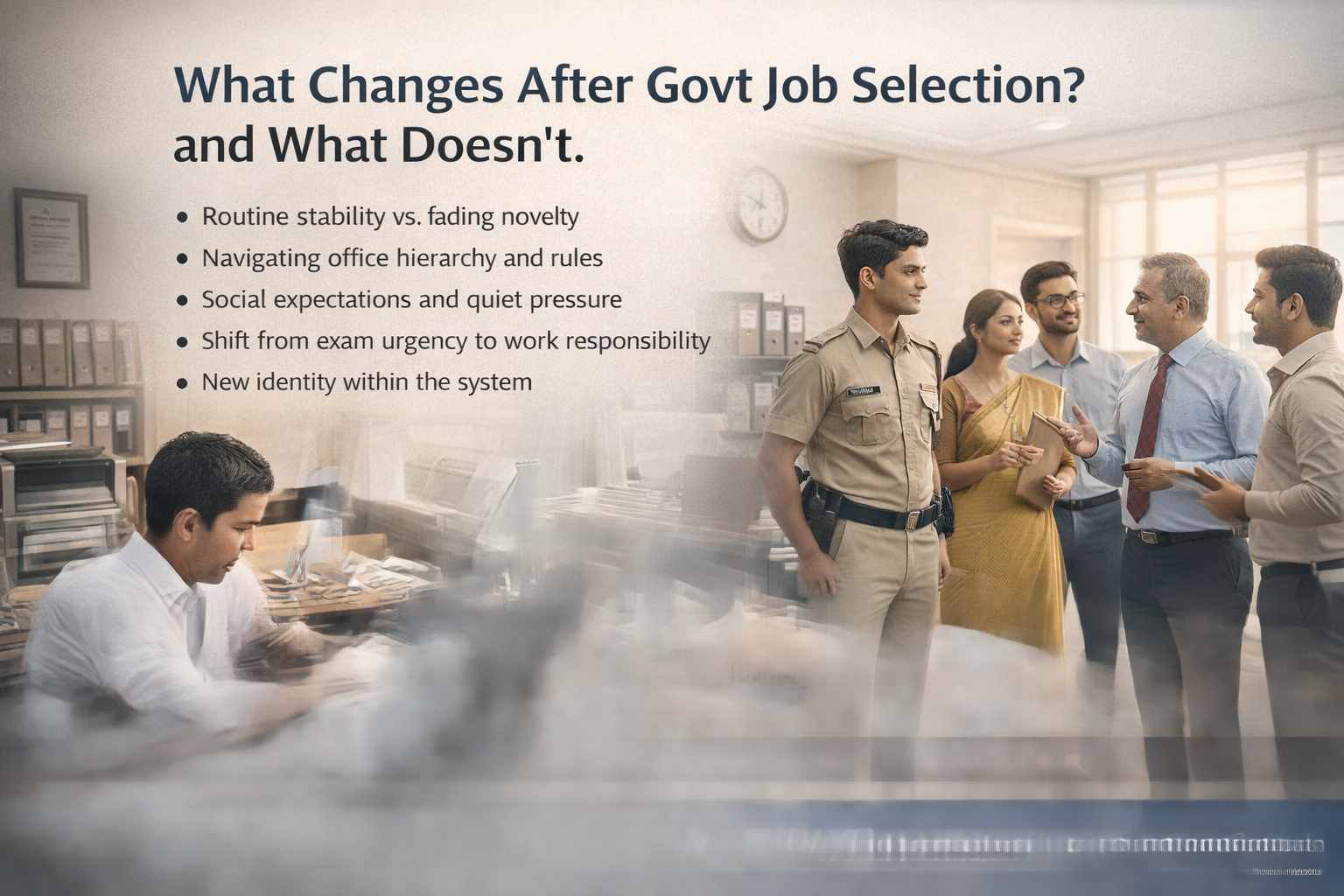
Category: After Selection

  • What Happens When the Exam Phase Finally Ends

    What Happens When the Exam Phase Finally Ends

    It is usually in the quiet of the first posting that the shift becomes real. Not on the day the result is declared. Not when relatives begin forwarding your name in family groups. It settles in later—when you unlock a government quarter that still smells of fresh paint, or when you sit at a desk that belonged to three officers before you. For years, life moved according to exam calendars and competitive exam results. Now there is no next attempt. No syllabus waiting. Just a designation on paper and a set of responsibilities that do not reduce themselves into objective questions.

    The first few weeks carry a strange dual feeling. Relief, certainly. The mind no longer calculates cut-offs or compares answer keys. But also a mild disorientation. Many newly selected officers tell me they wake up early out of habit, as if revision is pending. Then they remember—there is no exam left to clear. And that realization is not dramatic. It is flat. Work begins at a fixed hour. Files move. People address you differently. Inside, you are still adjusting to the fact that preparation mode has ended.

    The First Posting Is Less About Authority, More About Observation

    On paper, selection brings status. In reality, the first posting is a period of careful watching. You learn who actually runs the office rhythm. It is not always the highest rank in the room. Sometimes it is the senior clerk who knows which file can move today and which will wait. Sometimes it is the peon who quietly tells you the informal rule that no manual mentions.

    Probation is officially a training period. Unofficially, it is a test of temperament. You are measured less on brilliance and more on how you react to routine friction. The first year experience often feels slower than expected. Work does not always match the intensity of exam preparation. In fact, the pace can feel almost anticlimactic.

    Many imagine that once selected, decision-making becomes independent. But hierarchy in government offices is layered and procedural. Notes move upward. Approvals move downward. Accountability flows in both directions. Learning where you stand in that chain takes time.

    Life After Job Selection Is an Adjustment of Identity

    For years, your identity was “aspirant.” That word carries effort, hope, even sympathy. After selection, that label disappears overnight. You are now “sir” or “madam.” Expectations shift immediately.

    Family conversations change tone. Earlier, they revolved around preparation strategies and verified government job updates. Now they revolve around transfers, housing, and stability. Some relatives assume your life is settled permanently. They do not see the quiet learning curve you are still navigating.

    Government service is a long institutional commitment that reshapes routine, relationships, and self-perception over decades.

    That sentence sounds formal. But it reflects something practical. You are not just entering a job. You are entering a system with memory. Files have histories. Policies have context. Decisions carry precedents. You inherit more than a chair; you inherit accumulated expectations.

    Work Pressure Feels Different From Exam Pressure

    Exam pressure was sharp and measurable. Marks. Ranks. Deadlines. You could quantify progress. Work pressure is diffused. It appears as pending files, phone calls from seniors, local requests, audit queries. It is rarely dramatic. But it is constant.

    An industry cliché says government jobs are “stress free.” The reality is more layered. The stress is not about losing employment. It is about navigating procedure without error. A missed note or a poorly worded remark can stay on record. That awareness creates a different kind of caution.

    Another common belief is that once the exam phase ends, mental tension disappears. But adjustment stress is real. After years of high-intensity study, the mind suddenly enters structured routine. Some feel restless. Others feel unexpectedly calm. Both reactions are normal.

    And then there is monotony. Something aspirants rarely anticipate. Not every day carries significance. Many days are administrative, repetitive, procedural. The daily office routine does not applaud you. It simply continues.

    Hierarchy: Formal Rules and Informal Codes

    You learn quickly that official manuals describe only half the system. The rest operates through custom. Whom to call first. How to draft a note so it moves smoothly. When to push and when to wait.

    This is where new officers sometimes experience quiet disappointment. Selection was seen as the final milestone. But influence in a bureaucratic structure is gradual. Respect grows slowly. It is rarely granted automatically.

    An expert counter-point often surprises new entrants: high rank does not always equal high autonomy. In many departments, seniority brings visibility and responsibility, but also greater procedural constraint. Decisions are scrutinized more closely at higher levels.

    So you adjust. You observe before acting. You speak less in the first few months. You begin to understand the rhythm of approvals and objections.

    Social Attention Versus Inner Adjustment

    The outside world celebrates quickly. Invitations increase. Advice is requested from you, even in areas unrelated to your role. There is pride in your name being mentioned in social gatherings.

    Inside, the experience is quieter. You are still figuring out how to draft a proper note sheet. You are still understanding how transfer policy details actually operate beyond what was written in notifications.

    This contrast can feel isolating. Outwardly, stability is visible. Inwardly, adjustment is ongoing.

    Some officers describe a brief phase of emptiness after joining. Preparation had filled every hour. Now evenings are free. There is no test next month. No revision cycle. Free time can feel unfamiliar.

    But over months, rhythm forms. You begin recognizing patterns. Budget cycles. Inspection seasons. Reporting deadlines. The system reveals itself slowly.

    Promotion System and Long-Term Perspective

    In early years, promotion seems distant. Senior colleagues talk in spans of decades. That long horizon can feel both reassuring and intimidating.

    Another cliché suggests that government careers move automatically upward. The truth is subtler. Promotions are structured, yes. But they are linked to vacancy, performance records, departmental exams in some cadres, and administrative need. Career growth path exists, but it is paced by institutional timelines rather than personal urgency.

    And that pacing changes ambition. Some officers become patient. Others struggle with the slow visibility of progress. It depends on temperament.

    The salary growth pattern is steady, predictable, and structured through pay commissions and increments. It does not spike suddenly. Stability replaces acceleration.

    Transfers: The Unspoken Variable

    During preparation, postings are abstract. After selection, geography becomes personal. A transfer order can reorganize schooling, housing, even social circles.

    Young officers posted away from home often face their first long-term relocation. It is not always dramatic. Sometimes it is just a quiet evening in a rented room in a new district, realizing that stability includes movement.

    There is an understated resilience that develops through these adjustments. You learn to pack lightly. To rebuild routine quickly.

    Work Culture and Gradual Realism

    In the beginning, enthusiasm is high. You want to implement ideas. You want to improve processes. That energy is valuable. But systems move through consensus and file notings, not impulse.

    Some officers gradually discover that impact in government service is incremental. Not theatrical. A corrected procedure here. A resolved grievance there. Small improvements accumulate.

    The phrase job satisfaction reality rarely appears in official documents, but it becomes personal over time. Satisfaction often comes from stability, from seeing continuity in work, from knowing that your decisions are part of a larger administrative chain.

    There are also days of doubt. When routine feels heavy. When creativity feels limited. That tension is part of institutional life.

    What Changes Over Time

    In the first year, identity adjustment dominates. By the third or fourth year, competence grows. You draft faster. You anticipate objections. You understand how policy translates into field implementation.

    The system that once felt rigid begins to feel navigable.

    You also notice that exam preparation taught discipline and focus. But service life demands patience and negotiation. Different muscles.

    Over a decade, stability acquires meaning beyond salary or designation. It becomes about predictable structure, pension frameworks, community familiarity, and institutional belonging.

    Not everyone experiences the same arc. Some remain restless. Some find deep contentment. Most fall somewhere in between.

    And perhaps that is the quieter truth about what happens when the exam phase finally ends. The dramatic part is short. The adjustment is longer. Stability arrives, but it carries routine, hierarchy, and gradual understanding with it. Over time, you stop measuring life in attempts and start measuring it in years of service. And that shift, slow and almost unnoticeable, is where meaning either settles… or keeps searching.


  • How Aspirants Redefine Identity After Selection

    How Aspirants Redefine Identity After Selection

    How Aspirants Redefine Identity After Selection

    It does not happen on the joining day. Not even in the first month. The shift begins quietly, somewhere between signing the attendance register for the first time and realizing that no one here knows how many years you spent chasing this post. The exam rank that once defined you becomes a small line in your service file. People are polite. Some are curious. But the office does not pause to celebrate your struggle. Files move. Instructions come. The chair assigned to you has already seen others before you.

    In many conversations with newly appointed officers and staff, there is a similar undertone. Relief, yes. Pride in the family’s eyes, certainly. But also a strange thinning of identity. For years, “aspirant” was a full-time personality. Daily routine, friend circle, reading habits, even social media algorithm revolved around cut-offs, notifications, government answer key discussions, and speculation. And then suddenly, that ecosystem disappears. The phone still rings, but now it is about joining formalities or accommodation issues. The mind, used to high-stakes uncertainty, finds itself in structured predictability. That adjustment is not dramatic. It is subtle. And it takes time.

    The Silence After the Noise

    Exam life is loud in a psychological sense. Results, rumors, expectations, coaching debates. Even failure carries movement. Work life is different. The first few weeks often feel slow. Training modules. Basic orientation. Being told to observe. Some feel underutilized. Some feel overwhelmed by minor procedures that no one taught during preparation.

    There is an internal disorientation here. For years, success meant clearing the next stage. Now there is no next stage in the same way. Promotion exists, yes, but it is distant and procedural. The daily office routine replaces the adrenaline of waiting for merit lists.

    One officer once said quietly, “I thought joining would feel like a climax. It felt more like a beginning.” That statement captures the gap between imagination and administrative reality.

    Life After Selection Is the Process of Relearning Who You Are Without the Exam.

    That sentence may sound heavy, but in service life it becomes practical. Identity shifts from competitor to colleague. From candidate to government functionary. From someone proving merit to someone expected to follow process.

    First Posting: Geography Changes More Than Address

    Relocation is often the first concrete disruption. A district you never visited becomes your base. Language tone changes. Food habits shift. Rental house hunting begins before emotional adjustment even starts.

    Family expectations also realign. During preparation, relatives asked about attempts and cut-offs. After selection, they ask about influence, power, transfer possibilities. The assumption that stability equals authority begins to surface. But inside the office, hierarchy is clear. Seniority outweighs enthusiasm.

    There is an industry cliché that “once you enter government service, life is settled.” Settled financially, perhaps gradually. Settled emotionally? Not immediately. Adjustment to local office culture, unspoken norms, and regional administrative habits takes observation. No manual explains who actually moves files faster or which senior values initiative versus silent compliance.

    And then there is the probation period. Many imagine it as a formality. In reality, it is a long evaluation in disguise. Not just of technical performance but of temperament. How you respond to correction. How you handle public interaction. Whether you escalate unnecessarily. These things are watched, sometimes without your awareness.

    Hierarchy: The Unwritten Curriculum

    Preparation life rewards individual effort. Office life rewards alignment. You may be academically sharper than your immediate superior. It does not matter. Authority flows from position, not percentile.

    Some new appointees struggle here. Not out of arrogance, but habit. Years of independent study cultivate self-direction. Service demands coordination. File movement requires endorsement. Even good ideas must travel through layers.

    There is another popular belief: “Government offices do not change.” The reality is more layered. Change happens, but slowly, often tied to administrative cycles, audits, and transfer seasons. A newcomer’s impatience sometimes meets institutional inertia.

    This is where identity recalibrates again. You are no longer competing with thousands. You are navigating within dozens. Relationships matter. Observation matters. Timing matters.

    Work Pressure Is Different, Not Lesser

    Aspirants often imagine that once selected, stress drops permanently. It changes shape. Exam stress is speculative. Service stress is accountable.

    A delayed report affects a scheme. A missed deadline triggers explanation. A procedural error may return months later during audit scrutiny. The weight of signature feels different from the weight of OMR sheets.

    In the first year experience, many speak about the shock of responsibility. Not glamorous responsibility. Routine responsibility. Certifying documents. Addressing grievances. Attending review meetings where data accuracy matters more than eloquence.

    Some discover satisfaction in this. Tangible outcomes. Others feel mechanical. The excitement of cracking engineering govt job openings fades into the repetition of registers and circulars. Both reactions are normal.

    Social Attention Versus Personal Adjustment

    Selection changes how society sees you faster than it changes how you see yourself.

    Suddenly you are consulted for advice on career analysis before govt job prep. Younger cousins assume you have mastered life strategy. Neighbors introduce you by designation. But internally, you might still feel like someone figuring out attendance software or drafting formats.

    There is an awkward gap here. Public respect increases. Private confusion persists. And because the achievement is visible, expressing adjustment difficulty feels almost ungrateful. So many remain silent about that phase.

    During festival visits home, conversations shift. Earlier, relatives asked about परीक्षा परिणाम समाचार. Now they ask about transfer policy details or perceived benefits. The exam narrative ends abruptly in public memory. Your service narrative begins, whether you are ready or not.

    Routine: The Slow Architect of Identity

    After a year or two, something else happens. Routine begins shaping personality more than aspiration once did.

    Office hours regulate sleep. Weekly reviews structure thinking. Budget cycles influence mood. You begin to measure time not by attempt numbers but by financial year.

    Some find comfort in this rhythm. Predictability reduces mental volatility. Long term career stability reality becomes visible through incremental increments, seniority lists, and structured leave rules.

    But routine also tests meaning. When days look similar, motivation cannot rely on urgency. It must come from either professionalism or personal discipline. And not everyone anticipates this shift.

    There is another cliché often repeated: “Government job means no pressure.” Those who say this usually observe from outside. Inside, pressure exists, only less dramatic and more continuous. It sits quietly in compliance requirements and public accountability.

    Redefining Ambition

    Ambition does not disappear after selection. It changes direction.

    For some, it becomes promotion oriented. For others, transfer to preferred location. For a few, it turns inward—mastering domain knowledge, understanding policy intent, or improving local implementation efficiency.

    The competitive fire that once targeted cut-offs now recalibrates toward annual confidential reports and departmental exams. Some feel energized by this new structure. Others feel that the absence of open competition reduces urgency.

    Career growth after government job is rarely explosive. It is procedural. Incremental. Seniority-driven with occasional performance recognition layered within. Accepting this pace is part of identity adjustment.

    The Emotional Undercurrent

    There are quieter moments rarely discussed publicly.

    Sitting alone in government accommodation in a new town. Realizing that the intense preparation phase, though stressful, had camaraderie. Group studies, library acquaintances, shared anxiety.

    Service life can feel solitary at first. Colleagues are cordial but cautious. Trust builds slowly. Professional boundaries remain.

    Some experience a mild anticlimax. After years of defining life around selection, the achievement itself becomes a past event surprisingly fast. The badge remains. The thrill fades.

    This does not mean dissatisfaction. It means normalization.

    Job satisfaction reality in public service is rarely a constant high. It oscillates. A resolved grievance may bring quiet fulfillment. A bureaucratic delay may bring fatigue. Over time, these fluctuations stabilize into perspective.

    Long-Term Impact on Self-Perception

    After several years, when you look back, the transformation is clearer.

    You speak more cautiously. You think in terms of procedure. You measure statements before signing. The aspirant’s urgency softens into administrative patience.

    Stability begins to mean something practical. Not excitement. Not applause. Just continuity. Salary growth pattern becomes predictable enough to plan family decisions. Transfer seasons become anticipated rather than feared.

    And somewhere along the way, identity becomes less about proving merit and more about sustaining responsibility.

    The exam once tested knowledge. Service tests consistency.

    That distinction, subtle at first, gradually defines the professional self. Stability is not a destination reached on appointment day. It is a condition you grow into, sometimes reluctantly, sometimes gratefully. And meaning, if it arrives, usually comes not from the moment of selection, but from how quietly you learn to inhabit the role over time.

  • How Aspirants Redefine Identity After Selection

    How Aspirants Redefine Identity After Selection

    It usually begins quietly. Not on the day of joining, not even during the training period experience guide sessions where procedures are explained and files are demonstrated, but sometime after the congratulatory calls slow down. The first week carries a ceremonial feeling. New identity card. New designation. Parents repeating the title in conversations with relatives. But a few weeks later, when the desk becomes familiar and the routine stops feeling temporary, something shifts internally. The person who once introduced themselves as “preparing for exams” now pauses before saying who they are.

    In many cases, that pause is not confusion. It is adjustment. Years of preparation build a certain self-image—disciplined, aspirational, slightly restless. Selection brings stability, but it also removes the tension that structured daily life. The pressure of mock tests and result anticipation gets replaced by office timings and reporting hierarchy. And that change is not loud. It is gradual. Almost subtle enough to ignore.

    The Moment the Preparation Identity Ends

    For a long time, life revolved around the next notification, the next attempt, the next merit list. Aspirants measured months through exam calendars. After selection, that calendar disappears. There is no next big exam waiting to validate effort. The urgency fades.

    Some feel relief first. Deep, physical relief. Waking up without the weight of unfinished syllabus. But relief is followed by a strange emptiness. Because preparation was not just activity—it was identity. Conversations revolved around cut-offs and answer keys. Even family members introduced them as “the one preparing for government exams.” Suddenly, that storyline ends.

    And the new story has not yet formed.

    Life after government job selection is not just about employment; it is the slow reconstruction of personal identity inside an institutional structure.

    That reconstruction takes time.

    First Posting: Geography Changes, So Does Perspective

    The first posting often arrives with mixed emotion. Pride on one side. Practical concerns on the other. Relocation to a district that was once just a name on an exam paper. Rental house searches. Understanding local transport. Learning who handles what inside the office.

    The first year experience rarely matches the imagined version. The building might be older than expected. Resources limited. Work processes slower. Files move physically, not digitally. And suddenly, theory gives way to procedure.

    Some officers discover that the glamour attached to selection had little to do with actual daily office routine. A significant portion of time goes into documentation, compliance, record maintenance. It feels repetitive at first.

    But repetition teaches institutional rhythm.

    Hierarchy Is Not a Chapter in the Rulebook

    During preparation, hierarchy is abstract. After joining, it becomes personal. Reporting officers have preferences. Senior staff carry unwritten authority. Peons understand file movement patterns better than new recruits.

    There is an informal order beneath the official structure. Learning it is part of probation period adjustment. No one explains it directly. You observe. You notice who speaks in meetings and who stays silent. You understand which matters require escalation and which do not.

    An industry cliché says government service is relaxed and pressure-free. But internal dynamics can be intense in their own quiet way. Not loud targets. Not aggressive deadlines. Instead, a constant expectation to align with administrative culture.

    And that alignment reshapes personality.

    Social Attention vs Inner Adjustment

    The outside world sees achievement. Neighbors begin conversations differently. Distant relatives reconnect. Marriage proposals increase. Invitations multiply. Stability carries social currency.

    Inside, the selected candidate may still be adjusting. The confidence expected from them does not always match their internal state. They are learning systems, navigating expectations, trying not to make procedural errors.

    Another common belief is that job satisfaction reality automatically improves after selection. That financial stability guarantees emotional stability. Experience suggests something more layered. Satisfaction depends less on designation and more on how comfortably one fits within the department’s culture.

    Some adapt quickly. Others take longer. Both are normal.

    Work Pressure vs Exam Pressure

    Exam pressure was future-oriented. A constant question: What if I fail? Work pressure is present-oriented. A different question: Did I handle this correctly?

    The stress level in government job rarely resembles the anxiety of result day. It is slower, steadier. Deadlines tied to administrative cycles. Audits. Inspections. Reporting requirements.

    And the mind must reorient.

    During preparation, effort directly influenced outcome. Study more, score better. In service, outcomes are often collective. Dependent on multiple departments. Policy constraints. Budget allocations. Personal effort matters, but within limits.

    That limitation can feel unsettling at first.

    When Routine Becomes Identity

    There is a point, usually after several months, when the office routine stops feeling temporary. Morning commute becomes automatic. Colleagues’ habits become predictable. The nervousness of initial meetings fades.

    Identity slowly shifts from aspirant to officer, clerk, teacher, inspector—whatever the role may be.

    For those who once tracked teaching government job openings daily, the transition into the staff room or administrative office brings its own quiet irony. They now sit on the other side of the notification cycle.

    Routine does not always feel dramatic. It can feel ordinary. But ordinariness has weight. It anchors life.

    Expert Counter-Point: Stability Does Not Eliminate Ambition

    A widely accepted assumption suggests that once selected, ambition reduces. That security softens drive. Observations show otherwise. Ambition changes shape.

    Instead of chasing exams, individuals begin considering departmental exams, internal transfers, or specialized assignments. The career growth path is structured but not static. Yet growth moves at institutional speed, not personal impatience.

    And that adjustment to pace is significant.

    Expert Counter-Point: Promotion Is Not Always Immediate Validation

    The promotion system in government service is procedural. Based on seniority, departmental rules, vacancy positions. It rarely reflects sudden leaps.

    New recruits often expect visible progression within a short span. But administrative systems operate differently. Patience is not optional; it is embedded.

    Some struggle with this early realization. Others find comfort in predictability.

    Family Expectations Change Quietly

    Before selection, families focused on results. After selection, expectations shift toward performance and responsibility. Financial planning begins. Home renovation discussions appear. Siblings’ education may depend on this stable income.

    Salary growth pattern becomes part of household planning. Even if increments are modest, their predictability offers reassurance.

    But predictability also brings accountability.

    There are moments when newly selected employees visit the official recruitment result portal not to check their own status, but out of habit. A reflex from earlier years. Then they close the page, slightly amused.

    Because that chapter is over.

    Transfers and the Idea of Permanence

    The transfer policy details vary across departments, but movement is part of service life. The first transfer can feel disruptive. Just when one becomes comfortable, relocation emerges again.

    Stability, then, is not geographical. It is structural.

    Understanding this early prevents disappointment. Service is tied to institution, not location.

    Government Job vs Private Job Experience

    Conversations comparing sectors surface frequently. Some colleagues previously worked in private firms. They describe faster appraisal cycles, sharper competition. Government job vs private job experience comparisons often miss nuance.

    Government service emphasizes continuity and compliance. Private roles may emphasize rapid output and flexibility. Neither is universally superior. They serve different functions within the economy.

    The key difference lies in tempo.

    Tempo shapes temperament.

    Expert Counter-Point: Work-Life Balance Is Not Automatic

    There is an assumption that work life balance in job is guaranteed in government service. Reality varies. Certain departments experience heavy field duties, election assignments, emergency responses.

    Balance depends on posting, department, and individual boundary-setting. Some maintain healthy routines. Others find themselves absorbed by responsibility.

    It is contextual, not guaranteed.

    The Long View of Stability

    Long term career stability reality unfolds slowly. It becomes visible after observing seniors who have completed decades of service. Their lives reflect both security and compromise. They speak less about initial excitement and more about endurance.

    Stability reduces existential uncertainty. It does not eliminate internal questioning. Some wonder if they might have pursued different paths. Others feel deep contentment in structured service.

    Most experience a mixture.

    Identity, Rewritten in Layers

    Redefining identity after selection is not dramatic. It is layered. Aspirant identity fades. Professional identity grows. Personal identity negotiates between them.

    Over time, designation becomes less about pride and more about responsibility. The initial thrill stabilizes into routine acknowledgment.

    Some evenings, after returning from office, there is quiet reflection. The journey from exam hall to office chamber feels distant. The urgency of preparation replaced by the steadiness of service.

    And in that steadiness, identity continues to evolve—not loudly, not publicly, but through small daily adjustments that accumulate into a life shaped by structure, routine, and a form of stability that means different things at different stages.

  • Why Some Selected Candidates Feel Relief, Not Joy

    Why Some Selected Candidates Feel Relief, Not Joy

    It is something I began noticing in quiet conversations, not on social media. The day the result comes, there is noise, calls, sweets, photographs. But a week later, when the formalities begin and the dust settles, the tone shifts. Not sadness exactly. Not regret. Just a strange steadiness. Many selected candidates describe the moment not as happiness bursting outward, but as pressure leaving the body. A long exhale. For some, that exhale feels heavier than celebration.

    Years of preparation condition the mind to chase a list. Roll number. Cut‑off. Merit rank. Once the name appears, the chase stops abruptly. The mind, trained to run, suddenly has nowhere to go. Family members expect visible joy. Neighbours expect pride. And inside, there is mostly relief. The anxiety of uncertainty is gone. But uncertainty itself has not disappeared; it has only changed shape. It is now about posting location, department culture, reporting date, accommodation. The emotional texture is different from what people imagined during preparation years.

    The Silence After the Result

    During exam years, life has a rhythm. Study schedules, mock tests, result speculation, comparison with peers. Even failure has structure. After selection, that structure collapses overnight. I have seen candidates who studied twelve hours a day struggle with idle afternoons during document verification periods. The mind keeps waiting for the next target. But there is no exam form to fill now.

    This is where relief becomes dominant. The body relaxes. Sleep improves. Appetite normalizes. And yet, the absence of urgency creates an unfamiliar emptiness. It feels odd to wake up without a syllabus pressing on your chest.

    First Posting and the Shock of Geography

    The appointment letter often carries a district name that the candidate has never visited. Celebration pauses for logistics. Rental rooms. Mess facilities. Language differences. Distance from home.

    The first day in office rarely resembles imagination. Files are stacked. Senior clerks move with unspoken authority. Peons know the corridors better than new officers. The seating arrangement silently explains hierarchy. A newly selected employee quickly learns that designation on paper and influence in practice are not identical.

    Transfers are discussed casually in corridors, as if mobility is a weather condition. In many departments, transfer policy details are less about printed guidelines and more about administrative discretion. Stability exists, but it is procedural, not emotional.

    Hierarchy Is Learned, Not Announced

    No one formally teaches the informal rules. You observe. Who speaks freely in meetings. Who waits. Whose file moves faster. Whose recommendation matters.

    In competitive exams, merit list ranking feels absolute. In offices, seniority often outweighs entrance rank. This shift unsettles some candidates who built identity around exam performance.

    An Expert Counter‑Point appears here. The industry cliché says government jobs are slow and relaxed. But inside the office, pace depends on section workload and supervisory style. Some desks drown in files before lunch. Others wait for approvals that take weeks. The rhythm is uneven, not uniformly slow.

    Probation Is Not Just a Formality

    On paper, probation period is a time for assessment. In practice, it is a period of silent observation. Seniors watch how you draft notes, how you respond to public queries, whether you respect procedural channels.

    Mistakes are not catastrophic, but they are remembered. New recruits often feel cautious, even restrained. The authority they imagined during preparation feels distant. Responsibility is real, but autonomy grows slowly.

    I have heard many say their first year experience felt less about power and more about adjustment. Learning formats. File language. Acronyms. Internal software systems. The work is rarely intellectually dramatic. It is procedural. Repetitive at times. And that repetition can be grounding or dull, depending on expectation.

    Relief Comes From Ending Uncertainty, Not From Beginning Work

    Government job selection means institutional stability, not emotional transformation.

    This distinction matters. Stability removes financial anxiety for many families. It does not automatically create enthusiasm for daily tasks. Relief is tied to security. Joy is tied to meaning. And meaning in government service often emerges gradually, sometimes years later.

    Another Expert Counter‑Point surfaces here. The common belief says once selected, stress disappears. But stress level in government job simply shifts from performance anxiety to accountability anxiety. Instead of fearing a low score, you worry about file accuracy, audit remarks, public complaints, or supervisory displeasure.

    The nature of pressure changes. It does not vanish.

    Daily Office Routine and the Weight of Repetition

    Morning attendance. File movement. Drafting replies. Lunch at fixed hour. Tea breaks that double as informal policy discussions. Evenings marked by pending lists.

    After years of unpredictable exam life, routine feels comforting. Then monotonous. Then neutral.

    Some newly selected employees initially overperform, staying late, volunteering for extra sections. Over time, they observe experienced staff pacing themselves carefully. Energy conservation becomes an unspoken survival skill.

    And somewhere between these adjustments, candidates begin understanding job reality in ways that no coaching institute ever described.

    Family Expectations and Social Identity

    Selection changes how relatives speak to you. Invitations increase. Advice decreases. Parents feel visible pride. For some families, especially in small towns, the government designation becomes a social shield.

    But this external elevation can create internal pressure. You are now expected to behave with maturity beyond your years. Financial support may be assumed. Decision‑making authority in family matters shifts toward you.

    I have seen candidates who felt lighter personally but heavier socially. Responsibility extends beyond office hours.

    Career Growth Path Is Slower Than Imagination

    During preparation years, growth feels like a staircase: prelims, mains, interview, final list. After joining, increments and promotions follow administrative timelines. Annual increments are predictable. Promotions depend on vacancies, seniority, departmental exams.

    There is stability in this predictability. But there is also patience required. Ambitious recruits sometimes experience mild disillusionment when they realize upward movement spans decades, not months.

    Another widely accepted belief says government service guarantees satisfaction because of security. The non‑obvious reality is that job satisfaction reality depends heavily on posting type, immediate supervisor, and personal temperament. Two employees in the same cadre can experience the service very differently.

    Work Culture Is Localized

    Every department has a national framework. Yet each office functions with its own micro‑culture. One district office may encourage initiative. Another may resist deviation from precedent.

    New recruits learn to read rooms. When to suggest improvements. When to wait. When to document everything in writing. This cultural reading skill develops slowly and often through minor mistakes.

    Training period experience guide documents explain procedures. They cannot fully explain atmosphere. Atmosphere is sensed.

    Relief Without Celebration

    In private conversations, many selected candidates admit they did not feel explosive joy. They felt safe. Secure. Done with uncertainty. And sometimes simply tired.

    Years of competitive tension drain emotional reserves. So when success finally arrives, the emotional reaction is muted. Relief feels more authentic than celebration.

    There is no problem in that. Relief is honest.

    Long Term Career Stability Reality

    As months turn into years, the intensity of first posting fades. Routine stabilizes identity. Transfers may occur. Responsibilities increase gradually. The initial comparison with private sector friends reduces.

    Some discover deep meaning in public interaction. Others find comfort in predictable schedules. A few struggle with monotony but stay for security.

    Life after job selection is rarely dramatic. It is incremental. Stability accumulates quietly. Adjustments happen invisibly. And the sense of relief that marked the beginning slowly blends into something steadier.

    Not happiness in the cinematic sense. Not disappointment either.

    Just a life that moves within institutional boundaries, asking for patience more than passion, and offering security more than excitement.

    Over time, that exchange begins to feel normal. And sometimes, in small unnoticed moments, even enough.

  • The Emotional Shift After Years of Preparation End

    The Emotional Shift After Years of Preparation End

    Some of them say it quietly, almost as if admitting something disloyal — that the day after joining did not feel like the victory they had imagined for years. The exam phase had been loud, intense, consuming. Every morning carried urgency. Every evening carried calculation. And then, suddenly, there was a joining letter, a reporting date, a desk. Silence replaced anticipation.

    For many who enter service after years of preparation, the emotional adjustment is less dramatic than expected but more complex than anticipated. The phone calls from relatives come in waves during the first week. Photos are shared. Sweets are distributed. But inside, there is a slow, private recalibration happening. The mind that lived in constant exam-mode does not switch off simply because the result has been declared. It takes time for the body and identity to understand that the competition phase has ended and a different kind of life has begun.

    After selection into a government job means transitioning from a goal-driven identity to a role-bound identity within a structured system.

    That sentence may sound formal, but its reality is felt in small, everyday moments. On the first day of reporting, the new recruit often stands slightly uncertain in the corridor, file in hand, unsure which room to enter. There is no syllabus now. No clear marking scheme. Instead, there are people — seniors with established habits, clerks who understand procedural shortcuts, peons who know the unspoken chain of command.

    The first posting, especially if it involves relocation, carries its own quiet shock. After years spent studying in one city, sometimes in one rented room, the sudden move to a district office in another state feels abrupt. Finding accommodation becomes the first task. Understanding local language patterns becomes the second. The job begins even before official duties start.

    Some had imagined authority. The reality is probation.

    During the probation period, observation is constant though rarely acknowledged openly. Files are checked twice. Tone is monitored. Initiative is noted but not always encouraged. And the probationer begins to understand that competence in exams does not automatically translate into ease in administration. The skill set shifts — from memorising facts to interpreting circulars, from solving objective questions to navigating layered approvals.

    There is a common belief that government service offers immediate peace after selection. That is one of those industry clichés repeated casually. Stability, yes. Immediate clarity, not necessarily.

    An expert counter-point often overlooked: exam stress is acute and visible; service stress is diffused and procedural. During preparation, anxiety has a clear source — results, cut-offs, rankings. In service, pressure is subtler. Deadlines tied to audits. Public grievances waiting for resolution. A senior officer’s expectation communicated indirectly. The stress does not spike dramatically. It lingers.

    The daily office routine also surprises many. The rhythm is slower than private sector environments but heavier in documentation. Mornings begin with dak distribution. Files move from table to table. Some days are repetitive. Very repetitive. And this repetition, after years of high-adrenaline preparation, can feel under-stimulating.

    This is where the emotional shift becomes visible.

    During exam years, self-worth was linked to progress — how many mock tests cleared, how many topics mastered. In service, progress is less measurable. Promotions depend on vacancy cycles and departmental exams. Recognition is tied to seniority as much as performance. The promotion system functions on structure, not speed.

    Another expert counter-point worth acknowledging: people often say government jobs guarantee job satisfaction. But job satisfaction reality depends less on designation and more on alignment between temperament and routine. A candidate who thrived in intense study environments may initially feel disoriented by administrative pacing. It is not dissatisfaction exactly. It is unfamiliarity.

    Family dynamics shift too. Before selection, relatives asked about preparation strategy. After joining, they ask about transfers, perks, and influence. The expectations expand outward. Some officers quietly admit feeling pressure to justify the status others now assign to them.

    And then there is the hierarchy.

    Hierarchy in government offices is formal on paper and informal in practice. Official designations define authority, but senior clerical staff often carry institutional memory that no rulebook can replicate. Learning whom to consult, when to escalate, when to wait — this is part of the training period experience guide no manual provides. The real experience of first year job is rarely about policy implementation alone; it is about decoding culture.

    Lunch breaks become observation labs. Who speaks freely. Who remains silent. Who signs quickly. Who delays. These details matter. They shape daily functioning.

    There is also relief. That part should not be understated.

    The absence of exam uncertainty creates space in the mind. Even if routine feels heavy, the background noise of “what if I fail” is gone. For some, sleep improves for the first time in years. For others, the sudden drop in competitive intensity creates a void that takes months to understand.

    Social perception adds another layer. In many communities, government employment carries symbolic weight. Invitations increase. Opinions are sought more frequently. The individual becomes, subtly, a representative of the state. This shift can feel empowering one week and burdensome the next.

    A third expert counter-point: the idea that government job vs private job experience is defined only by work hours misses the emotional component. Private roles may demand longer hours but allow quicker decision-making. Government roles may offer defined timing but require patience within layered approval structures. Adjustment depends on personality more than sector.

    Transfers introduce further complexity. Even when not immediate, the awareness of future relocation shapes long-term planning. Renting instead of buying. Avoiding deep social roots in the first posting. Planning children’s schooling cautiously. Stability exists, but it is institutional stability, not always geographical stability.

    Salary growth pattern is steady, predictable, incremental. It rarely surprises positively. But it also rarely collapses unexpectedly. For some, this predictability is comforting. For others, it feels limiting when compared to stories of rapid private-sector raises.

    The first appraisal cycle often passes quietly. There is no dramatic evaluation meeting. No bonus announcement ceremony. Files are reviewed. Remarks are recorded. And life continues. The absence of dramatic feedback can create a strange emotional neutrality — neither high praise nor harsh criticism, just continuation.

    Over time, identity reorganises.

    The candidate who once introduced themselves by exam attempt number begins introducing themselves by designation. The study table is replaced by an office desk. Notes are replaced by notings. And gradually, without ceremony, the internal narrative changes.

    But the adjustment is not linear. Some months feel settled. Others reopen doubts. A difficult public complaint. A stalled file. A disagreement with a superior. These moments test the emotional expectations built during preparation years.

    Long term career stability reality becomes clearer only after observing seniors. Watching someone twenty years ahead in service offers perspective — not just on promotions but on posture, tone, fatigue, resilience. Service is less about dramatic peaks and more about endurance.

    Work life balance in job exists structurally through fixed timings, yet mentally the responsibility can follow home. A pending issue stays in thought. A surprise inspection call interrupts dinner. Boundaries are defined on paper, but blurred in practice.

    And then there are small satisfactions that were never part of the exam imagination. Resolving a pension issue for an elderly applicant. Completing a long-delayed file. Receiving a quiet thank you from someone who rarely expresses it. These moments are not loud. But they accumulate.

    The emotional shift after years of preparation end is not about losing excitement. It is about replacing uncertainty with responsibility. Responsibility is heavier. But steadier.

    Some officers take a year to feel settled. Some take longer. There is no fixed timeline. Adjustment depends on posting, mentorship, personal expectations, even health. It is uneven.

    What remains constant is structure. The system moves at its own pace. Individuals adapt within it.

    And somewhere between the first posting and the third annual increment, a different kind of confidence forms. Not the sharp, competitive confidence of exam halls. A quieter one. Built from routine. From repetition. From understanding limits and working within them.

    Stability, over time, feels less like celebration and more like rhythm. And rhythm, once accepted, becomes its own form of meaning — not dramatic, not glamorous, but steady enough to live with.

  • How New Officers Learn the System Gradually

    How New Officers Learn the System Gradually

    Sometimes the first week in office passes in a strange silence. Not because there is no work, but because no one expects you to understand anything yet. Files move across your table and you sign where someone gently places a pencil mark. People call you “sir” or “madam” with a tone that carries both respect and evaluation. You realize quickly that clearing the examination was a public event. Learning the system is a private one.

    In many conversations with newly selected officers, the early months sound less like triumph and more like quiet observation. The building has its own rhythm. The clerks know which file will come back from headquarters and which one will sleep for weeks. The peon knows which visitor must not be kept waiting. And the officer, freshly appointed, sits at the center but understands the least. It is an unusual inversion of expectation. Selection brings authority on paper. Experience distributes authority in practice.

    Authority in government service is the formal power to decide within rules, not the informal power to influence without resistance.

    That difference does not appear in appointment letters. It appears on the first day someone disagrees with your noting. Or when a senior officer rewrites your carefully drafted order in three lines. The system begins to reveal itself slowly, almost reluctantly.

    The First Posting and the Shock of Geography

    The posting order often sends officers away from familiar cities. A district town. A subdivision office. Sometimes a training academy first, then a field attachment. The move itself is a lesson. Accommodation may not be ready. Government quarters need repairs. The market closes earlier than expected. And the new officer learns that administrative responsibility extends beyond office hours because the phone does not recognize weekends.

    Families also adjust. Parents who proudly told relatives about the selection now worry about distance. Spouses assess schooling options. There is pride, yes. But also logistical strain. Life after job selection quietly reorganizes itself around duty rosters and transfer possibilities.

    Learning the Hierarchy Without Being Taught

    No one formally explains the unwritten hierarchy. The service rules define rank. The office culture defines influence.

    A newly appointed officer might assume that designation alone ensures compliance. But then a senior assistant with twenty years of service casually suggests, “Sir, this is not how it is usually done.” That sentence carries institutional memory. Ignoring it can create friction. Accepting it blindly can prevent reform.

    There is a balance to be found. And that balance takes time.

    Industry cliché says government offices resist change entirely. The more nuanced reality is that they resist sudden change without procedural backing. When new officers try to introduce efficiency in the first month, they often meet procedural reminders, not personal opposition. Files require references. Approvals need precedents. The system protects itself through documentation.

    Probation Period: More Observation Than Authority

    During probation, evaluation is subtle. Seniors watch how you draft. How you respond to pressure. Whether you escalate minor issues unnecessarily. The probation period rarely feels dramatic, but it is psychologically heavy. You are officially part of the system, yet not fully trusted.

    The first year experience often includes small embarrassments. A file returned for incorrect rule citation. A meeting where you realize everyone else knows the background of a scheme launched ten years ago. These moments accumulate. They shape caution.

    But there is also quiet relief. Exam pressure disappears. No more syllabus. No more rank lists. The stress level in government job is different — less about uncertainty of future, more about responsibility of present decisions.

    Routine Replaces Preparation

    For years, aspirants live in a structured preparation cycle. Timetables. Mock tests. Deadlines defined by examination bodies. After joining service, structure comes from office routine instead.

    • Dak received in the morning. • Review meetings before lunch. • Field visits twice a week. • Reporting to higher authority by evening.

    It sounds predictable. It rarely is. An unexpected inspection. A political delegation visit. A grievance that escalates to media attention. Routine bends without warning.

    Another cliché says government jobs guarantee work life balance. In some departments, yes. In others, especially field postings, officers carry files home. Transfers disrupt stability. Emergencies ignore calendars. Work life balance in job depends less on the label “government” and more on department culture and district conditions.

    Understanding the Promotion System Slowly

    New officers often enter service imagining a clear upward path. Years of service, departmental exams, seniority lists. On paper, the promotion system looks linear.

    In practice, promotions depend on vacancy position, vigilance clearance, annual confidential reports, and sometimes state-level policy shifts. Growth exists, but it is paced. Slower than private sector accelerations. More secure than market-dependent roles.

    Some officers feel impatience in the third or fourth year. The excitement of joining fades. The reality of incremental salary growth pattern becomes visible. But over time, stability begins to outweigh speed in personal calculations.

    The Silent Shift in Social Perception

    Selection changes how society interacts with you. Invitations increase. Relatives seek guidance. Neighbors mention your designation with visible pride. Yet inside the office, you are still learning basic file tracking systems.

    This duality creates an internal split. Public image suggests competence. Daily work demands humility. Managing that tension is part of the adjustment.

    There is a line I often hear from officers in their early service years: government job vs private job experience feels less about income difference and more about the pace at which identity evolves. In private roles, performance metrics shift identity quickly. In government roles, identity settles gradually through tenure.

    Transfers and the Slow Education of Adaptability

    Transfer policy details are discussed frequently in corridors. Official rules exist. Administrative exigencies override them when necessary. A transfer can arrive just as you begin to understand local dynamics.

    The first transfer is usually unsettling. The second is less dramatic. By the third, officers often begin packing mentally even before formal orders arrive.

    With each posting, learning restarts. New staff. New district issues. New political context. The system reveals different faces in different regions. That gradual exposure builds administrative maturity, but it also tests personal roots.

    Moments of Quiet Disappointment

    Not every day carries a sense of purpose. Some weeks are consumed by repetitive compliance reporting. Audit queries from previous years. Clarifications on minor procedural deviations. It can feel mechanical.

    There are days when new officers wonder if their role is merely to forward files upward and downward. That doubt is common. It does not mean the service lacks meaning. It means impact is often indirect.

    The idea that selection automatically ensures job satisfaction reality is misleading. Satisfaction in government service emerges slowly, often from cumulative small decisions rather than dramatic interventions.

    Learning to Read Between the Lines

    File noting is an art. Senior officers read what is written. Experienced officers read what is implied. A seemingly simple proposal might carry budget implications. A routine sanction could set precedent for future claims.

    Gradually, new officers begin to anticipate consequences before signing. They consult rule books less frequently because patterns become internalized. This is where true system learning begins — not when you memorize procedures, but when you foresee administrative ripple effects.

    Another popular assumption is that government jobs offer long term career stability reality without emotional fluctuation. Stability of employment does not eliminate internal questioning. Officers still measure their growth. They still compare batches. They still wonder about alternate career paths occasionally.

    But over years, the rhythm of service reshapes expectations. Promotions come when due. Transfers become chapters rather than disruptions. The anxiety of proving oneself reduces.

    From Authority to Responsibility

    In the early phase, designation feels heavy. Later, responsibility feels heavier.

    You begin to see how decisions affect pension approvals, scholarship releases, land disputes, or disciplinary proceedings. The file is no longer paper. It represents someone’s pending relief or grievance. That realization deepens seriousness.

    And slowly, very slowly, the new officer stops feeling new.

    Not because the system has become simple. It has not. But because its patterns are familiar. The hierarchy no longer intimidates. The routine no longer confuses. The public expectation no longer overwhelms.

    There remains a steady awareness that government service is a long journey, measured less in dramatic milestones and more in consistent navigation of rules, people, and changing postings.

    Stability arrives first on paper. Meaning arrives later, unevenly, sometimes unexpectedly, often through small administrative acts that no headline records. And adjustment, more than achievement, becomes the quiet measure of belonging.

  • Understanding Work Pace and Structure in Government Offices

    Understanding Work Pace and Structure in Government Offices

    Somewhere between the congratulatory calls and the first day at the office, the tempo shifts. Not dramatically. Just enough to feel unfamiliar. For years, life moved according to exam notifications, syllabus cycles, mock test calendars. Then suddenly, the clock belongs to the office. Files move slower than results once did. Decisions pass through layers. And the urgency that once lived inside you now competes with institutional rhythm.

    I have watched many new appointees walk into their first posting with a strange mixture of relief and restlessness. Relief because the uncertainty of selection is over. Restlessness because the structure they enter does not respond to individual speed. The building looks stable. The desks are arranged with quiet permanence. Peons know where everything is. Clerks understand unwritten shortcuts. And the new officer stands there, holding an appointment letter, trying to understand how fast—or how slow—work is actually meant to move.

    Work Pace Is Institutional, Not Personal

    The first real adjustment is to pace. In competitive exams, speed is rewarded. In offices, speed without process is suspicion. A file does not move because you are enthusiastic. It moves because each required signature has been placed, each noting recorded, each rule cited. New entrants often try to clear files quickly during the first few weeks. It feels productive. But soon they realise that work is less about clearing and more about aligning.

    Government office work pace is the collective rhythm created by procedure, hierarchy, and accountability. That rhythm existed before you joined and will continue long after transfers reshuffle the room.

    There is a silence in most sections that outsiders mistake for inactivity. It is not inactivity. It is waiting. Waiting for approvals, waiting for clarifications, waiting for the right moment to push a file upward. Once you observe closely, you begin to see patterns. Mondays are heavy with review meetings. Month-end has its own administrative urgency. Financial year closing changes the atmosphere completely.

    And the new officer slowly understands that productivity here cannot be measured by how tired you feel at the end of the day.

    First Posting: Between Authority and Observation

    The first posting is less about exercising authority and more about decoding structure. You may hold a designation that commands respect outside. Inside the office, respect follows familiarity. Senior assistants often know more about procedural intricacies than the officer signing the papers. This is not hierarchy reversal. It is functional memory.

    Many new entrants experience what I quietly call first posting shock. They expected structured guidance. Instead, they encounter a mix of formal rules and informal adjustments. Some colleagues are helpful. Some are distant. Some are testing the new appointee’s temperament.

    An industry cliché says government jobs are easy once you enter. But the early months are mentally dense. You are absorbing service rules, financial codes, departmental manuals, and local administrative culture at the same time. No one announces this learning curve. It simply unfolds.

    Hierarchy: Visible and Invisible

    Hierarchy in government offices is layered. There is the official chart—designation, reporting structure, sanctioning authority. Then there is the lived hierarchy—who influences decisions, who drafts effectively, who can anticipate objections from higher authorities.

    New appointees sometimes assume that designation alone ensures control. But files do not respect designation in isolation; they respect clarity. If a note is weak, it returns. If a proposal lacks justification, it stalls. And slowly, you realise that the power of signature is inseparable from the responsibility of reasoning.

    Another widely repeated idea is that seniority automatically means stagnation. In reality, senior officers often operate with caution born from experience. They have seen audit objections, vigilance inquiries, political shifts. Their pace may appear slow, but it is often calibrated.

    This calibration takes time to internalise.

    Daily Office Routine: The Unexpected Calm

    After years of intense exam schedules, the daily office routine can feel strangely calm. Attendance. File review. Meetings. Correspondence. Lunch at a fixed hour. Leaving at a predictable time unless urgent matters intervene.

    At first, this predictability feels like a reward. Then, for some, it becomes monotony. The mind that was trained to chase targets now encounters repetition. Not every day brings visible achievement. Some days are purely administrative maintenance.

    It is during this phase that many reflect quietly on the real experience of first year job. Not in a dramatic way. Just in moments between tasks, when the room is quiet and you realise that this is not a temporary phase. This is structure.

    Some adjust easily. Others take longer. There is no standard timeline for comfort.

    Family and Social Repositioning

    Outside the office, life changes faster than inside it. Family expectations recalibrate overnight. Relatives speak differently. Neighbours introduce you with your designation. Social respect becomes visible in small gestures.

    But the internal experience is less glamorous. You may be in a new city, adjusting to accommodation, managing relocation expenses, navigating a different language or administrative culture. The probation period often coincides with personal resettling.

    There is another cliché—that stability automatically brings satisfaction. Stability brings predictability. Satisfaction depends on alignment. If the work aligns with temperament, the stability feels grounding. If not, it feels confining.

    These reflections rarely surface in public conversations. They remain private.

    Probation and Performance Anxiety

    Probation is often misunderstood as a formality. It is not merely procedural. It is a phase where superiors observe judgment, not speed. How you draft. How you respond to pressure. Whether you escalate appropriately or bypass protocol.

    Some new officers carry exam-style performance anxiety into this period. They seek constant validation. But offices operate on implicit trust built gradually. Mistakes are expected, but recklessness is not.

    Here lies another subtle counter-point. People say government jobs have no pressure. The pressure is different. It is not about targets every hour. It is about accountability over years. A poorly processed file today can resurface during audit much later.

    This awareness changes how you approach even routine paperwork.

    Transfer as Structural Reality

    Sooner or later, transfer becomes part of the narrative. Sometimes expected. Sometimes abrupt. The first transfer can feel destabilising. Just when you understand the internal file movement system and build working relationships, relocation intervenes.

    In private conversations, many admit that transfer policy details matter more in daily life than initial salary figures. Because transfer reshapes children’s schooling, spouse employment, social continuity.

    So the structure of government service extends beyond office walls. It shapes geography.

    Work Culture: Between Formality and Familiarity

    Work culture in government offices is rarely uniform. One department may be dynamic, another procedural. One district may function through strong administrative leadership, another through senior staff continuity.

    New appointees often enter with idealistic expectations of reform. Over time, they learn where change is feasible and where it meets structural inertia. This does not mean stagnation is inevitable. It means reform requires navigation, not impulse.

    You begin to recognise which battles are worth pursuing and which are symbolic. This discernment matures gradually.

    The Slow Emergence of Identity

    During exam years, identity is aspirational. You are defined by what you aim to become. After selection, identity becomes functional. You are addressed by designation. Files carry your initials. Decisions bear your accountability.

    The shift can feel heavy at first. Then ordinary.

    And somewhere in the routine, you realise that long term career stability reality is less about permanence and more about endurance. Endurance of process. Endurance of repetition. Endurance of incremental change.

    There are days of visible impact. And many days of quiet continuity.

    Stress: Not Loud, But Persistent

    Stress in government offices is rarely theatrical. It sits in pending files, in audit queries, in unexpected inspections. It surfaces before review meetings. It lingers during sensitive administrative situations.

    It is not constant adrenaline. It is sustained responsibility.

    And work life balance in job depends less on office hours and more on mental detachment after office hours. Some learn it early. Others struggle, especially when files follow them home in thought if not in paper.

    Promotion System and Time

    The promotion system operates within defined frameworks—seniority lists, departmental exams, vigilance clearance. It is structured, sometimes slow. Impatience in early years is common. But career growth path here resembles a staircase more than an escalator.

    The pace of growth may not match private sector acceleration. But it also does not collapse abruptly. The structure protects continuity.

    An often-heard belief is that once selected, ambition fades. That is inaccurate. Ambition transforms. It becomes less about entry and more about competence within structure.

    Some rediscover intellectual engagement through policy interpretation, others through administrative leadership. A few feel underutilised and quietly explore deputation or specialised roles.

    Adjustment is ongoing.

    Stability and Meaning

    Years after joining, when initial excitement has settled, what remains is rhythm. You wake up, go to office, handle files, return home. It sounds simple. It is not simplistic.

    Meaning in government service is rarely dramatic. It hides in small administrative corrections, in fair hearings conducted properly, in ensuring that a benefit reaches the right person without procedural distortion.

    And stability, when observed closely, is not static comfort. It is structured continuity. Some find deep grounding in that continuity. Others take longer to reconcile personal aspiration with institutional pace.

    Life after selection does not unfold as a constant celebration or a constant disappointment. It becomes a steady negotiation between expectation and structure. Between individual speed and institutional rhythm.

    Over time, most stop trying to change the pace of the office. They begin adjusting their own pace within it. And that adjustment, quiet and gradual, shapes not only career but perspective.

  • Why the First Year in a Government Job Feels Overwhelming

    Why the First Year in a Government Job Feels Overwhelming

    Somewhere between the joining letter and the first salary credit, reality begins to rearrange itself.

    The exam is over. The waiting is over. The result has come and the appointment order has been signed. But the first year in a government job does not feel like a celebration stretched across twelve months. It feels like adjustment. Continuous, layered adjustment.

    The phone calls slow down after the first few weeks. The congratulations reduce. And then, what remains is an office chair, a desk, a reporting officer, and a system that has been functioning long before you arrived.

    The Silence After the Noise

    For years, life revolved around preparation cycles, notifications, cut-offs, and deadlines. The mind was always racing. There was always something pending.

    And suddenly, there is a structured routine.

    Office timing. Attendance register. Assigned seat. Official email ID. A predictable calendar.

    Many newly selected officers quietly admit this part feels strange. The adrenaline that once powered long study hours has nowhere to go. The urgency disappears. In its place comes a different kind of weight — responsibility that is slower but more permanent.

    Exam pressure was sharp and immediate. Work pressure is subtle and prolonged. It does not shout. It accumulates.

    First Posting: Geography Becomes Personal

    The first posting often changes more than just your address.

    Relocation sounds administrative on paper. In practice, it means learning a new city’s rhythms. Searching for accommodation. Understanding local language accents. Figuring out transport routes. Sometimes living alone for the first time.

    And then reporting to an office where everyone already knows each other.

    There is an unspoken observation period. Seniors watch how you speak. Colleagues measure how quickly you adapt. Support staff quietly assess whether you are approachable or rigid.

    It takes time to understand informal hierarchies. The official designation is only one layer. Real influence often flows through experience, relationships, and unwritten norms.

    Many expect authority to arrive automatically with the appointment order. It doesn’t. Respect grows slowly, and sometimes unpredictably.

    Government service is stability, but stability is not the same as certainty of experience.

    That distinction becomes clear in the first year.

    Hierarchy: The Visible and the Invisible

    On paper, the structure is clear. Designations, reporting channels, rules of procedure.

    But daily functioning depends equally on invisible currents.

    Who drafts notes carefully. Who prefers brief discussions. Who expects deference in tone. Who values speed over precision.

    The first few months are spent observing these patterns. Mistakes happen. A file moves slower than expected. A note is returned for correction. A decision requires multiple approvals when you assumed one would suffice.

    There is a common belief outside that government offices move slowly because individuals are inefficient. Inside, you realize movement is shaped by layered accountability. Every signature carries risk. Every action leaves a record.

    So caution becomes culture.

    For someone who has just entered, this caution can feel overwhelming. You begin to double-check every word. You reread drafts. You hesitate before committing something in writing.

    Confidence, in the first year, is fragile.

    From Aspirant Identity to Officer Identity

    The shift in identity is not immediate.

    For years, you were known as someone preparing. Your introduction carried that qualifier — “studying for exams.” Now the introduction changes. Your designation is spoken first.

    Family expectations rise subtly. Relatives assume you now “know everything” about administration. Friends expect influence. Some people seek favors within weeks of your joining.

    Internally, though, you may still feel like a learner.

    There is often a quiet gap between how society sees you and how you see yourself. That gap can create unease.

    One widely repeated idea is that selection solves uncertainty. But inside the first year, you notice a new type of uncertainty — about competence, about decision-making, about long-term fit.

    It is not doubt about the job. It is doubt about oneself within the job.

    Routine Replaces Urgency

    During preparation years, each day felt consequential. Missing one day of study felt risky.

    In service, days begin to resemble each other.

    File review. Meetings. Correspondence. Reports. Compliance work. Follow-ups.

    Some days are intense. Others are procedural. Many are repetitive.

    This rhythm is not dramatic. It is steady.

    And steady work can feel overwhelming in a different way — because it does not end. There is no final exam. No last paper. Just continuation.

    People often imagine government jobs as either extremely relaxed or endlessly hectic. The reality is uneven. Some weeks stretch quietly. Then suddenly, inspection schedules tighten. Deadlines compress. Unexpected audits appear.

    The unpredictability within a predictable structure confuses many newcomers.

    Social Attention vs Personal Adjustment

    In the first few months, social recognition peaks.

    Invitations increase. Advice flows from all directions. Comparisons with private sector friends begin. Questions about transfers, promotions, and perks appear early.

    But inside the office, you are still learning how to draft properly, how to escalate matters, how to read between the lines of official language.

    There is a dissonance here.

    Outside, you are “settled.” Inside, you are adjusting daily.

    This contrast can make the first year emotionally heavy. Not because the job is unbearable. But because you cannot express uncertainty openly when everyone assumes confidence.

    The Weight of Permanence

    Temporary struggles feel different from permanent roles.

    Preparation struggles had an exit point — selection or shift in plan. Service roles feel long-term. Even probation carries a sense of permanence.

    You begin to think in decades instead of attempts.

    That shift in time horizon can feel overwhelming. Not negatively. Just deeply.

    You start noticing career ladders, seniority lists, departmental politics, transfer policies. The system is not just your workplace. It is your professional ecosystem for years.

    And ecosystems are complex.

    Some seniors will guide patiently. Some will test boundaries. Some will remain distant. Learning how to navigate personalities becomes as important as learning rules.

    There is an industry cliché that once you enter government service, life becomes easy. Ease is not the right word. Structure is more accurate. And structure demands adjustment.

    Another assumption is that job security removes stress. It removes a particular type of stress — fear of job loss. But it introduces responsibility stress. The knowledge that your signature affects people’s files, benefits, approvals.

    And one more quiet misconception: that salary credit equals satisfaction. Income stabilizes. Satisfaction depends on meaning, environment, and personal alignment. These take longer to evaluate.

    Learning the Limits

    The first year also reveals limitations.

    Policy decisions have boundaries. Administrative powers are defined. Resources are finite.

    Sometimes you want to resolve something quickly but procedural constraints intervene. Sometimes you understand a citizen’s urgency but cannot bypass process.

    That realization is sobering.

    Government work is rarely about individual brilliance. It is about compliance, documentation, and continuity. The system must survive beyond individuals.

    Understanding this helps reduce frustration, but it does not eliminate the initial overwhelm.

    Because most newcomers enter with energy. And energy meets structure.

    Quiet Relief, Quiet Disappointment

    There are moments of relief in the first year that are rarely discussed.

    The relief of not checking notifications obsessively. The relief of stable income. The relief of introducing yourself without uncertainty.

    And there are quieter disappointments.

    Work that feels less impactful than imagined. Promotions that are time-bound rather than performance-bound. Realizing that change happens incrementally, not dramatically.

    Neither emotion dominates permanently. They coexist.

    Some evenings feel satisfying. Some feel routine. Some feel draining.

    Over time, the overwhelm reduces. Not because the job becomes simple, but because familiarity grows. Files become less intimidating. Conversations become easier. Institutional language becomes natural.

    The first year is rarely about proving brilliance. It is about learning placement within a system that values continuity over speed.

    And somewhere in that process, a quieter understanding forms.

    Stability does not automatically create meaning. Meaning develops slowly, through engagement, patience, and acceptance of limits.

    The overwhelming feeling of the first year is not a sign of mismatch. It is often the mind recalibrating — from competition to continuity, from urgency to responsibility, from ambition to alignment.

    Some adjust quickly. Others take longer. Both are normal.

    Because government service, in its most practical form, is not a single achievement moment. It is a long corridor of ordinary days, structured decisions, and gradual internal shifts.

    And learning to walk that corridor without constant comparison — that is where real adjustment begins.

  • The First Posting Experience and Its Long-Term Impact

    The First Posting Experience and Its Long-Term Impact

    Some of the most complicated conversations I have had with newly selected officers did not happen before the result. They happened three or four months after joining. By then the congratulations had faded a little. The sweets were over. The photographs had been uploaded and archived. And real work had started.

    The first posting does not arrive as an abstract concept. It arrives as a transfer order, a district name, sometimes a remote block, sometimes a crowded city office where no one has time to notice a new entrant. Families celebrate the posting location as if it defines the entire future. The candidate studies it quietly, trying to calculate distance from home, schooling options, rent, language, climate. Already, adjustment has begun.

    The First Posting Is Not Just a Location

    There is a line I often repeat when people ask what changes after selection.

    A first posting is the transition point where aspiration becomes administrative responsibility.

    Until that moment, identity is built around effort. After that moment, identity is shaped by accountability. The shift feels subtle but it rearranges daily life in ways that no result day prepares you for.

    On the first day in office, the new recruit walks into a system that has existed for decades. Files are older than their preparation years. Clerks know procedures by memory. Peons understand who prefers tea at what time. The hierarchy is not written only in service rules; it lives in tone, body language, silence.

    No one explains these things formally.

    You observe. You misread. You adjust.

    Learning the Unwritten Hierarchy

    Most aspirants imagine hierarchy as a simple ladder—junior to senior, section officer to under secretary, sub-inspector to inspector. Reality is layered differently. There are formal reporting lines, and then there are influence lines. A senior assistant who has served twenty-five years in the same branch can quietly shape the pace of your file movement. A driver may know more about district tensions than a fresh officer with perfect academic credentials.

    The industry cliché says: once you clear the exam, authority comes automatically.

    But authority in government offices is rarely automatic. It is negotiated through conduct, patience, and consistency. The uniform or designation opens the door. It does not guarantee cooperation.

    In the first few months, many new officers experience a quiet discomfort. They hesitate before signing. They double-check notes. They fear making procedural mistakes that will follow them for years. This caution is not weakness. It is the mind recalibrating from exam precision to administrative consequence.

    Routine After Years of Uncertainty

    For years, life revolved around preparation cycles—forms, prelims, mains, interviews. Days were structured around targets. Nights carried anxiety. Then suddenly, the uncertainty ends. Salary comes on a fixed date. Office hours are defined. Leave rules are printed.

    And yet, an unexpected emptiness sometimes surfaces.

    The exam pressure disappears, but work pressure replaces it in a different form. It is less dramatic, more repetitive. Instead of a three-hour paper determining fate, it is a daily stream of small decisions. File after file. Inspection after inspection. Meeting after meeting.

    Some officers feel relief. Others feel restlessness.

    Stability, which once felt like the ultimate goal, can initially feel slow. Predictable. Almost too structured. The nervous system, conditioned to long-term uncertainty, needs time to settle into routine.

    Family Expectations and Social Attention

    Selection changes the way relatives speak to you. Advice becomes frequent. Comparisons begin. There is pride, but also projection. Every family member carries a version of what this job should mean—faster promotions, influential contacts, visible impact.

    The officer, meanwhile, is still learning how to draft a simple office note without error.

    This gap between external perception and internal adjustment creates tension. Social gatherings become subtle performance spaces. Questions are asked about power, perks, transfer possibilities. Rarely does anyone ask how the first inspection felt, or how confusing the first disciplinary file appeared.

    Another cliché says: once selected, respect is permanent.

    Respect in service is situational. It depends on posting, conduct, and time. Initial social attention is intense. It gradually normalizes. What remains is daily work.

    The First Transfer Within the First Posting

    Sometimes, before one fully understands the office culture, a transfer order arrives. It may be routine. It may be administrative. But for the individual, it feels destabilizing.

    The house hunt begins again. New schools are considered. Files are handed over mid-process. Relationships with colleagues pause abruptly. There is little ceremony in these transitions.

    This is when many officers understand that government service is not built around personal comfort. It is built around institutional need. And that realization can feel impersonal.

    Yet, over time, frequent relocations build a different kind of adaptability. You learn to travel light, emotionally and materially. Attachments become measured.

    Work Culture and the Pace of Change

    New recruits often enter with reformist energy. They want to streamline processes, digitize records, remove inefficiencies. Some changes happen. Many stall.

    Systems move at a pace shaped by law, precedent, and caution. A proposal that seems obvious may require multiple approvals. Patience becomes a professional skill.

    But patience is rarely taught during preparation years. It develops through friction—when enthusiasm meets procedure.

    An expert counter-point worth noting: people say government jobs lack innovation. The truth is more complex. Innovation exists, but it must survive layers of audit, compliance, and accountability. That filtering process slows visible change, but it also protects institutional continuity.

    Understanding this balance reduces frustration.

    Loneliness in Structured Spaces

    Offices are full of people, yet the first posting can feel isolating. Peer groups from preparation days scatter across cadres and states. Conversations shift from mock tests to departmental circulars.

    In many districts, especially remote ones, social circles are limited. Official interactions dominate daily life. Friendships form slowly because transfers are frequent.

    Some officers immerse themselves in work to cope. Others cultivate hobbies quietly. Adjustment takes different forms.

    There is another assumption—that government service guarantees satisfaction because it guarantees stability.

    But stability means predictability of income and tenure. It does not automatically mean emotional fulfillment. Meaning in service grows gradually, often through small, unnoticed contributions rather than dramatic achievements.

    The Weight of Signature

    One moment stands out in many first postings: the first time your signature authorizes something consequential. A sanction. A suspension. A fund release. The pen feels heavier than during any exam.

    With that signature comes traceability. Records remain. Audit queries surface years later. Responsibility is no longer theoretical.

    This awareness changes personality. Some become overly cautious. Some become decisive with time. Most find a middle ground after early mistakes and corrections.

    Redefining Identity Beyond the Exam Rank

    In preparation years, identity is tied to rank lists and cut-offs. In service, rank becomes background information. Performance, conduct, and relationships take center stage.

    Colleagues rarely discuss how many attempts someone took. They observe punctuality, clarity in noting, fairness in dealing with staff.

    For some, this is liberating. For others, it is unsettling. The metric of self-worth shifts.

    Gradually, the uniform or designation stops feeling like an achievement badge and starts feeling like work attire. That transition is quiet but profound.

    Long-Term Impact of the First Posting

    The first posting leaves marks that persist for decades. It shapes confidence levels, work habits, and attitudes toward hierarchy. An officer who faced supportive seniors early often carries forward a culture of mentoring. One who navigated hostility may become guarded.

    Patterns formed in the first two years—how you read files, how you interact with staff, how you manage stress—become default responses.

    I have seen officers fifteen years into service still referencing lessons from their first district. Not the glory of selection day, but the confusion of initial inspections. The embarrassment of procedural errors. The relief of a well-handled crisis.

    Those experiences settle into memory quietly. They influence future decisions more than formal training modules do.

    Stability, Over Time

    Years pass. Transfers continue. The novelty fades. What remains is rhythm.

    Salary increments feel routine. Promotions bring additional responsibility rather than dramatic change. Public recognition becomes episodic.

    And somewhere along the way, the meaning of the job shifts again. It becomes less about proving oneself and more about sustaining consistency. Showing up. Signing carefully. Listening patiently.

    Some officers find deep contentment in that rhythm. Others continue searching for something more dynamic within or outside the system.

    There is no single emotional outcome after selection. Relief and doubt can coexist. Pride and fatigue can sit side by side.

    The first posting does not determine happiness, but it does introduce the realities that will define professional life—hierarchy, accountability, routine, movement.

    Over time, stability reveals its quieter side. It is less about celebration and more about continuity. Less about applause and more about persistence.

    And in that steady persistence, many eventually discover what the job actually means to them—not as a result achieved, but as a role inhabited.

  • How Expectations Meet Reality After a Government Job

    How Expectations Meet Reality After a Government Job

    Some of the most honest conversations I have heard did not happen before selection. They happened three or four months after joining. In quiet government quarters. On late evening train rides back to hometown. In small pauses between office files.

    That is usually when the surface excitement has settled. And the uniform — literal or metaphorical — has started to feel real.

    The Silence After the Celebration

    Selection brings noise. Phone calls. Garlands. Relatives who suddenly remember your existence. Neighbours who once asked, “Still preparing?” now say, “We always knew.” The first few weeks are social.

    But once reporting formalities end and the posting letter is signed, there is a silence that arrives without announcement.

    The exam pressure disappears almost overnight. For years, the mind functioned on targets — syllabus, mock tests, cutoffs, attempt counts. Then suddenly, there is no exam to wake up for. No result date to refresh.

    And that absence feels unfamiliar.

    Some describe it as relief. Others feel oddly restless. A few quietly ask, “Now what?”

    Life After Selection is the Transition from Competitive Identity to Institutional Identity.

    That shift is rarely discussed. During preparation, identity revolves around struggle and aspiration. After selection, identity becomes role-based — designation, department, service cadre.

    The mind does not switch modes as quickly as the appointment letter suggests it should.

    First Posting: The Relocation Reality

    The first posting often carries romance in imagination. A new city. A government office. Official responsibilities.

    But the first week is mostly logistics.

    Finding accommodation. Understanding transport. Learning local language nuances. Figuring out office timings that do not exactly match what was mentioned in induction.

    Government quarters, when allotted, come with their own realities — old fittings, slow maintenance cycles, and paperwork even for minor repairs. If quarters are not available, the house hunt begins in an unfamiliar place.

    Families adjust too. Parents feel pride. Spouses sometimes feel isolation. Children change schools.

    No one prepares you for how administrative transfers affect emotional stability. It becomes part of the service rhythm. And that rhythm continues for decades.

    Hierarchy Is Not Just Structural. It Is Cultural.

    In exam preparation, merit lists feel linear. Rank decides entry. After joining, hierarchy becomes layered.

    There is official hierarchy — designation, seniority, batch order.

    Then there is informal hierarchy — influence, experience, political sensitivity, administrative networks.

    A new officer or employee quickly learns that understanding the unwritten rules is as important as knowing the service manual.

    Whom to consult before making a note. When to escalate a file. When to wait. When silence is safer than enthusiasm.

    The popular belief says, “Government job means security and freedom.”

    Security, yes. Freedom, not always.

    Every file carries precedent. Every action sits within procedure. Initiative exists, but within boundaries. And boundaries are often historical.

    The Work Itself: Routine Over Drama

    There is another adjustment that comes slowly — the nature of daily work.

    Exams feel intense. Work often feels repetitive.

    Files move in cycles. Letters get drafted in formats that have existed for years. Data entry repeats. Meetings follow protocol. Inspections involve documentation more than excitement.

    And yet, small decisions can have real impact on citizens. That weight is subtle but constant.

    An outsider may assume government offices are slow because people are relaxed. The inside truth is more complex. Delay often comes from layered approval systems, audit concerns, or risk aversion.

    Young recruits sometimes begin with reformist energy. Some keep it. Some moderate it. Not because ambition fades, but because institutional pace teaches patience.

    Expert Counter-Point: “Stability Means Happiness.”

    This is a common assumption outside the service.

    Stability means predictability of income. It means defined increments. It means retirement benefits.

    But emotional satisfaction depends on alignment between expectation and daily experience. A person who imagined constant field action may find desk assignments limiting. Someone who expected intellectual challenge may find routine paperwork numbing.

    Adjustment is less about salary and more about internal recalibration.

    From Exam Pressure to Administrative Pressure

    Pressure does not disappear. It changes shape.

    Earlier, pressure was measurable — marks, attempts, cutoffs.

    Now, pressure is situational. A pending file. A senior’s displeasure. Public complaints. Audit observations. Media scrutiny in certain departments.

    The anxiety becomes less visible but more continuous.

    And unlike exam life, where effort directly correlates with outcome, administrative work involves variables beyond personal control — policy shifts, budget constraints, political decisions.

    That unpredictability takes time to accept.

    Social Attention vs Private Adjustment

    Outside the office, the social label remains powerful. “Government officer.” “Central service.” “State cadre.” These words carry weight in social gatherings.

    But inside, the individual may still be learning basic procedural formats.

    There is sometimes a quiet mismatch between how society sees the selected candidate and how the candidate feels internally — still adjusting, still uncertain, still new.

    Few speak about this gap openly.

    Expert Counter-Point: “Once Selected, Life Is Settled.”

    Settled is a relative word.

    Financial stability may improve. Social standing may rise. But transfers disrupt continuity. Departmental exams may still exist. Performance reviews continue.

    And ambition does not stop just because selection happened. Some aim for promotions. Some prepare for internal upgrades. Some rethink career paths altogether.

    Settlement, in reality, is administrative stability — not emotional completion.

    The Routine Years

    After the initial two or three years, something steadier emerges.

    Morning attendance becomes habit. Office corridors become familiar. Clerical staff know your signature style. You begin recognizing patterns in citizen applications even before reading fully.

    Routine, once uncomfortable, becomes anchor.

    But routine can also blur time.

    Ten years pass quietly in service. Increment letters arrive predictably. Transfers punctuate continuity. Colleagues retire. New batches join.

    And slowly, identity shifts again — from newcomer to experienced hand.

    Authority and Its Limits

    Authority in government service is defined but contextual.

    Designation grants decision-making power within a framework. It does not grant absolute control.

    There are compliance requirements. There are audit trails. There are political sensitivities in certain departments. There are citizen expectations that cannot always be met due to resource limitations.

    Understanding these limits prevents early disillusionment.

    A common cliché says, “Government officers have power.”

    Power exists. But it is procedural power. And procedure is often slow.

    Personal Life Under Institutional Structure

    One rarely discussed aspect is how government service shapes personal life rhythm.

    Leave requires approval. Transfers require relocation. Even personal decisions — buying a house, planning children’s schooling — often revolve around posting cycles.

    Families adapt to uncertainty that outsiders may not notice.

    At the same time, the fixed working hours in many departments create space that private sector roles may not offer. Evenings can belong to family. Weekends, in many roles, are predictable.

    Balance depends heavily on department and cadre.

    Long-Term Psychological Adjustment

    The deeper adjustment is internal.

    For years, preparation builds a mindset of competition. After selection, competition reduces externally but continues internally — comparison of postings, batch rankings, confidential reports.

    Some adapt by focusing purely on work. Some detach emotionally and treat service as structured employment. Some rediscover interests outside work.

    There is no single pattern.

    But almost everyone experiences a phase where they realize that success did not freeze life into perfection. It simply changed the context of struggle.

    That realization is neither negative nor dramatic. It is grounding.

    Over time, the glamour fades into functionality. The designation becomes daily routine. Respect becomes normal. Criticism becomes manageable.

    And stability — real stability — begins to feel less like celebration and more like responsibility.

    Years later, when looking back at the day of joining, many describe it not as the end of uncertainty but as the beginning of structured responsibility.

    The job provides continuity. The institution provides framework. Meaning, though, evolves slowly — through files signed, decisions made, mistakes learned from, citizens helped, and limitations accepted.

    Stability, in government service, is not a destination reached on selection day. It is a condition that deepens quietly as expectation meets routine, and routine meets acceptance.

  • The Reality of Joining Formal Government Service

    The Reality of Joining Formal Government Service

    What Life Actually Feels Like After You Join a Government Job

    It is usually quiet after the first few weeks. Not the kind of quiet people imagine while preparing, but a different one. Files stop feeling ceremonial. The phone stops ringing with congratulations. The chair becomes just a chair. Many officers tell me this is when the job actually begins, long after the appointment letter has been framed and forgotten.

    There is a small moment that repeats across services and cadres. A newly selected officer sits in an office, sometimes borrowed, sometimes temporary, and waits. Not for orders. For context. Nobody explains everything at once. Nobody really can. Years of preparation end, but nothing formally begins in the way the mind expects.

    What Selection Actually Changes—and What It Does Not

    The common assumption is that selection is a switch. One life ends, another starts. But in practice, selection behaves more like a slow leak. Pressure drains unevenly. Identity reshapes in fragments. Some anxieties disappear overnight. Others quietly survive.

    Joining formal government service is a structural shift, not an emotional resolution. That sentence unsettles people because it contradicts the story repeated during preparation years. Selection solves uncertainty about employment, but it does not solve uncertainty about meaning, pace, or belonging.

    Family expectations often spike before reality settles. Parents speak with pride that feels heavier than before. Relatives assume authority has arrived fully formed. Inside the office, the new entrant is still learning where to sit, when to speak, and which opinions should stay private.

    The First Posting Is Rarely What People Imagine

    The first posting carries symbolic weight, but operationally it is often awkward. Many are placed in offices where systems predate their birth. Files move according to habits, not rules written in manuals. Seniors may be helpful, indifferent, or simply busy surviving their own workloads.

    Relocation adds another layer. New cities do not arrive with welcome notes. Housing is functional. Neighbours are polite but distant. Evenings stretch longer than expected. For years, time was measured in study hours and exam cycles. Now it expands.

    Some officers describe a strange guilt during this phase. Relief at having stability, mixed with the sense that something urgent is missing. There is no immediate target. No syllabus. No rank list. Just attendance, responsibility, and repetition.

    Office Hierarchy Is Learned, Not Explained

    Formal hierarchy is written. Informal hierarchy is absorbed. This distinction shapes early service life more than rules ever will. Who signs quickly. Who delays. Who listens. Who tolerates questions. None of this appears in training handbooks.

    New officers often overestimate the importance of competence in the first year. Competence matters, but alignment matters more. Understanding tone, timing, and silence becomes as critical as understanding procedure.

    An industry cliché suggests that “good work speaks for itself.” In government offices, good work speaks only when the room is ready to listen. This is not cynicism. It is institutional reality built over decades.

    Routine Feels Like Freedom—Until It Does Not

    The absence of exam pressure feels liberating at first. Fixed hours. Predictable income. Official leave. The body adjusts quickly. The mind takes longer.

    Some officers report a dullness that is difficult to name. After years of intensity, routine can feel emotionally flat. This does not mean dissatisfaction with the job. It means the nervous system is recalibrating.

    Another popular belief is that stability automatically brings peace. Stability brings predictability. Peace requires adaptation. The two are not the same.

    Public Respect Is Uneven and Contextual

    Outside the office, the title carries weight. Inside, it dissolves into function. Clerks, assistants, and seniors often know systems better than the new officer. Respect flows according to usefulness, not designation.

    Social interactions change subtly. Old friends speak differently. Some distance themselves. Others overstep. Conversations increasingly revolve around transfers, influence, and expectations rather than personal interests.

    This shift can feel isolating. Not because people are hostile, but because roles harden. You are seen as your position before you are seen as a person.

    Work Pressure Is Different from Exam Pressure

    Exam pressure is internal and time-bound. Work pressure is external and ongoing. There is no finish line, only cycles.

    Mistakes carry consequences beyond marks. Files return. Queries escalate. Accountability is shared but uneven. Learning happens in public view, often without cushioning.

    An expert counter-point rarely acknowledged is that responsibility fatigue can appear early, not late. The weight of decisions, even small ones, accumulates quietly.

    Transfers Teach Impermanence

    The idea of a permanent setup dissolves quickly. Transfers rearrange life at intervals that rarely align with personal readiness. Children change schools. Houses change. Circles reset.

    This instability coexists with employment security, creating a paradox few outsiders understand. You are secure, but unsettled. Anchored, but mobile.

    Meaning Emerges Slowly, If At All

    Some officers find deep satisfaction over time. Others settle into acceptance. A few struggle silently. All outcomes are normal.

    Service does not automatically answer existential questions raised during preparation years. It reframes them. Meaning becomes situational rather than aspirational.

    There is a moment, usually unnoticed, when an officer stops measuring life in before-and-after terms. The job becomes part of the background. Not everything. Not nothing.

    And that is often where real adjustment begins.

  • What Changes After Selection? and What Does not?

    What Changes After Selection? and What Does not?

    What Really Changes After a Government Job Selection — And What Quietly Stays the Same

    It usually starts quietly.

    A few weeks after joining, when the congratulatory calls have reduced and the house feels normal again, something shifts. Not dramatically. Just enough to be noticed. The exam years end in noise. The service years begin in silence.

    The first thing most new appointees notice is not the workload or the office politics. It is the absence of urgency. For years, time was counted in attempts, notifications, cut-offs. Now time stretches differently. Office hours exist. Files move at their own pace. Nothing is chased the way results once were.

    Some people feel relief here. Others feel an unexpected restlessness.

    The Day the Exam Life Actually Ends

    There is a moment—often during the first posting—when the old identity finally dissolves. Not when the appointment letter arrives. Not on joining day. It happens later, maybe while sitting alone at a government desk after lunch, when you realize nobody here knows or cares how many exams you cleared.

    In service, past struggle has no operational value. Rank, marks, attempts—none of it travels with you. What travels is designation. And the unspoken hierarchy attached to it.

    This can feel grounding. Or disorienting.

    Many new officers expect some continuity between exam hardship and workplace respect. That connection does not exist. Respect in government offices is positional, not historical. The chair carries more weight than the story behind how one reached it.

    The First Posting Is Not a Beginning, It Is an Adjustment

    Most postings are not designed for comfort. They are designed for function. Remote districts, unfamiliar languages, limited infrastructure. Even urban postings come with institutional constraints that no coaching class prepared anyone for.

    The adjustment is not only geographical. It is procedural. Simple tasks require files. Files require notes. Notes require signatures. Speed is rarely rewarded. Compliance is.

    Some find this stabilizing. Others find it suffocating.

    The idea that selection equals control over one’s life meets its first correction here. Posting decides daily rhythm. Transfers decide long-term planning. Personal preferences adjust around official needs, not the other way around.

    What the Routine Does to the Mind

    Exam life trained the mind for peaks—tests, interviews, results. Service life trains it for consistency. That transition is harder than expected.

    In the beginning, many feel oddly tired despite fewer hours of study or stress. The reason is simple. The mind is learning a new type of pressure. Not competitive. Administrative.

    Deadlines exist, but they are rarely absolute. Mistakes carry consequences, but they unfold slowly. Accountability is layered. This creates a low-grade, continuous cognitive load.

    Some adapt. Some drift.

    And some quietly miss the clarity of exam preparation, where effort and outcome felt more directly connected.

    Government Service Is Stability, Not Fulfillment

    Government service is stable employment with defined authority, not a promise of daily satisfaction.

    This distinction matters.

    A common cliché says that once selected, life settles. In reality, life reorganizes. Stability removes uncertainty, but it also removes urgency. For some personalities, urgency was the fuel.

    The job offers structure. Salary arrives on time. Leaves exist. Rules are clear. But meaning does not automatically arrive with structure. It has to be built, slowly, often outside official roles.

    This is where dissonance begins for some. Not because the job is bad. Because expectations were quietly exaggerated.

    Hierarchy Is Learned, Not Explained

    No training module fully explains informal hierarchy. You learn it by observing who speaks last in meetings. Who interrupts whom. Which files move faster and why.

    For new entrants, especially those from merit-heavy exam backgrounds, this can be jarring. Intelligence is not the main currency here. Alignment is.

    Understanding hierarchy takes time. Resisting it takes energy. Most eventually choose accommodation.

    This does not mean surrender. It means learning the grammar of the institution before trying to speak in it.

    Family Expectations Change Faster Than You Do

    Selection does not only alter professional life. It recalibrates family dynamics.

    Parents feel secure. Relatives feel entitled. Advice starts flowing. Marriage conversations become louder. Financial expectations subtly rise.

    Meanwhile, the individual is still adjusting internally. The mismatch between outer confidence and inner uncertainty can be uncomfortable.

    Some feel pressure to appear settled before they actually feel settled.

    The Quiet Moments Nobody Talks About

    There are days when work ends early. You return to quarters or rented rooms. The phone is silent. No exam forms to fill. No syllabus to chase.

    In those moments, some feel peace.

    Others feel strangely empty.

    This is not failure. It is transition. A long one.

    Years of preparation compress identity around a single goal. Once achieved, the mind needs time to widen again. Many underestimate this psychological recalibration.

    Expert Counter-Point: “Job Security Brings Mental Peace”

    Security reduces one category of anxiety. It does not eliminate anxiety. It changes its shape.

    Instead of fear of failure, there is fear of stagnation. Instead of fear of unemployment, there is fear of irrelevance. These are quieter fears. Harder to articulate. Easier to ignore.

    Expert Counter-Point: “Government Work Is Slow and Relaxed”

    The pace is slower. The responsibility is not.

    Errors linger in files. Decisions resurface years later. Delays accumulate consequences invisibly. Stress here is not explosive. It is cumulative.

    Those who expect perpetual ease often misread the nature of pressure.

    Expert Counter-Point: “Once Selected, Life Becomes Predictable”

    The system is predictable. Human variables are not.

    Transfers, leadership changes, political climates—these reshape work environments without warning. Stability exists, but within moving boundaries.

    Over Time, Something Settles

    Not excitement. Not ambition.

    Something quieter.

    An understanding of limits. Of trade-offs. Of what can be changed and what must be worked around. Many eventually find a personal rhythm within institutional constraints.

    Others continue searching.

    Neither response is wrong.

    Service does not complete a person. It situates them.

    And for most, the real work after selection is not administrative. It is internal. Learning to live with stability without confusing it for fulfillment. Learning to value meaning without expecting it to be handed over with a posting order.

    Life after selection is not better or worse. It is different. And difference takes time to metabolize.

  • Life After Selection in Government Service

    Life After Selection in Government Service

    It usually begins after the celebrations have faded, when the posting letter is already folded and kept somewhere safe, and the first morning of office arrives without ceremony. Many new appointees describe this phase not as excitement or fear, but as a quiet recalibration. The pressure that once dominated daily life is suddenly absent, yet replaced by something harder to name. The exams are over, the result is final, and the next years will not be decided by a rank list.

    The early days in service often feel strangely slow. After years of measuring time in mock tests, cut-offs, and notification cycles, the office clock moves at a different rhythm. Files do not hurry. Instructions repeat. People wait. New officers notice this immediately, though few say it aloud. The contrast is sharp enough to feel disorienting, especially for those who imagined work life as a continuation of high-stakes performance.

    The First Posting Is Not a Beginning, It Is a Shift

    For many, the first posting involves relocation. Sometimes it is a district they have never visited, sometimes a city that exists only in official records and exam centres. The move is administrative, but its effects are personal. Housing, transport, language, and even food habits begin to shape daily experience. Unlike preparation days, where location mattered little, place now has weight.

    What surprises new appointees is not the difficulty of work, but the informality with which they are expected to absorb it. There is rarely a structured induction beyond a few introductions and a stack of files. Learning happens by watching others, asking cautiously, and making small mistakes that are quietly corrected. Adjustment here is not intellectual; it is behavioural.

    Understanding Hierarchy Without Being Taught

    One of the earliest adjustments involves hierarchy. On paper, government hierarchy is clearly defined. In practice, it is understood through tone, timing, and silence. New appointees quickly realise that authority is not exercised uniformly. Some seniors expect initiative, others prefer strict adherence to routine. Some encourage questions, others interpret them as hesitation.

    This creates an initial tension. Those who were confident decision-makers during preparation now hesitate, unsure of boundaries. Over time, they learn that hierarchy is less about rank and more about reading the room. The learning curve here is invisible, and often misunderstood by those outside service.

    From Individual Effort to Collective Process

    Exam preparation is solitary by nature. Even in crowded coaching rooms, success is personal and competition is implicit. Office work reverses this. Files move through multiple desks, and outcomes depend on collective compliance. New appointees often struggle with this loss of individual ownership. A file delayed is not necessarily a reflection of incompetence; it may simply be waiting for its turn.

    This shift requires patience, not ambition. Many learn, sometimes with frustration, that efficiency is not always rewarded visibly. The system values continuity over speed, and consistency over innovation. Adjustment means accepting this without internalising it as personal stagnation.

    Routine Replaces Urgency

    After selection, urgency fades in unexpected ways. The days are structured, predictable. Attendance, lunch breaks, and closing times define the flow. For some, this brings relief. The body relaxes. Sleep improves. For others, the absence of urgency creates restlessness.

    It is common to hear new appointees say they feel less driven, even when the work itself is not difficult. This is not laziness. It is the psychological aftermath of prolonged pressure. When the nervous system has lived in anticipation for years, calm can feel unfamiliar.

    Social Attention and Private Adjustment

    Selection brings a sudden shift in social standing. Family pride, neighbourhood recognition, and unsolicited advice become part of daily interactions. Outsiders often assume satisfaction is immediate and complete. Inside, adjustment is slower.

    New appointees rarely speak openly about their doubts during this phase. There is a sense that questioning anything after selection is ungrateful. As a result, many internalise confusion. They continue performing their roles while privately recalibrating expectations.

    Learning the Unwritten Rules

    Every office has unwritten rules. When to speak, when to wait, when to follow up, and when to let things be. These rules are not documented, yet violations are noticed. New appointees learn them through observation rather than instruction.

    Mistakes here are rarely catastrophic, but they leave impressions. Over time, the anxiety around these rules reduces, replaced by an intuitive understanding. This phase can take months, sometimes years, depending on the environment and the individual.

    Work Pressure Is Different, Not Lesser

    There is a common assumption that government work lacks pressure. New appointees know this is incomplete. The pressure is not competitive, but cumulative. Deadlines exist, but consequences are delayed. Accountability is shared, but responsibility is personal.

    The stress comes not from intensity, but from persistence. Files return. Queries repeat. Decisions are revisited. Adjustment involves learning to carry this without urgency, without detachment, and without burnout.

    Identity After Selection

    Perhaps the most subtle adjustment is internal. During preparation, identity is future-oriented. Everything points toward selection. After joining, identity stabilises, but not always comfortably. Some feel anchored. Others feel prematurely settled.

    This does not mean regret. It means recognising that achievement does not resolve all questions. Work culture absorbs new appointees slowly, reshaping habits, expectations, and definitions of success. Over time, stability becomes less about excitement and more about continuity.

    The adjustment after selection is rarely dramatic. It unfolds quietly, through routines, silences, and small accommodations. For most, it is neither disappointment nor fulfilment, but something in between. A long process of learning how to exist within a system that values steadiness over momentum.

  • Life After Selection in Government Jobs

    Life After Selection in Government Jobs

    It usually shows up quietly.

    A few weeks into the job, sometimes a few months. The excitement has already been spent elsewhere—on relatives, phone calls, formal photos, forwarded messages. Inside the office, none of that matters. Files keep moving. Chairs remain the same. The workday does not pause to acknowledge that someone crossed a long personal threshold to sit here.

    Many newly selected officers describe this phase without dramatic words. They say things like, “Bas kaam chal raha hai,” or “Ab routine set ho raha hai.” These sentences hide more than they reveal. What is actually happening is a slow internal recalibration—from years of imagined outcomes to a present that feels solid but strangely unresponsive.

    When the noise stops suddenly

    The end of examination cycles does not feel like rest. It feels like silence that arrives without warning. For years, the mind lived inside urgency—forms, cut-offs, revisions, uncertainty. After selection, that pressure collapses overnight. The nervous system does not immediately understand that it can stand down.

    Some people notice it during their first posting, often in a new city. Evenings feel long. Mornings feel oddly flat. There is no syllabus waiting at home, no guilt attached to doing nothing. What remains is time, unstructured and unfamiliar.

    This is not boredom in the casual sense. It is the absence of a familiar internal alarm.

    The first posting is not a fresh start

    New entrants often assume that the first posting will feel like arrival. In reality, it feels like entry into an already running system. The office has its own rhythm, alliances, frictions, shortcuts, and silences. None of these are written down.

    Learning the job is only one part of adjustment. Learning whom to approach, when to speak, when to stay quiet, and how much initiative is acceptable takes longer. The hierarchy is not just structural; it is cultural. It is conveyed through tone, seating arrangements, and who interrupts whom.

    Many newcomers struggle not because the work is difficult, but because feedback is scarce. Good work is absorbed without comment. Mistakes are corrected indirectly, sometimes publicly, sometimes through silence. This ambiguity can feel unsettling to those who come from exam environments where evaluation was explicit.

    Work pressure behaves differently than exam pressure

    Exam pressure was anticipatory. It lived in the future. Government work pressure is present-oriented. It sits inside files, deadlines, phone calls, and occasional confrontations.

    There are days that are uneventful to the point of dullness, followed by days when everything arrives at once. Unlike exams, effort does not always correlate with visible outcomes. A carefully prepared note may be delayed for reasons unrelated to its quality. Decisions can be revised without explanation.

    This unpredictability forces a different kind of endurance. Not intensity, but patience.

    Identity shifts without announcement

    After selection, how others see you changes faster than how you see yourself. Family members begin to assume availability, authority, or financial stability. Neighbours adjust their tone. Distant relatives reappear.

    Inside, however, many officers still feel provisional. They hesitate before answering questions about their role. They are unsure how much influence they actually have. The title exists, but the internal sense of legitimacy takes time.

    This gap between external recognition and internal confidence is rarely discussed. Admitting uncertainty feels risky when everyone else assumes you have “made it.”

    Routine settles in before meaning does

    Government service offers structure quickly. Reporting time, lunch breaks, registers, and procedures establish themselves within weeks. Meaning does not arrive with the same efficiency.

    Some officers find satisfaction in stability. Others notice a mild disappointment that surfaces only during quiet moments. It is not regret, exactly. More like a question that does not demand an answer yet.

    This questioning is not a failure of gratitude. It is a normal response to realizing that selection solved one problem but did not automatically resolve questions of purpose.

    Learning to exist inside hierarchy

    Hierarchy in government offices is rarely aggressive, but it is persistent. Decisions flow upward. Responsibility flows downward. Authority exists, but it is bounded.

    New entrants often underestimate how much of the job involves alignment rather than execution. Knowing what is technically correct does not always determine what is finally done. Negotiation, timing, and institutional memory play larger roles than expected.

    Over time, some officers adapt by lowering expectations of control. Others struggle, holding onto an imagined version of autonomy that the system does not easily allow.

    Transfers change more than addresses

    Relocation disrupts personal continuity. Each transfer resets social circles, daily routes, and informal support systems. For families, it requires repeated adjustments. For individuals living alone, it can deepen isolation.

    The work remains similar, but the context shifts. What was acceptable in one office may be frowned upon in another. Relearning norms becomes a recurring task.

    This constant adaptation shapes temperament. Some develop flexibility. Others grow guarded.

    Moments of quiet relief

    Not everything feels heavy. There are moments when the absence of exam pressure brings relief that was not anticipated. Sleeping without anxiety. Planning a weekend without guilt. Watching time pass without measuring productivity.

    These moments often go uncelebrated because they lack narrative value. Yet they represent a real change in how life is lived.

    Stability is not static

    With years, the job becomes more predictable. Systems reveal their limits and their strengths. Expectations adjust.

    Some officers find a steady satisfaction in continuity. Others maintain parallel interests to compensate for what work does not provide. Neither path is superior.

    What remains consistent is that feeling settled is not a single event. It is a gradual accommodation between personal expectations and institutional reality.

    Living with the gap

    The gap between getting selected and feeling settled does not close completely. It narrows, shifts, and becomes manageable. It stops demanding attention.

    Most officers do not articulate this. They simply live it.

    Over time, stability becomes less about certainty and more about tolerance—for routine, for limitation, for oneself.