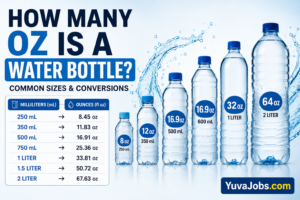
How many oz is a water bottle
A bottle can look ordinary on the shelf, yet its size can be surprisingly easy to misread when one label uses ounces and another uses milliliters. A bottle marked 500 mL, for example, is not exactly 16 oz, even though people often treat those sizes as interchangeable. When someone asks how many oz is a water bottle, the real issue is usually identifying the bottle’s capacity and translating it into the measurement system being used. There is no single ounce size for every water bottle. Common bottles range from small 8 oz containers to large 32 oz reusable bottles and much larger hydration jugs. And the word “ounce” itself can cause confusion because fluid ounces measure liquid volume, while ounces can also describe weight. The easiest approach is to understand the common bottle sizes and their actual volume.
Background and context
The size printed on a water bottle tells you how much liquid the container is designed to hold, but the number can appear in several different units. In the United States, bottled drinks commonly use fluid ounces (fl oz), while many countries, including India, primarily use milliliters and liters.
For liquid measurements, 1 U.S. fluid ounce equals approximately 29.57 mL according to the National Institute of Standards and Technology (NIST). That means a 16 oz bottle contains about 473 mL, while a 32 oz bottle contains about 946 mL.
This distinction matters because “oz” and “fl oz” are not technically the same thing. An ordinary ounce can describe mass, whereas a fluid ounce describes volume. Water makes the difference easy to overlook because its density is close to 1 gram per milliliter, but the two measurements still describe different properties.
There is another wrinkle. U.S. and Imperial fluid ounces are different — a U.S. fluid ounce is about 29.57 mL, while an Imperial fluid ounce is about 28.41 mL. For everyday water-bottle conversions, U.S. fluid ounces are normally the relevant measurement when an American bottle label says “fl oz.”
So, when comparing bottles, always check whether the label says mL, L, fl oz, or oz before assuming two containers are the same size.
The main substance: Common water bottle sizes in ounces
There isn’t one standard water bottle size. Manufacturers make containers for school, travel, sports, work, outdoor activities, and everyday drinking, so capacity varies considerably.
A useful reference is the following:
| Water bottle size | Approximate U.S. fluid ounces |
|---|---|
| 250 mL | 8.45 fl oz |
| 300 mL | 10.14 fl oz |
| 330 mL | 11.16 fl oz |
| 350 mL | 11.83 fl oz |
| 400 mL | 13.53 fl oz |
| 500 mL | 16.91 fl oz |
| 600 mL | 20.29 fl oz |
| 750 mL | 25.36 fl oz |
| 1 liter | 33.81 fl oz |
| 1.5 liters | 50.72 fl oz |
| 2 liters | 67.63 fl oz |
These figures come from converting volume using approximately 29.5735 mL per U.S. fluid ounce. NIST gives the same conversion factor.
The familiar 16.9 oz bottle
One of the most recognizable sizes is the 500 mL water bottle. It works out to approximately 16.9 U.S. fluid ounces.
That is why you may see bottled water described as a “16.9 oz bottle” even when the package displays 500 mL. The two numbers represent the same capacity after conversion, with rounding applied.
And this is where everyday language gets slightly messy. People may casually call a 500 mL bottle a “16 oz bottle,” but technically 16 U.S. fluid ounces equal about 473 mL, not 500 mL.
What about an 8 oz bottle?
An 8 fl oz bottle contains about 237 mL. NIST’s conversion tables similarly show 8 U.S. fluid ounces as approximately 237 mL.
This smaller size is useful for children, portion-controlled beverages, events, or situations where carrying a full-size bottle is unnecessary.
A 12 oz water bottle
A 12 fl oz bottle holds about 355 mL. It sits between the small 8 oz size and the much more common 16.9 oz/500 mL bottle.
This size is also familiar from beverage packaging, so it can be a convenient comparison when estimating how much water a container holds.
A 20 oz bottle
A 20 fl oz bottle contains roughly 591 mL. In practical terms, that is very close to a 600 mL bottle.
For people comparing U.S. ounce measurements with metric packaging, this is a good example of why the numbers don’t always look identical even when the physical capacities are nearly the same.
A 32 oz bottle
A 32 fl oz bottle contains approximately 946 mL, which is just under one liter.
That makes 32 oz a popular size for reusable sports and hydration bottles. It provides nearly twice the capacity of a standard 16.9 oz bottle, although the actual dimensions vary greatly between manufacturers.
A one-liter bottle, by comparison, contains about 33.8 U.S. fluid ounces. NIST lists 1 liter as approximately 33.8 fluid ounces in its conversion information.
The difference between 32 oz and 1 liter is therefore small but measurable.
Why bottle labels may show two numbers
Many products use both metric and U.S. customary measurements because they are sold in markets where consumers expect different units. A label might therefore say something like 500 mL (16.9 fl oz).
That isn’t two different amounts of water. It is the same volume expressed using two systems.
And packaging can also use rounded figures for convenience. A manufacturer doesn’t necessarily need to print every decimal place, so 473 mL may be presented as 16 fl oz, while 500 mL may be presented as 16.9 fl oz.
Practical angle: Choosing the right bottle size
The best bottle size depends less on the number printed on the package and more on how you intend to use it.
For a short trip, an 8–12 oz bottle may be convenient because it is small and light. A person heading to school or work for several hours may prefer something around 16–24 oz, giving them more water without making the container excessively bulky.
For exercise, commuting, hiking, or outdoor work, 24–32 oz can make more sense. A larger bottle reduces the number of times you need to refill it, although it also becomes heavier as it fills.
Here’s the thing: the bottle’s capacity is only part of the decision. A 32 oz metal bottle filled with water weighs roughly 2 pounds before accounting for the bottle itself, while a 16 oz bottle contains about half that amount. The difference becomes noticeable when you’re carrying it in a backpack.
If you’re comparing bottled water at a store, check the volume in milliliters first if you’re more familiar with metric measurements. A 500 mL bottle is about 16.9 U.S. fl oz, while a 1-liter bottle is about 33.8 fl oz.
The same approach works when buying reusable bottles online. Product listings may describe a container as 20 oz, 600 mL, or both. Converting the number lets you compare products without relying on the marketing name.
And don’t confuse bottle capacity with recommended water intake. A bottle’s size tells you how much it holds; it does not automatically tell you how much water a particular person should drink.
For packaged beverages, serving size creates another potential source of confusion. The FDA explains that Nutrition Facts labels identify serving size and the number of servings in a container, meaning one bottle does not necessarily equal one serving. A container can hold multiple servings even if someone drinks the entire bottle at once.
What to know going forward
The easiest conversion to remember is 1 U.S. fluid ounce ≈ 29.57 mL. From there, bottle sizes become much easier to understand.
A 250 mL bottle is about 8.5 oz. A 500 mL bottle is about 16.9 oz. A 750 mL bottle is about 25.4 oz, and a 1-liter bottle is about 33.8 oz.
But don’t assume every bottle marketed as “16 oz” contains exactly 500 mL. Sixteen U.S. fluid ounces equal approximately 473 mL, while 500 mL converts to nearly 16.9 fl oz.
There is also a limitation worth keeping in mind: conversions between metric and U.S. customary measurements are mathematically precise, but product labels often round the displayed number. So small differences between a label and a calculator aren’t necessarily errors.
When comparing bottles, read the actual capacity rather than relying only on the product’s description.
Closing
Water bottles don’t have one universal ounce size. The most common everyday examples include 8 oz, 12 oz, 16 oz, 20 oz, 24 oz, and 32 oz, while metric bottles are frequently labeled 250 mL, 500 mL, 750 mL, or 1 liter. The familiar 500 mL bottle is approximately 16.9 U.S. fluid ounces, which is probably the most useful conversion to remember. If you’re checking a bottle you already own, find its mL or fl oz marking and convert that number rather than guessing from its physical appearance. That small habit makes comparing bottle capacities much easier