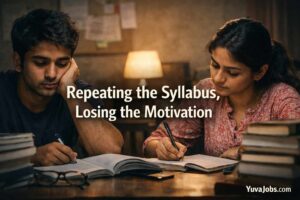
What Long Preparation Does to Confidence and Focus
There is a particular silence that settles in after the first year of preparation. Not the silence of laziness. Not the silence of giving up. A different kind. The kind where the books are still open, the notes are still being made, mock tests are still attempted, but something inside has shifted. I have seen this shift repeatedly across batches, across cities, across exams. The early sharpness softens. The urgency becomes mechanical. Aspirants rarely notice the exact day it happens. It creeps in slowly, between postponed notifications and extended exam cycles.
In the beginning, confidence is borrowed from possibility. The syllabus looks large but conquerable. Seniors say it takes one or two serious attempts. Coaching institutes project timelines. Family members speak in future tense. So focus feels natural then. It is almost romantic. Long study hours don’t feel heavy because there is a clear mental image of a result date somewhere ahead. But when that date keeps moving — when exams are delayed, patterns change, vacancies shrink, or results take a year — confidence begins to depend less on belief and more on stamina. And stamina behaves differently.
Preparation Is Not Just Study Time
Long-term government exam preparation is a prolonged psychological condition that gradually reshapes confidence and attention span.
People outside this world often reduce preparation to hours studied. They count productivity in chapters completed. But over years, preparation becomes an environment you live inside. You wake up into it. You plan social interactions around it. You postpone personal milestones because of it. So confidence is no longer just about marks. It becomes tied to identity.
One widely accepted cliché says, “Consistency automatically builds confidence.” That sounds correct in motivational spaces. But in long preparation cycles, consistency without visible movement can quietly erode self-belief. When someone studies daily for two years and still waits for a final list, consistency stops feeling powerful. It starts feeling repetitive.
The Slow Erosion of Initial Certainty
The first few attempts are usually fueled by certainty. Even failure is interpreted optimistically. “Next time.” That phrase carries strength initially. But repetition changes its tone. By the third or fourth attempt, “next time” sounds thinner. Not hopeless. Just thinner.
I have noticed that confidence in long preparation rarely collapses dramatically. It doesn’t shatter. It reduces in small, almost unnoticeable adjustments. An aspirant who once discussed cutoff predictions energetically now avoids such conversations. Someone who once debated strategy now studies quietly. They still show up at the library. They still revise. But they stop imagining outcomes with the same clarity.
And this is not weakness. It is fatigue layered over ambition.
Focus Becomes Fragmented Over Time
Focus in the first year is sharp because uncertainty is abstract. Later, uncertainty becomes lived experience.
Studying without knowing when the next notification will come affects attention in ways that are rarely discussed. When exams are regularly postponed, the mind hesitates to sprint. It begins to conserve energy subconsciously. You sit with the same book, but attention drifts faster. Not because you don’t care. But because the finish line has become blurry.
Another industry belief says, “If focus is strong enough, distractions disappear.” But in prolonged preparation, distraction is not always social media or entertainment. Sometimes distraction is internal — calculating age limits, counting remaining attempts, comparing peers who have moved on to jobs or marriages. These thoughts interrupt focus more than external noise.
And they return repeatedly.
Repetition Without Closure
The government exam syllabus does not change dramatically every year. Most aspirants end up revising the same subjects again and again. Polity. History. Quantitative aptitude. Current affairs cycles that overlap.
Repetition initially builds mastery. Later, it creates a strange stagnation. You know the chapters. You can solve similar questions. But because the exam cycle stretches, you keep revisiting familiar territory without receiving closure.
Closure matters more than most realize.
When results are delayed for months, preparation exists in suspension. You cannot move forward. You cannot stop. This suspended state affects confidence deeply. The mind prefers decisive outcomes — success or failure. Indefinite waiting creates low-grade anxiety that slowly disturbs concentration.
I have seen aspirants who perform well in mocks but hesitate in actual exams after long preparation periods. Not due to lack of knowledge. But due to accumulated pressure. Over time, the stakes feel heavier because years are attached to each attempt.
Identity and the Weight of Years
After three or four years, preparation is no longer something you are doing. It becomes something you are known for.
Relatives ask the same question each year. Friends who once studied together now work in private companies or other sectors. Social gatherings become uncomfortable spaces where time is measured differently.
Confidence then begins to depend on social perception. And social perception is unpredictable.
An aspirant may internally know they are working sincerely. But repeated external reminders of “still preparing?” slowly affect posture, tone, even daily energy levels. Focus weakens not because of lack of discipline, but because mental bandwidth is shared with self-doubt.
There is also financial pressure in many households. Long preparation often means limited income. When peers start earning, comparisons intensify. This doesn’t immediately break confidence. But it introduces a background noise that reduces cognitive clarity.
Busy Days That Feel Unproductive
One pattern appears repeatedly in long-term aspirants: days filled with activity that still feel empty.
You attend coaching. Revise notes. Attempt a sectional test. Watch analysis videos. And at night, you feel unsettled. Not because nothing was done. But because there was no visible forward shift.
This sensation accumulates. When too many days feel like maintenance rather than progress, confidence weakens quietly. The mind begins to question whether effort is translating into advancement.
There is another common statement: “Hard work never goes to waste.” In long exam cycles, hard work may not be wasted — but it may not be immediately rewarded either. That gap between effort and outcome is where focus strains.
The Emotional Cost of Delayed Validation
Government exams are not like monthly performance systems. Feedback is infrequent. Results can take six months to a year. Interviews are separated by long intervals. Merit lists are unpredictable.
So validation is delayed.
And delayed validation alters how the brain sustains effort. In the absence of frequent positive reinforcement, motivation must be self-generated. Not everyone maintains the same intensity over years without external markers.
I have observed that after multiple cycles, aspirants stop celebrating small milestones. Clearing prelims once felt like a breakthrough. Later, it feels routine. Expectations rise internally. With rising expectations comes heavier disappointment when results fluctuate.
This emotional oscillation affects focus more than syllabus difficulty ever does.
Attention Narrows, Then Scatters
Interestingly, long preparation can create two opposite effects at different stages.
Initially, attention narrows intensely. Social life reduces. Distractions are cut off. Study hours increase.
But after extended periods, attention sometimes scatters. Not outwardly. Internally. The mind begins to overthink minor syllabus changes. Overanalyze mock scores. Compare percentile rankings obsessively. Small variations feel magnified.
This hyper-awareness drains energy.
Confidence thrives on proportion. When small setbacks feel disproportionately large because years are invested, focus becomes fragile.
The Trade-Offs That Accumulate
Long preparation silently rearranges life priorities. Weddings are skipped. Vacations postponed. Career alternatives delayed. These trade-offs are often made willingly in the beginning. Over time, the cumulative weight of postponed experiences grows.
And the mind keeps a record, even when the aspirant tries not to.
Some begin to question not just the exam, but their own decision to continue. This questioning is rarely dramatic. It appears during quiet evenings. Or after seeing someone else move forward. Or when another notification is delayed.
Confidence in such moments does not disappear. It fluctuates. And fluctuating confidence is harder to manage than clear failure.
Focus Under Uncertainty
Preparation without a fixed timeline is fundamentally different from preparation with a scheduled end.
When the next exam date is unknown, planning becomes provisional. You study as if it may come soon. You also study as if it may be delayed. This dual-mode thinking splits attention.
Uncertainty demands mental flexibility. But prolonged uncertainty exhausts it.
I have seen aspirants who once solved questions with speed begin to re-check simple answers excessively. Not because they forgot concepts. But because prolonged uncertainty makes the mind cautious.
Caution slows rhythm.
And rhythm matters in competitive exams.
What Changes Quietly
Long preparation rarely makes people less capable. Often, knowledge deepens significantly. Analytical ability improves. Memory strengthens.
But confidence becomes less expressive. Focus becomes more effortful.
There is a visible difference between someone in their first year and someone in their fifth. The first-year aspirant studies with urgency. The fifth-year aspirant studies with endurance.
Endurance is heavier.
It carries accumulated attempts, revised strategies, changed patterns, and social expectations. It carries the memory of previous results. It carries time itself.
And time changes how confidence feels.
Long preparation does not simply test knowledge. It tests emotional stability across uncertain cycles. It tests whether focus can survive repetition. It tests whether identity can remain intact when outcomes are delayed.
For some, confidence stabilizes into quiet resilience. For others, it becomes cautious and reserved. Both are natural responses to prolonged uncertainty.
The outside world often sees only the final result — selected or not selected. But the internal journey across years leaves marks that are invisible in merit lists.
Preparation, when stretched across time, stops being a phase you are passing through. It becomes a phase that passes through you, slowly reshaping how you measure progress, how you interpret silence, how you respond to waiting.
And when confidence changes under the weight of years, it rarely announces the shift. It simply adjusts, adapts, and carries on — sometimes steady, sometimes strained — within a preparation cycle that feels less like a task and more like a long season of life.